


If you walk into Earl Hall—Columbia’s center for religious life—descend the flight of stairs on the right, take a left at the end of the basement’s slender, sterile-lit hallway, and duck into a cozy room consisting of two couches and a table, you will have just reached the first-ever general body meeting of BridgeColumbia in September 2024. The club, where I serve as director of outreach, is the University’s chapter of BridgeUSA, a nationwide organization with chapters at 125 schools and whose mission is to promote “viewpoint diversity, responsible discourse, and a solution-oriented political culture” on America’s college campuses.
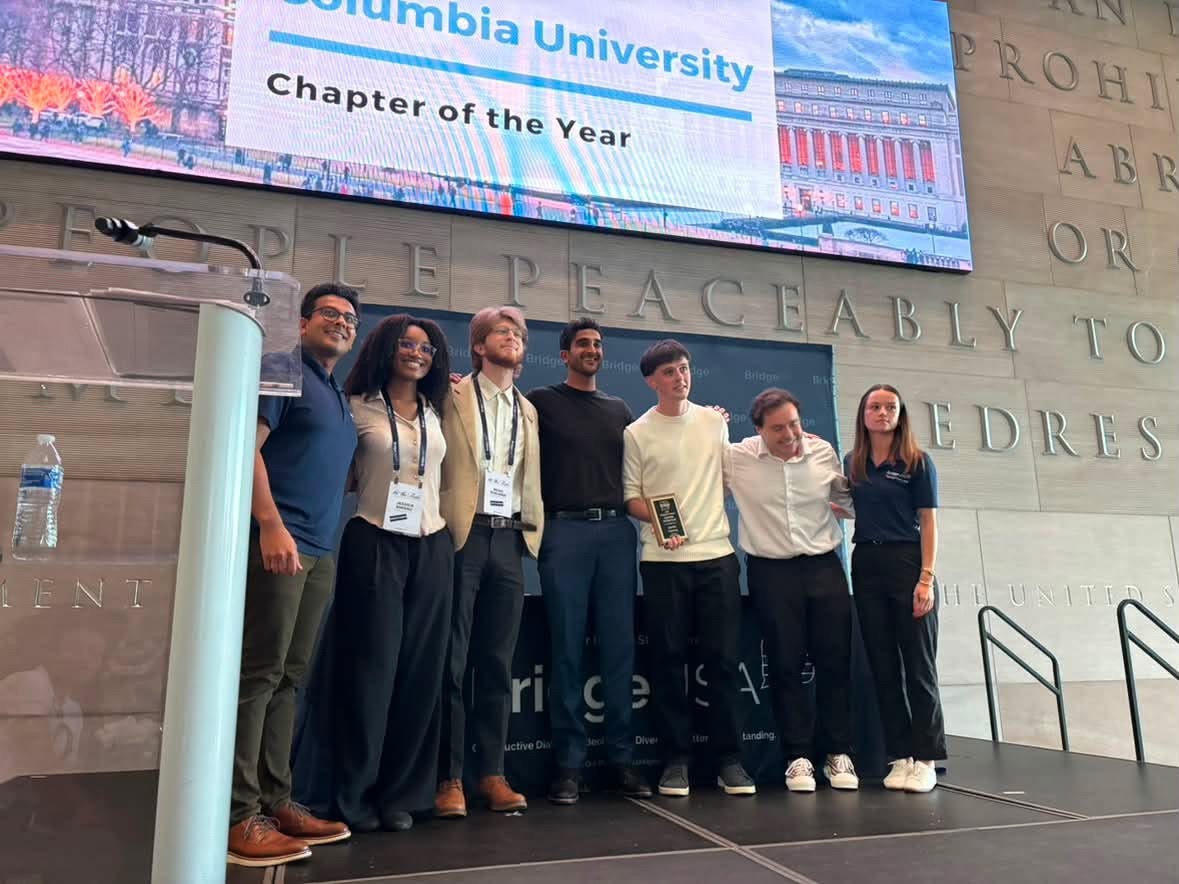
BridgeColumbia’s humble beginnings stand in stark contrast to its accomplishment just earlier this August: In Philadelphia, a crew of its board members arrived at the BridgeUSA National Summit as nominees for the organization’s “Chapter of the Year” award.
Accomplishing such a feat in anti-polarization work, at a campus as polarized as Columbia’s, is no easy task. “Our first-ever meeting was in literally the only room we could find,” explained chapter president Harvey Pennington GS/JTS ‘27. “It was a discussion on the southern border. We made each board member bring a friend, but in the end, only about six people showed up, and half of them were doing homework the whole time.”
Eighteen months later, BridgeColumbia convened again in the auditorium of Earl Hall: This time, they were joined by roughly 170 students from Columbia and six other universities in the region for a day-long event. “Bridge the Northeast,” the March 2026 summit for which Pennington and the rest of the club had been planning since the previous July, is one of several large discussion-based initiatives the club has organized.
This past semester, the chapter also hosted a heated debate between Columbia’s Republican and Democratic student groups, drawing in over 200 attendees. Finally, just recently, it announced its inclusion in the official new student orientation programming this coming semester.
Indeed, the meteoric rise of such a passionately pro-dialogue and pro-free-speech student club may be an inflection point for a Columbia campus culture infamously known for neither.
“When they announced we had won chapter of the year, I think we literally jumped up,” vice president TJ Gill CLS ‘27 explained. “The first thought in my mind was how we were able to accomplish this in spite of so many obstacles: the number of student groups who didn’t want to work with us, the students who looked down on the work we were doing, the number of obstacles that the administration threw… it was very gratifying.”
This past year, the Foundation for Individual Rights and Expression (FIRE)’s College Free Speech Rankings ranked Columbia 256th out of 257 schools for “free speech climate.” The only institution that fared worse was Barnard College. While the ranking’s architect, Sean Stevens, placed the school’s “F” free speech grade “far more on the administration than what the students have done,” the report also blames “a lack of student understanding in First Amendment principles,” whether that be the several classroom disruptions or the student-led intrusion into Butler Library. These instances are examples of the “heckler’s veto” in First Amendment lingo, where crowds of students deny other students their own right to speak or study freely.
Criticism of BridgeColumbia has come from both the left and the right. In a Sundial op-ed published this February, staff editor Jessica Weinfeld CC ‘27 took issue with the club’s discussion, originally just titled “Genocide?”, taking place on the evening of October 7 last year. Likewise, in a Columbia Daily Spectator op-ed, Jacob Gold CC ‘27 argued that clubs like BridgeColumbia advocate for an “empty civility” that “obscures” the free speech problems posed by the administration. (Although I myself have yet to see Gold at any BridgeColumbia event.)
Ironically, the club’s attempts at hosting discussions on hot-button issues have regularly placed Bridge in the position of uncovering barriers and inconsistencies in how the administration handles student expression.
On the one hand, then-Columbia President Claire Shipman declared the administration’s “enduring commitment to freedom of expression,” going as far as to say that “we believe in difficult conversations at Columbia.” However, Pennington described the administration’s support as “limited,” even admitting that the club’s biggest challenge “was navigating our relationship with the administration.”
“They may often claim to have concerns about security risks and student pushback. In the case of our October 7 discussion, they flat-out canceled it. Yet a few weeks later, we co-hosted that same event with the Alexander Hamilton Society, and it ended up going really well. Meanwhile, for Bridge the Northeast, the campus gate closures made it extremely difficult to bring in so many non-CUID holders. Bringing media onto campus for the event, too, was made pretty difficult.”
Of course, that didn’t stop Columbia from posting about said event on its social media. “It’s not that they’re against dialogue work, but rather that they’re inconsistent with it,” Gill said. “There are moments where they’ve been legitimately helpful, but then there’s been moments where we’ve faced obstacles that no one really told us we’d face, and times when things were just a lot harder to face than at other schools because of this extra layer of administrative bureaucracy.”
Despite such hardship, most students could tell you that Bridge is far from the only dialogue-ist club on campus. From the Columbia Open Discourse Alliance and the Listening Tables to the University’s Campus Conversations and Dialogue Across Difference initiative, buzzwords of “dialogue” and “discussion” have become mainstays of the undergraduate vocabulary. Such a trend has not been without criticism, and whether the market for these ‘d’ words has been oversaturated remains another question.
At the very least, for Pennington and Gill’s corner of the Columbia free speech movement, the desire to arrive at discussions on controversial topics and engage in uncomfortable conversations has been apparent amongst a growing number of students. Revealed by the rising popularity of its events and seemingly confirmed by its “Chapter of the Year” award, there is a mounting demand at Columbia for productive disagreement or, at the least, disagreement that is processed through a conversation rather than through a classroom disruption or library incursion.
If the inflection point has indeed been reached, and the paradigm of “dialogue-ism” has indeed won over large portions of the student body, it remains to be seen how the administration, for all its previous inconsistencies, will follow suit. “I just want to better understand how they can tangibly support dialogue groups on campus,” Pennington summarized. Free speech and open discourse could have a stable future in Morningside Heights, but to get there, students’ and administrators’ priorities must align on what is worth protecting.
Mr. Baum is a senior in the joint degree program between the Jewish Theological Seminary and School of General Studies, studying economics and Jewish history. He is the editor-in-chief of Sundial.
The opinions expressed in this article are solely those of the author and do not necessarily reflect the views of the Sundial editorial board as a whole or any other members of the staff.
Phenomenal read great job!
Our sponsoring organization, the St. John's University Political Student Union, was proud to participate in the 2026 Bridge the Northeast Conference, and they're looking forward to the 2027 edition as well. BridgeColumbia has done excellent work in the civil dialogue space not only on their campus, but in the greater NYC area as a whole - bringing together voices from across all of those universities was proof of that, and it was only the begining. We're excited to see what comes next!