


Sometimes rhetorical flourishes are so well executed that they can almost fool the reader into thinking an argument is not banal. Columbia Open Discourse Alliance’s (CODA) invocation of “open discourse” and having people “talk to each other” is one of those instances.
On February 4 CODA’s founders Aum Desai CC ’28, Nikos Mohammadi CC ’28, and Chloe Hoyle BC ’26 penned an op-ed in The Columbia Daily Spectator. CODA, for those who are unfamiliar, is “a non-partisan, student-led coalition dedicated to strengthening our capacity to uphold free speech and open inquiry.” In their piece, they invoke Columbia’s rich history in contrast to the last two years, proclaiming that undergraduates lack dialogic skills and that this deficit is intellectually damaging.
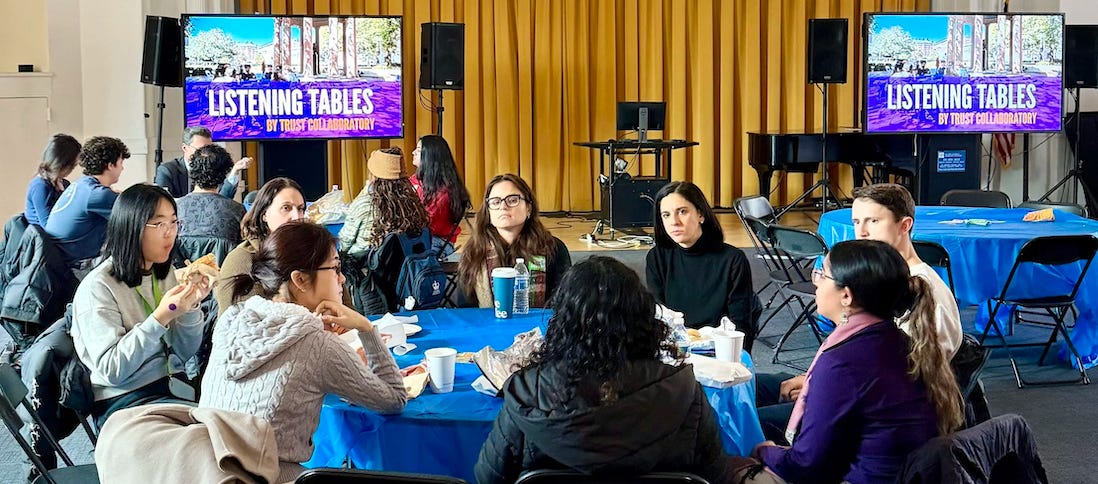
It sounds nice that the CODA leaders are rising to the challenge against their ideologically homogenous peers by proclaiming that we just need to talk to each other. To be clear, I do not take issue with emphasizing dialogue and ideological pluralism: I work as a Listening Tables fellow and write for Sundial. However, I take issue with this sanctimonious tone that presents a widely accepted principle as novel, while simultaneously oversimplifying the problem at hand.
CODA has diagnosed the problem as merely a lack of dialogue. Their solution, as articulated in their op-ed, is to create a new initiative for fostering such dialogue that Columbia is so clearly lacking. While this sounds laudable, universities and research centers around the country (including Columbia) have already been installing dialogue programs, such as Dialogue Across Difference and University Life’s Campus Conversations. In these spaces, I have engaged in countless moments of successful dialogue on secondary matters, from news headlines to university drama.
I struggle to believe that CODA is doing anything conceptually different from these other efforts. The writers’ claim that “if we can imagine a university brave enough to exchange ideas, then we ought to try to build it,” implies not only that Columbia is presently failing in this regard, but also that such bravery is largely absent from existing understandings of the University’s purpose. The suggestion that a new “durable civic infrastructure for dialogue” must now be constructed subtly positions CODA as the primary—or even first—architect of this effort.
What CODA fails to realize is that young people do not need more dialogue: They need more convictions. The first prerequisite for disagreement is belief. People cannot talk to each other or contribute to an intellectual conversation if they have no convictions of their own. CODA’s emphasis on dialogue as the problem does nothing to rectify the underlying issues of the modern university, and instead exacerbates them by drawing attention away from the core problem.
Allan Bloom, a philosophy professor at the University of Chicago, penned a now ubiquitous op-ed for the National Review in the 1980s diagnosing the nihilism of young people. He argued that young people are being taught by their universities to believe in a moral and intellectual relativism that casts all ideas as equally worthy of consideration. The problem with this logic is that it leads to an inability to judge truth-claims, which, in turn, leads to a total confusion as to how one ought to live their life.
Forty years later, this issue has yet to be resolved. College-age students lack the capacity to make judgments because judgment requires choice, and choice requires commitment. The result is a crippling decision paralysis that prevents students from committing to beliefs, habits, religions, and relationships. We also see this manifest in the classroom: Many lack the confidence to share their thoughts on assigned readings in seminars. If they can’t commit to opinions in low-stakes environments like Core classes, there is little reason to believe they can form opinions on larger moral or philosophical questions.
The problem of the past two years was not protests, as CODA’s leaders claim. In fact, one could argue that the protests, however misguided, represented moments in which students stood for something. They reached conclusions, made moral judgments, and attempted to act principally. In a strange way, I would much rather share a classroom with a leftist—despite how misguided I find many of their views to be—than with the passionless, amorphous, nihilistic average young person. At least the leftist activist acknowledges that certain ideas are better than others. And commitment, not dialogue alone, is the true precondition for serious intellectual life. We can argue about what is right and wrong, but if one does not even believe in a right and wrong, there is no point in conversation.
I would compare the difference in types of belief most closely to St. Thomas Aquinas’s distinction between credere Deum and credere in Deum. Some beliefs are intellectual assents, propositions held at a distance and subject to revision. Others are beliefs “into” something: movements of the heart, soul, and body oriented toward the Good. In other words, our deepest convictions are not opinions we hold, but commitments that shape the way we live. These latter beliefs are not inculcated across a dialogue panel. CODA and similar dialogue-based initiatives risk flattening this distinction by treating all beliefs as equally debatable.
I should be able to believe in the existence of certain moral laws without being obliged to have to “both sides” the claim. I find it offensive that some of my most deeply held truths, the ones I order my life around, are expected to be dissected and reduced to matters of “dialogue” and “disagreement.” It often feels as though, with just enough talking, I am supposed to be persuaded to abandon or amend them, as if they were merely another intellectual abstraction. Taken to its logical conclusion, this hyper-emphasis on “dialogue” produces intellectual hysteria. This is where a person cannot decide on even minor policy or political opinions without compulsively remaining “open” to every possible argument and rebuttal, endlessly deferring judgment without ever accepting an answer.
This is why Desai, Mohammadi, and Hoyle’s op-ed’s reference to civil rights leaders like John Dewey as exemplars of Columbia’s tradition of open discourse is so puzzling. This is my first time hearing about such a tradition. The “point” of the Core is not to teach students how to “argue their way toward understanding across texts, traditions, and moral disagreements.” Core classes are not debate clubs. Nor should they be treated as a buffet of opinions. The point of the Core, at least according to Columbia’s promotional material, is more closely related to developing the person and instructing them in a non-disciplinary environment.
More to the point, civil rights leaders represent the opposite of what CODA describes. They were not merely participants in dialogue, holding opinions open to revision. They made substantive claims about truth and justice and devoted their lives to it. One does not dedicate himself to the civil rights movement if he thinks he can simultaneously hold a middle ground with a segregationist.
CODA’s purpose is another reproduction of Bloom’s worries about the modern university student. Overemphasizing and mechanizing dialogue reproduces relativism. We should not chastise those who believe that there is a right and wrong out there. These are the types of trailblazers that for better or worse, shape our world. They are what make Columbia a remarkable place.
Ms. Chaudhry is a senior at Columbia College studying history. She is a deputy editor for Sundial.
The opinions expressed in this article are solely those of the author and do not necessarily reflect the views of the Sundial editorial board as a whole or any other members of the staff.