


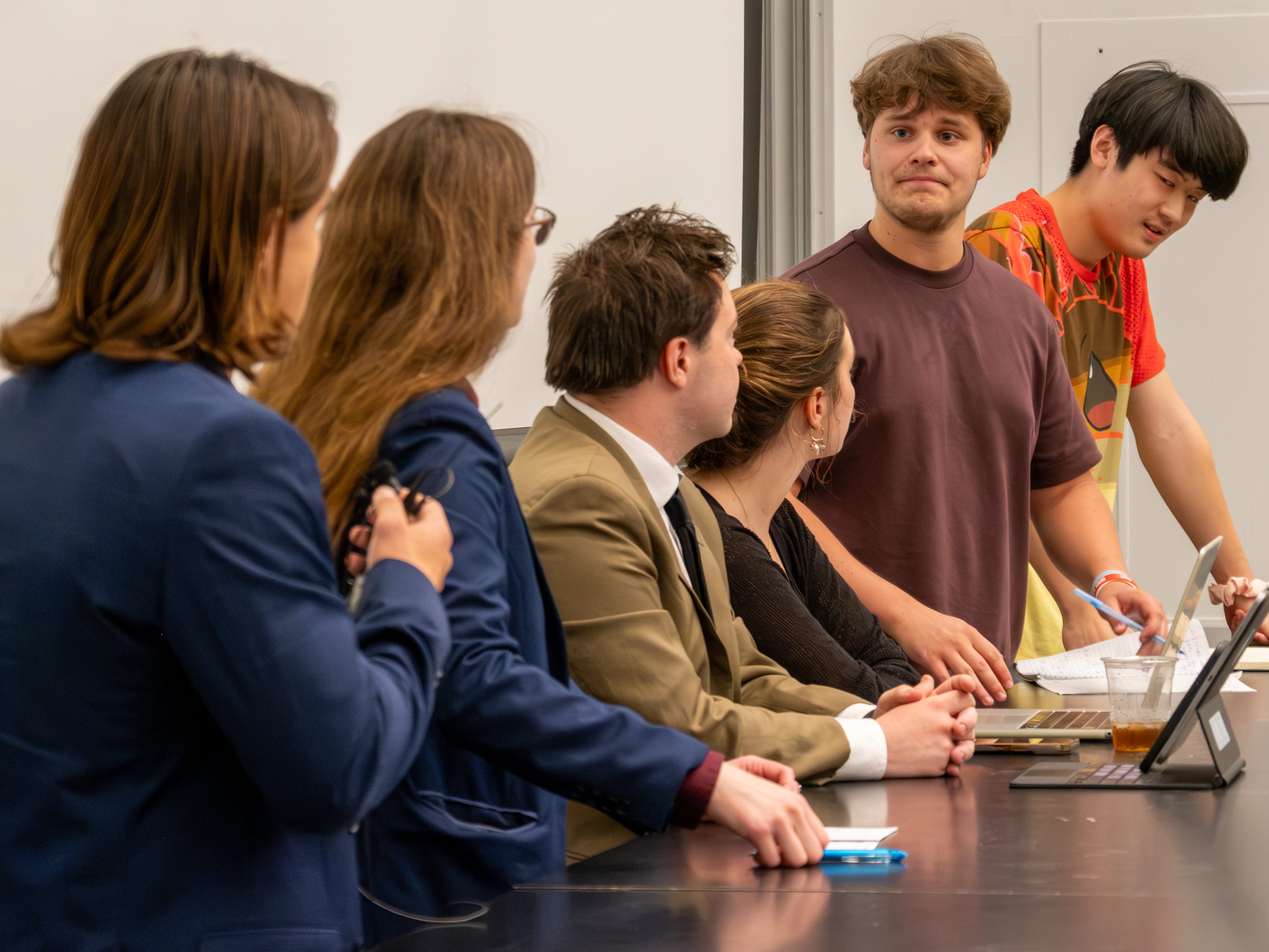
On the evening of April 15, in a packed Pupin lecture hall, Columbia’s Democratic and Republican student groups faced off in a debate hosted by BridgeColumbia, spanning issues such as healthcare, foreign policy, immigration, and government bureaucracy.
At an Ivy League university like Columbia, one might expect a debate akin to Oxford’s debate societies, where extensive preparation and oratory polish are put on display. On Wednesday, however, no such debate ensued. The event felt akin to a brash Piers Morgan segment. That said, it was deeply entertaining.
The event began with introductions from each group’s leaders. First to speak was CU Democrats’ President Praharsha Gurram CC ‘27. He wore a relaxed blue button-down and emitted a focused, prepared, anticipatory energy.
Afterwards, CU College Republicans Co-President Jessica Weinfeld CC ‘27 introduced her club as an ideologically diverse group of right-leaning students on campus. Weinfeld, also a staff editor for Sundial, was not involved in the writing or editing of this article.
Before beginning the discussion, the BridgeColumbia moderators—Ryan Crawford CC ‘27 and Gia Mercer CC ‘29—introduced the “norms of discussion” for the debate, a sort of friendly warning for the participants, which included: “Listen to listen, not to respond,” “address the statement, not the person,” “avoid interruptions and side conversations,” and “individual representation.” Individual representation refers to the idea that no statement made by any debater is representative of any identity or social groups they belong to. For each topic discussed during the debate, both sides had two minutes for opening statements, followed by a five-minute open discussion exchange.
As we in the audience came to learn quickly, the open discussion portions of the debates felt more like a contentious corner of the Thanksgiving table rather than a serious intellectual exchange.
Immigration
The first issue debated was immigration. The Democrats opened, critiquing ICE officers’ alleged lack of training, the murders of Alex Pretti and Renee Good, and overreach into other areas of society, such as airports, where the Democrats contended that agents are unneeded. They also argued that, even if one takes ICE’s stated goals at good-faith value, the agency is not doing a good job of “removing undocumented people” and that the agency should be abolished entirely.
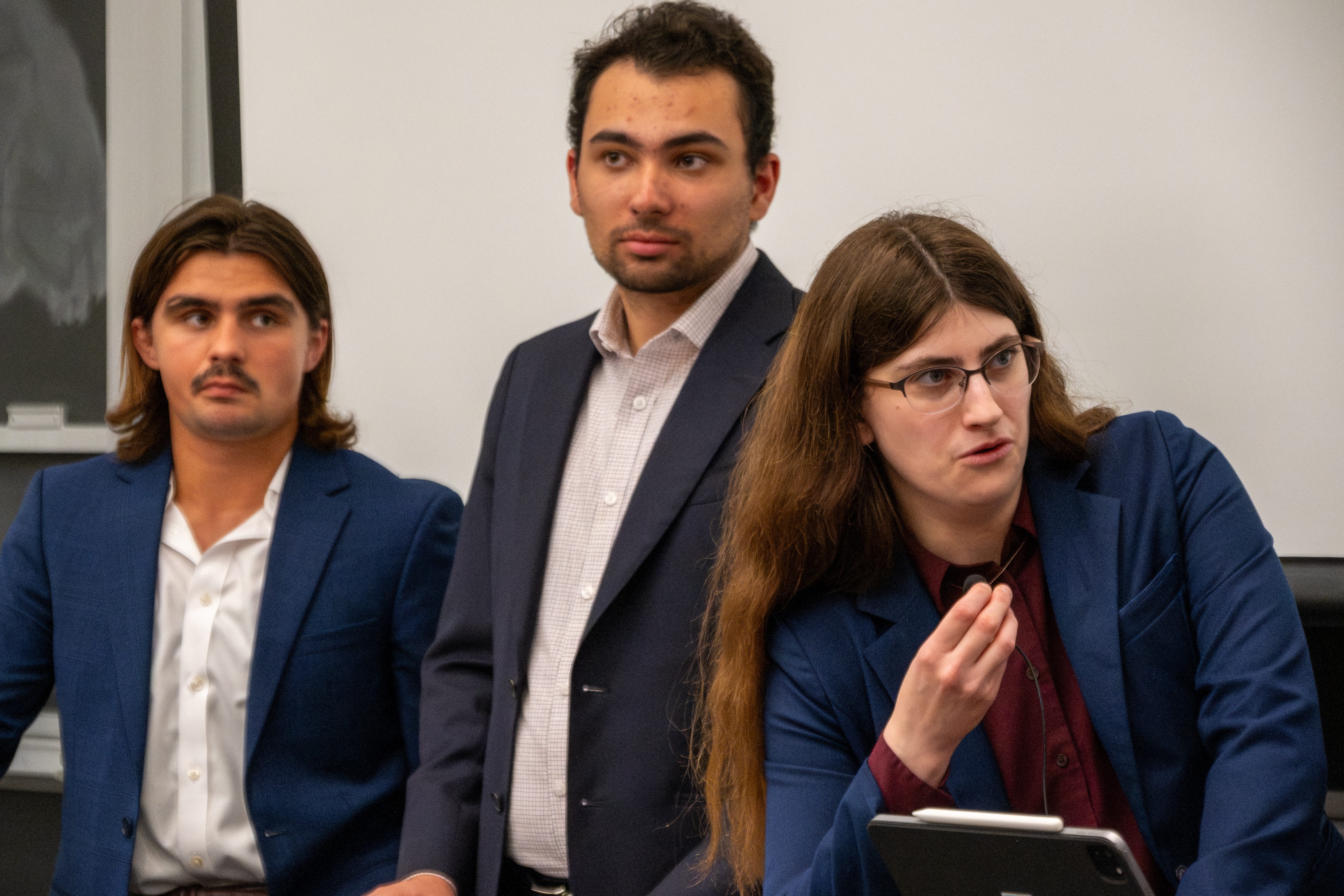
The Democrats appeared prepared for the debate, with extensive printed and computer notes. They were observably eager to argue their points in front of the crowd. The Republicans, on the other hand, spoke largely off the cuff and emitted a more relaxed, though at times unprepared and deer-in-headlights demeanor when faced with common arguments against the Trump administration. The Republicans were on defense from the get-go, struggling to respond to the depth and sheer quantity of the Democrats’ contentions.
In his response to the Democrats’ opening statement, Columbia Republicans Treasurer Salvatore Manella CC ‘26—who joked about his name’s likeness to salmonella bacteria—asserted that “every tragedy is deserving of justice,” referring to the Democrats’ contentions about ICE’s murders of civilians. Manella posited that, despite these tragedies, escalations against law enforcement officers have been increasing for decades and that these events are simply a continuation of this trend. His argument boiled down to the idea that this is just what happens, and that officers’ expectations of violence led them to react more aggressively. This response represents a more general weakness with the Republicans’ contentions throughout the night: They continually relied on Fox News-esque boilerplate arguments instead of engaging with the Democrats’ arguments at face value, using haphazard statistics and flummoxing anecdotes.
While more interesting discourse could have occurred with better preparation, the Republicans’ stated positions on immigration were underbaked at best. Their most convincing argument was that, as students at an elite Ivy League university, we are insulated and don’t fully understand the effects of mass immigration to the U.S. The crowd didn’t seem impressed or open to that point.
Healthcare
The Republicans spoke first in this round. Weinfeld began her speech by defending the American healthcare system compared to those of other countries, citing statistics that wait times in hospitals and for critical medical procedures are comparatively lower in the U.S. About 30 seconds into her statement, Weinfeld began to attack the mainstream progressive idea of single-payer universal healthcare, warning that the U.S. will suffer if it gives up on “free market incentives” that drive medical innovation. She offered less of a Republican vision for American healthcare and more of an immediate attack on progressive healthcare policy proposals.
Weinfeld also pointed out that she had undergone a heart operation in the U.S. that was only possible because of free-market innovation that produced the technology and techniques needed for her procedure.
The Democrats pushed back against this perspective by invoking the greed of American healthcare companies. They passionately expressed to the audience that Americans pay some of the highest costs for healthcare in the world, and that insurance companies rip off Americans for medical essentials such as insulin, which could be mass-produced for less than two dollars per dose.
At one point, CU Democrats Treasurer Adler Rice CC ‘28 dramatically invoked a statistic about how one in three Americans forgoes essential medical care because of high costs: “Look to the right, look to the left. Statistically, one of you had to skip a visit to the hospital because of medical costs,” he said. This was a moment of melodramatic theatrics that made the event feel even more unserious than it already did.
They also pointed out President Trump’s inaction on healthcare policy, reminding the audience of his statement during a 2024 debate with former Vice President Kamala Harris that he had “concepts of a plan” for how to improve American healthcare.
At this point, expressive sighs and eye rolls were traded between the debaters as more partisan or controversial points were made. Because of this, the debate began to feel unproductive, bordering on histrionic.
Foreign Policy
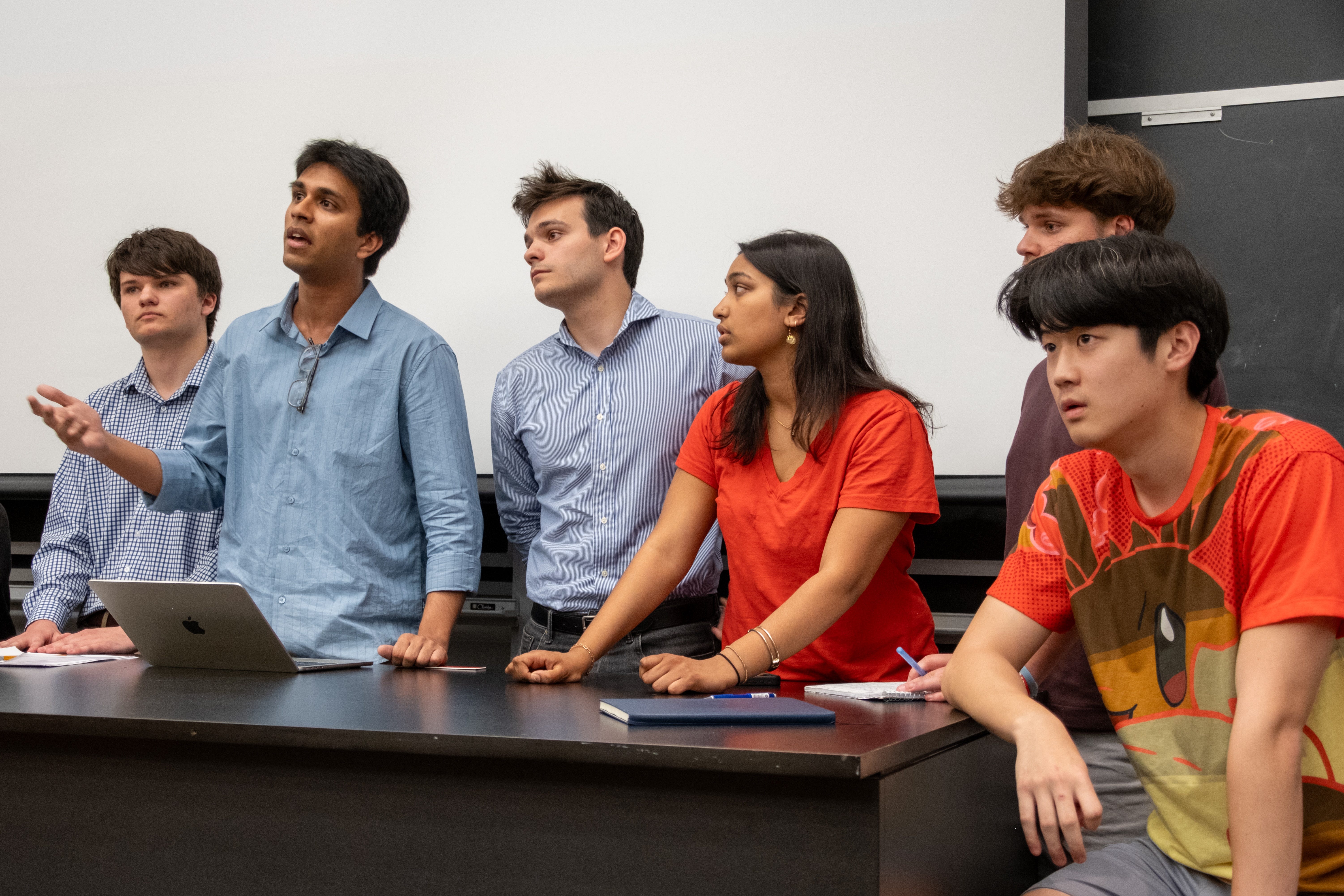
The Democrats began this part of the debate with a simple assertion: The U.S. is more involved in foreign conflicts than “ever” before, most principally Iran and Venezuela. They devotedly posited that Trump’s interventions in these countries are ineffective and unnecessary.
The Democrats also suggested that the billions of dollars being spent on the war in Iran should be spent on healthcare domestically. They also touched on rising gas prices and the deaths of innocent civilians in Iran.
Weinfeld offered a bold rebuttal, claiming that Trump was obliged to go to war with Iran because of the “general shield” they were building up. Then, at approximately 8:49 p.m., an audience member seated in the back of the auditorium began to yell at Weinfeld after she commented that she would rather have oil be more expensive to prevent a “terrorist state” from possessing nuclear weapons. The moderators swiftly hushed the heckler.
Weinfeld also touched on the Democrats’ condemnation of Trump’s Venezuela policy, calling Nicolas Maduro’s abduction and arrest a “perfect operation.” At this point in the debate, it became clear that Weinfeld was the leading voice for the Columbia Republicans. She was speaking and defending her group’s positions the vast majority of the time, with her fellow Republican debaters only chiming in every now and then. The Democrats, on the other hand, had a more even distribution of speaking time across their various team members.
Midway through the cross-exchange portion of this round, BridgeColumbia President Harvey Pennington GS JTS ‘27 interrupted and reminded debaters to make sure they were listening to one another. Towards the middle and into the end of the debate, the members of each team developed a habit of scoffing at the other side’s arguments. Though understandable, this clarified that there was not an active effort being made to respect the norms of discussion established by Crawford and Mercer at the beginning of the event.
The Economy
The Columbia Republicans called the One Big Beautiful Bill “awesome.” Weinfeld highlighted the bill’s inclusion of Trump’s no tax on tips policy and the extension of the Child Tax Credit.
In response, the Democrats went heavy on criticizing Trump’s tariffs. They, with a sense of moral urgency in their tone, detailed the economic costs of global trade wars and farmers who have struggled as a result of tariff policies. As a rebuttal, Weinfeld contended that the U.S. needs to “grow itself out of debt.”
The Democrats claimed that Trump had failed to deliver on the campaign promises that carried him to victory in 2024, citing that inflation is now the highest it’s been since 2022. This was the most mundane portion of the debate, though some interesting arguments were made by both sides.
Federal Bureaucracy
This was the last topic debated. The Democrats pointed out what they perceive to be the hypocrisy of Trump’s Department of Government Efficiency (DOGE), asserting that Trump has spent billions on foreign wars. The Democrats also personally attributed the deaths of thousands of Africans to Trump and former advisor Elon Musk for shutting down USAID.
The Republicans, in expected fashion, mainly contended that DOGE has saved the U.S. millions of dollars on alleged ridiculous, extraneous government-funded projects such as “injecting baby beagles with cocaine” and “lizards on treadmills.”
In the final open-exchange portion of the evening, Eira Prakash BC ‘28, Organizing Director of the Columbia Democrats, simply asked how many felony convictions Trump has. When the Republicans answered a separate question asked previously, Prakash asked how many convictions Trump had once again. At this point, Crawford interrupted and reminded her of the norms of discussion.
Participant Perspectives
Weinfeld told Sundial the event “went great,” was “a productive conversation,” and that she “really appreciated being able to give the Republicans’ perspective to a lot of people who probably haven’t heard it before.”
Despite my observations, Crawford believed the debate was productive: “I think this went very well. It went a lot better than what I previously thought. I think we were able to bridge the divide, at least somewhat. I’m happy we were able to bring both sides together.” When asked if there were any areas where he believed the debate fell short, Crawford said: “I think there were moments where people were listening to respond instead of listening to listen.” Here, Crawford is correct. This was a common theme throughout the event that dictated the direction of the conversation on essentially every issue—in other words, resentment took the front seat over respectful argumentation. This was especially true of the Democrats—they came prepared with notes, but generally lacked a civil compass. Between the eye rolls, finger pointing, and scoffing, I didn’t feel terribly proud to be a Democrat that night.
The Columbia Democrats did not respond to Sundial’s multiple requests for comment.
What Was Accomplished
It’s unclear. In all fairness, this was a debate. The event was not branded as a common ground or dialogue event. While the event was not advertised in such a way, it was good entertainment at best. Throughout the night, there were better arguments the Republicans could have made against the Democrats’ positions. In large part, however, the Republicans failed to make compelling rebuttals. This was disappointing, not because I personally sided with the Republicans or hoped that they’d win, but because Columbia is still a hotbed of political tension in desperate need of widespread respect for viewpoint diversity.
Well-intentioned initiatives at Columbia, such as the Listening Tables, tend to draw the most open-minded, curious, and dialogue-craving. This debate served as evidence that Columbia’s main political organizations do not seem genuinely interested, not even in dialogue, but in doing the work to have a genuinely respectful exchange. Columbia, as editor-at-large Imaan Chaudhry has written about in these pages, has enough dialogue. That said, this debate cemented my belief that civility in political discourse is scarce within Columbia’s gates.
For some of the debate, both sides spoke to each other civilly. However, especially on the Democrats’ side, moments of respect felt deeply performative. When they followed up on one of the Republicans’ answers in a civil manner, it felt like they were waiting impatiently to ask their next “gotcha” question as opposed to actually listening to their opponents. And as the debate progressed, they held back less and less—they pointed fingers (literally) at the Republicans, leveled ad hominem attacks, and seemed to blame them directly for America’s ills.
Middle ground was not achieved; neither side did a great job of actually listening to one another. Even though the Democrats clearly won the debate, the evening felt more like an opportunity for them to blow off some steam at their political adversaries on a campus where liberals and conservatives rarely come face to face.
Mr. Nagin is a senior in the Dual BA program with Trinity College Dublin, majoring in political science. He is the editor emeritus of Sundial.
The opinions expressed in this article are solely those of the author and do not necessarily reflect the views of the Sundial editorial board as a whole or any other members of the staff.
No mention of genocide or of students getting arrested for opposing it?
At least the heckler had some balls...
Pathetic.
Thanks for this report and summary of the debate. Based on your description, I can well understand your disappointment in the event overall. Too bad; it was a missed opportunity.