


I recently came across BridgeColumbia vice president and Sundial staff writer TJ Gill’s piece, “Can We Talk About the Genocide Question?” on his club’s attempt to hold a discussion on the Israeli-Palestinian conflict. Bridge is a campus group dedicated to fostering dialogue on different issues, and in the article, Gill describes the hoops that the Columbia administration made Bridge jump through before ultimately cancelling the discussion.
First, I want to start by congratulating Bridge for finally succeeding in holding what was by all accounts a thoughtfully run and honest discussion about the Israeli-Palestinian conflict. It is shameful that the administration delayed them for so long and apparently attempted to suppress the discussion. At Columbia, clubs should be allowed to hold discussions and events, no matter how offensive someone might find them to be.
Second, as the co-president of the Columbia University College Republicans (CUCR), I want to clarify our club’s promotion of this event.
The original poster promoting the event featured the word “Genocide?” over a bloodstained outline of Israel and Gaza. CUCR leadership informed Bridge that we could not, in good conscience, endorse an event that was advertised like an accusation against one party instead of an open discussion. We also expressed concerns that the chosen date and time—the very evening of October 7—coincided with the timing of Jewish holiday services, ensuring that no religious Jews would be able to attend the event and express their views.
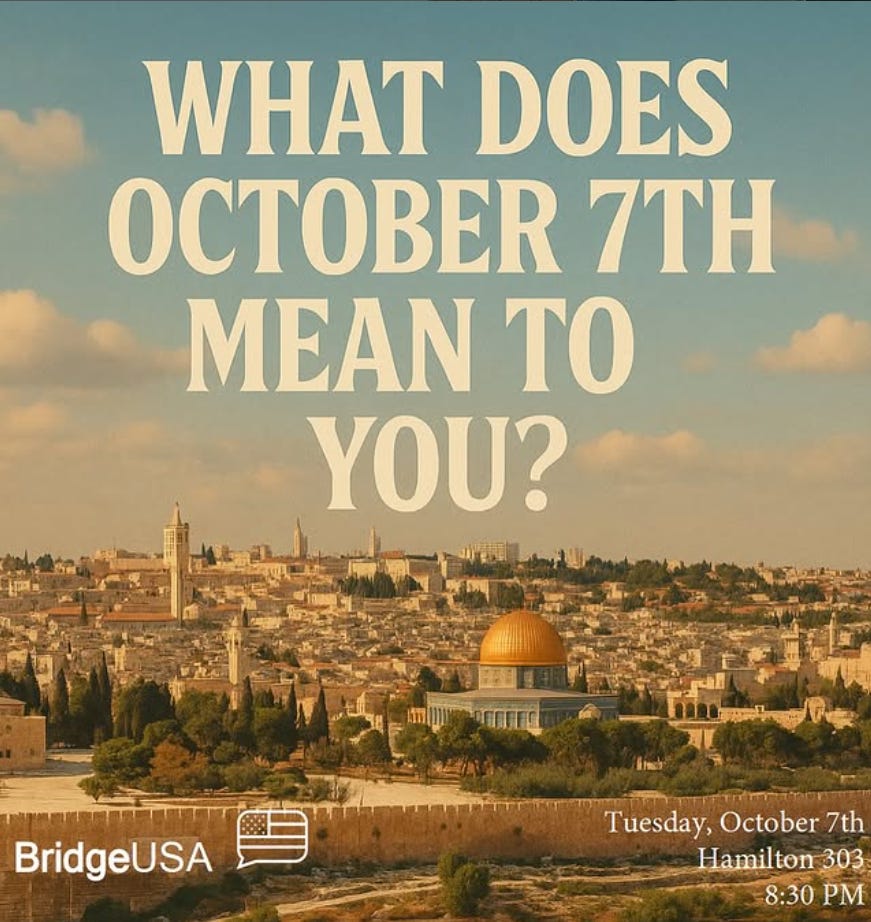
We were presented with a new poster reading, “What Does October 7th Mean to You?” and were told that Bridge had changed the wording and image to be more welcoming. CUCR then endorsed the event and encouraged its members to attend. At the time, we did not know that the poster change was due to the administration’s pressure and the forced rebranding that Gill described in his piece. We did not know that Gill believed the new poster to be “a betrayal of our members,” and that Gill considered the new flyer “tepid” and “more sterile than a hospital room.”
In fact, given that the new flyer depicted the Temple Mount, the religious site that Hamas cited as justification for their barbaric attack on October 7, 2023, and perhaps the most important religious flashpoint in the broader Israeli-Palestinian conflict, it didn’t seem to be avoiding any discussion of the conflict’s long, bloody violence and religious overtones. When I visited the Temple Mount a few years ago, I was shouted at by Palestinian men and guarded by rifle-carrying Israeli soldiers as we Jews were forced to wear garments with Holocaust-esque yellow stripes. The experience was certainly not “tepid” or “sterile.” Instead of a forced rebranding by the administration, I thought that the new poster was a genuine attempt to invite a more balanced discussion.
When I spoke to Gill about Bridge’s original decision to use the “Genocide?” poster, he told me that Bridge had assumed that they were finding some middle ground in part because “both sides were getting offended”—Zionist students at the accusation of “genocide,” and anti-Zionists because they were angry that the “genocide” label was even being questioned.
I believe this logic is faulty. By judging the middle ground to be where both sides have an equivalent emotional reaction, one allows the more emotional side to set the terms of the debate, ceding ground to those who are more volatile and apt to get offended.
On Columbia’s campus—where pro-Palestinian rioters have violently taken over buildings multiple times in the past few years, and professors, citing emotional distress, have repeatedly cancelled classes after Trump’s victories in 2016 and 2024—judging by emotion gives the advantage to a hyper-emotional left. Additionally, the emotion-driven false “neutrality” punishes conservative students on campus for being less easily offended and valuing rational discussion more than some of our extreme peers.
In this particular case, to advertise a discussion of the incredibly complicated Israeli-Palestinian conflict as a discussion of whether Israel’s actions constitute “genocide” clearly and immediately puts right-leaning and Zionist students on the defensive, framing the entire conversation around a certain accusation against Israel. It would be like advertising a discussion with the question, “Is Trump Hitler?” or “How racist are the police?”
Bridge states that their mission is to build a community in which “students from across the ideological spectrum can engage as a group working together to understand…various perspectives.” If they are really serious about inviting in students from across the ideological spectrum and building community, Bridge would be best served by advertising discussion questions that leave room for both sides of a given issue, rather than exhibiting a bias towards one side or the other.
A quick review of their Instagram reveals that for other discussions, Bridge has managed to produce neutral advertisements with astonishing regularity. Examples include posts titled, “The Era of Zohran: Sunrise or Twilight in NYC?”, “Golden Age or Hellscape: Is the New Right, Represented by Figures Like Charlie Kirk, Good for Our Country?”, and “AI and Public Policy: Threat or Opportunity?” Even for discussions that weren’t advertised by presenting two equal sides, Bridge’s other posts have neutral, subject-defining titles like “The Trump Administration Wants to Instill Federal Oversight of Columbia University,” “A Discussion on Death and Political Violence,” and “The Rise of Red Pill Men.” Only for the Israeli-Palestinian conflict did Bridge seem to bias their advertising, perhaps because of the subject’s history of emotional reactivity at Columbia (including the aforementioned building takeovers and lawsuits that have cost the University millions).
If dialogue groups at Columbia use the standard of emotional volatility to find the “middle ground,” they will almost certainly find themselves with discussion questions that are biased in favor of the left. And not because of any objective fact pattern, but simply because we right-leaning students on Columbia’s campus are used to functioning in an overwhelmingly left-wing environment. We value mental resilience and strive not to be easily offended by the many accusations hurled at us and our beliefs.
I’ve heard so many wonderful accounts of Bridge providing space on campus where people can come together for honest discussions. I hope that in the future, fair discussions can begin on balanced ground, free of the heavy-handed intervention that we all oppose from Columbia’s administrative state.
Ms. Weinfeld is a junior at Columbia College studying political science and creative writing. She is a staff editor for Sundial.
The opinions expressed in this article are solely those of the author and do not necessarily reflect the views of the Sundial editorial board as a whole or any other members of the staff.