


In an article released in Sundial’s November-December issue, authors Avi Litvak and Rafael Vanuno argued that “SSI [Students Supporting Israel] faces challenges other nation-based groups do not.” They claim to be victims of a double standard when clubs ask them to comment on the current actions of the Israeli government, asking, “Does the Chinese Students Club have to apologize for the actions of the CCP in Xinjiang before every meeting?”
This is utterly disingenuous. It is an intellectual sleight of hand on multiple levels. First, it disregards the very nature of SSI as an organization of students supporting Israel, as opposed to an identity-based organization, such as an Israeli Students Association, which would be a rational parallel to the Chinese Students Club. Secondly, it disregards the fact that SSI explicitly calls itself Zionist, which—far from the same as being Israeli—is by definition a political ideology. Third, the authors conflate Israeli and Jewish identity to make their argument, creating dangerous fodder for antisemitism.
The comparison of SSI to the Chinese Students Club is actually quite telling. The Chinese Students Club is based on a shared cultural and national background, but is not explicitly devoted to supporting Chinese national interests on the international stage. This is a different purpose than an explicitly Zionist organization serves. SSI is not only an affinity group for Israelis, but also promotes a specific stance on the country of Israel.
This brings me back to my point: Zionism is a political ideology. Litvak and Vanuno attempt to neatly sidestep this by claiming to support ideological diversity: “Rafael identifies as an independent, while Avi is a Democrat. SSI exists to foster open dialogue about Israel.” I don’t doubt that the members of SSI have many different views on a variety of political issues, but they are all Zionists. Whether they are Democrats or Republicans in the United States is about as relevant as whether they prefer cats or dogs. The question is: Within SSI, does there exist a diversity of views about Israel?
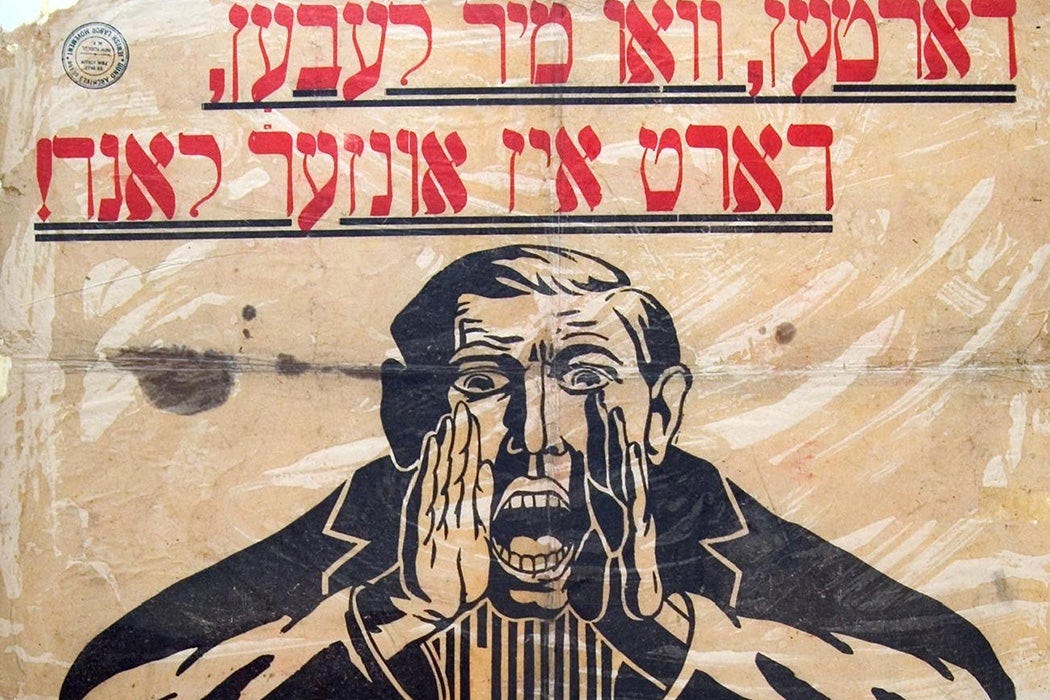
Among Israelis, there are. A full 10 percent of Israeli Jews do not consider themselves Zionists, and more than a quarter of Israelis are not Jewish. Furthermore, Jews (in Israel and in the diaspora) have historically held various views about the notion of a Jewish state in Israel. While I am not necessarily opposed to a Jewish state, I personally align myself more closely with the Bundist movement, a political ideology that emerged among Jews in the late 19th century. Bundists argue that our safety and well-being are best achieved by advocating for fair treatment in the diaspora, through labor organizing and cultural education. Bundism rejects the ultra-nationalistic Zionist project on the grounds that Jews can and should remain rooted in our local communities.
Are there any Bundists in SSI? Any Hasidic Israeli anti-Zionists? If so, they weren’t mentioned in Litvak and Vanuno’s article.
At the heart of Litvak and Vanuno’s argument is the idea that SSI is a cultural organization—a Jewish one—and is thus exempt from taking a political stance on Israel. Yet the very name of their organization, Students Supporting Israel, ties them to a political stance about the country. This distortion has a simple outcome: the conflation of Jewish and Israeli identity.
It implies—falsely—that Jewish and Israeli interests are the same. In reality, as Thomas Friedman compellingly posited in the New York Times, Israel’s present actions are currently endangering Jews all over the world. I object to Litvak and Vanuno’s article because, by conflating Judaism and Zionism, they encourage casual readers to blame Jews for the actions of Israel and vice versa.
Columbia’s official definition of antisemitism, the IHRA definition, explicitly states that “Holding Jews collectively responsible for actions of the state of Israel” is a form of antisemitism. Like many other pro-Israel individuals and organizations, Litvak and Vanuno promote this type of antisemitism by categorically lumping Jews and Israelis together. This is the danger of calling an organization “Students Supporting Israel” and then claiming that organization is free of political ideology.
SSI should clarify what it is. After all of the hemming and hawing in Litvak and Vanuno’s article (Is SSI apolitical? What issues does SSI take stances on? What is unfair to ask of them?), I still don’t quite know what they actually stand for. I can only guess from SSI’s advertising and actions.
The SSI website claims that they are fighting a “war on campus,” an implicit parallel to the war in Gaza. The SSI programming that I have seen around campus seems to consist largely of reactionary responses to campus pro-Palestinian activism. While SSI may have other, less reactionary programming, it has been far less visible to me than their protests, demonstrations, and tabling. Since SSI positions itself on the opposite side of this “war on campus,” I arrive at the conclusion that, whether they admit it or not, SSI does take an institutional stance on the present war in Gaza—indeed, that they support it.
I am left to assume SSI supports the actions of the current administration in Israel—led by Benjamin Netanyahu—who has been committing war crimes that likely constitute genocide in Gaza. As such, I find it difficult to engage with Litvak and Vanuno’s argument until they can more convincingly dispel that concern. If I am wrong about their views—and I hope I am—I will be happy to engage in dialogue with them. First, however, they need to clarify exactly what it is they are talking about.
Mr. Edelman is a junior at Columbia College studying environmental biology with a minor in mathematics. He is a dual citizen of Austria and the United States, plays in the Columbia Klezmer Ensemble, and is learning Yiddish. He is a guest contributor for Sundial.
The opinions expressed in this article are solely those of the author and do not necessarily reflect the views of the Sundial editorial board as a whole or any other members of the staff.
This article reads like it was written in 1930, when Zionism was still an ideology, and not a reality. Worth recalling the words of once-Bundist once-anti-Zionist Isaac Deutscher, “If, instead of arguing against Zionism in the 1920s and 1930s, I had urged European Jews to go to Palestine, I might have helped to save some of the lives that were to be extinguished in Hitler's gas chambers." Worth also recalling why Bundism fell apart: a very large proportion of its advocates, who didn’t flee to Israel, were murdered. To reject the history of Zionism is to reject the efforts which saved many millions of Jews from extermination or ethnic cleansing across Europe, MENA, Ethiopia, and the former Soviet Union.
Anti-Zionism was maybe a tenable political position in the 1930’s but times have changed. Drastically. Israel is now a nation of 16 million which has been around for generations. It is a culture. It’s a reality. To advocate its destruction— considering what its enemies expressly advocate doing to the Jews once it is disassembled—is bigoted. Israel is now older than half of the countries on Earth. To treat Israeli culture like it’s a fake culture, which doesn’t deserve the respect of other societies, that it really is just an ideology and not the multi-generational reality of millions, is bigoted.
Now at Columbia, shunning or taunting or harassing people who have lived, worked, prayed, etc in Israel is seen as virtuous bc “Zionism” is depicted as an ideology—when really what’s been happening at Columbia is discrimination based on national origin or identity. Worth noting again is that a great proportion of the world’s Jews would not be alive today if it wasn’t for the creation of Israel which has been the main refuge for fleeing Jews in the 20th and 21st centuries. To say our existence is just an ideology is hate, not reasonable political disagreement.
David’s post below is beautifully written and on the nose. So sad elitist Columbia students are so ignorant of history. How wonderful it would be if we lived in a magical land of no religions or nationalities. But we don’t. I was reminded of that ever time i saw the Auschwitz stamp on my father’s arm. Edelman has fallen into the trap of the Jew haters who strive to divide us. Mamdani shows how it was executed back in the 30’s and has already started to apply it to his mayoralty. Zionism is a necessity