


Editor’s note: The online version of this article has been lightly modified from the original print publication to clarify Students Supporting Israel’s policy about declaring political stances as a student group.
At the clubs fair this September, we approached the tables of cultural and nation-based clubs as representatives for Students Supporting Israel (SSI). We cordially explained that SSI was trying to develop relationships with other groups on campus. Yet, time and again, our attempts at outreach were met with uncomfortable grimaces, followed by disingenuous apologies, and replies along the lines of, “We’re not really looking to do that right now, it sounds too political for us.”
Representing SSI has been tricky. We’re a grassroots, nonpartisan organization. We don’t take stances on politics in Israel or the U.S., and are not funded by corporations or political action committees. As such, we don’t take deliberate action against other clubs, and we don’t align with all pro-Israel and Zionist voices at Columbia.
In recent years, the word “Zionist” has taken on a complex meaning. To some, it’s a simple affirmation of a cultural or political stance on the state of Israel they’ve held since they were young, believing in the “Jewish people’s right to self-determination in [their] ancestral homeland of Israel.” To others, the word is associated with genocide, ethnic cleansing, or apartheid. These competing interpretations have fueled a tension that makes it difficult for SSI to fulfill its mission.
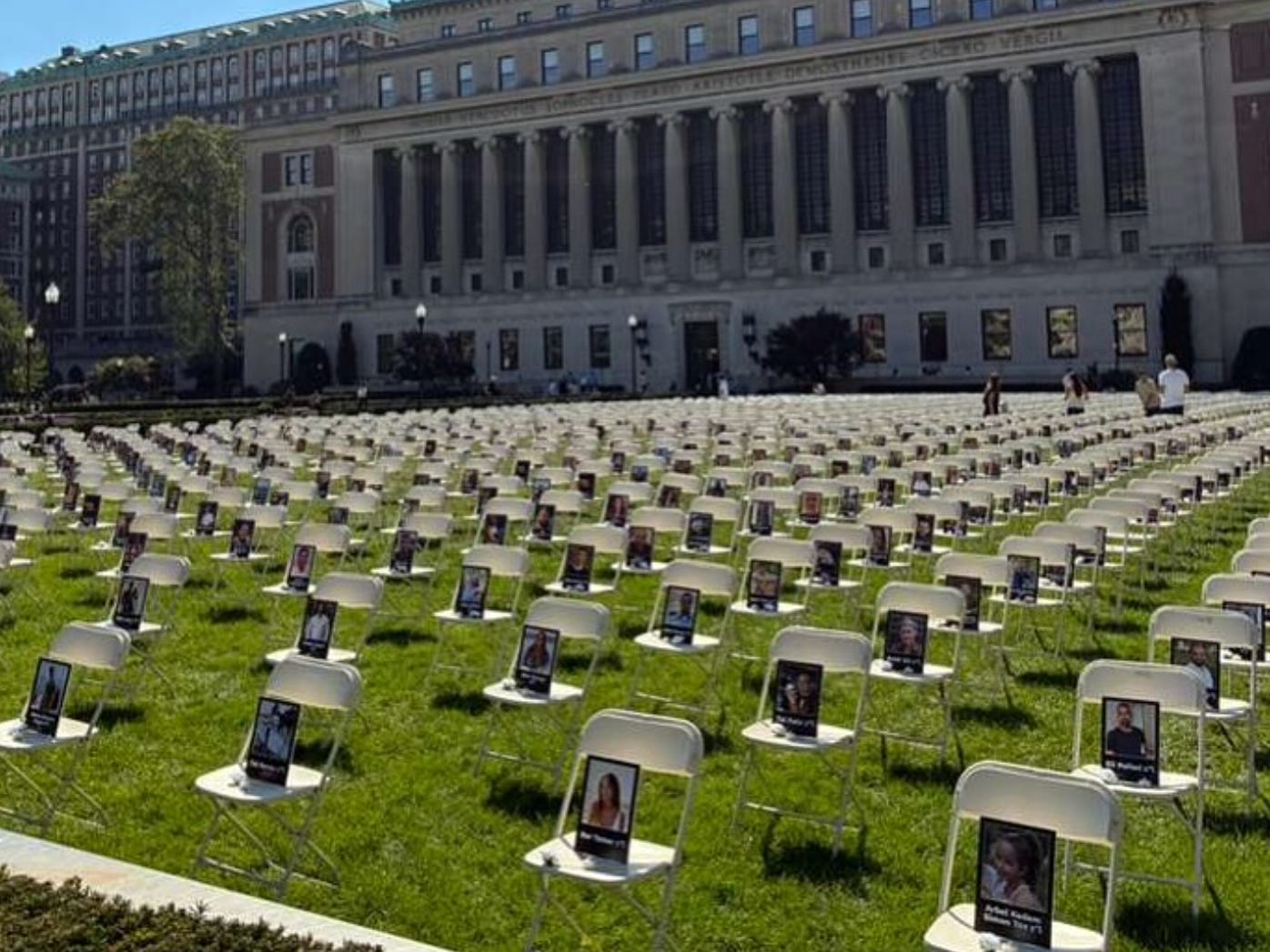
To us, Zionism is about supporting Israel and the Jewish people. On Monday, October 6, Students Supporting Israel put 1,205 empty chairs on Butler lawns to commemorate the victims of Hamas’s barbaric attack on Israel. The monument was an imposing yet silent presence in the heart of campus. It was a gesture of remembrance, a human acknowledgment of loss, and a way to visualize the sheer calamity of October 7, 2023.
Events like these are the essence of SSI’s mission: “To be a clear and confident pro-Israel voice on college campuses and to support students in grassroots, pro-Israel advocacy.” As members of the executive board, we are here to represent Israel. We speak for the students already “supporting Israel,” but we also serve those who are more critical or on the opposite side of the debate. While our mission remains constant, the context in which we carry it out has changed dramatically in recent years.
At Columbia, being a Zionist is controversial. The degree of visibility attached to presenting as a Zionist here often feels alienating. It is a difficult title to hold; often, social groups self-segregate based on political ideology, and being a Zionist on Columbia’s campus can significantly narrow one’s social world. Though we personally don’t choose our friends based on political positions they hold, the unfortunate reality is that many others do. It has been disheartening to attend a university that prides itself on being “globally engaged,” only to find that the student body barely seems interested in engaging beyond its own bubbles.
Similarly, this especially charged campus climate of the past two years has reshaped the role of SSI and its members since we first arrived at Columbia. We’ve encountered a tense environment that often makes us hesitant to share our involvement in SSI. Perhaps they’ll make unfounded assumptions about us in the same way that they will about the club.
Yet, despite these preconceptions, our body of members is diverse. We fall on all sides of the American and Israeli political spectrums, including us authors. Rafael identifies as an independent, while Avi is a Democrat. SSI exists to foster open dialogue about Israel. And despite our disagreements, we share a mutual affinity for the nation we love—the same impulse that validates participation in any club.
We aim to teach campus about the rich history of a beautiful nation and to spread the love we have for Israel, in the same way that other groups do so for their own cultural backgrounds. SSI faces challenges that other nation-based groups do not, as opinions are often ascribed to us rather than expressed by us. Despite these challenges, we continue to host events that celebrate and recognize the diversity of Israeli society. We have full faith in culture as an educational bridge, rather than a plane of conflict.
Yet, conflict often occurs when biases about Israel seep into other students’ interactions with us. We are asked to condemn the actions of the Israel Defense Forces (IDF) to create relationships with other clubs. We have refused before and will continue to do so. This request disguises itself as a desire for “peace” and “humanitarianism,” but really exemplifies an insidious double standard. Does the Chinese Students Club have to apologize for the actions of the CCP in Xinjiang before every meeting? Must the African Students Association issue a statement about Sudan every time they interact with another club? The moral standards selectively applied to SSI are reflective not of the overall “moral purity” of Columbia students. Instead, they show that many students here are more concerned with merely seeming virtuous than actually working to resolve these difficult questions through dialogue.
Moreover, we tend to steer away from enforcing specific Israeli or broader policy stances on members of our community, yet we as individual members do not shy away from voicing our opinions. We seek not to dictate opinions and speak for our members but to create pockets of space for community dialogue. If this means some other clubs won’t collaborate with us, so be it. But we hope that more clubs can keep an open mind and reflect honestly on our club’s mission.
SSI is aware of the campus climate surrounding the Middle East in recent years. We know that our club has different standards to uphold in the public eye, and we experience this day in and day out. But should we? Should SSI have to exist isolated from the rest of campus, forced to guard our events with a watchful eye? We are here to represent a culture and a nation, not to invoke political discourse and make enemies. With these goals, being met with such a caustic reaction from others on campus makes us wonder where that leaves SSI.
At SSI, we recognize that conversations about Israel will always carry political weight in today’s global climate. Given this reality, we understand that people may approach our club with certain preconceptions. Rather than giving credence to these stereotypes, we hope others engage with us in the spirit of listening and learning. We do not expect uniformity or agreement—only respect. On a campus that is so polarized, our club strives to create a community that does not shy away from complexity and intellectually rigorous conversation. Moving forward, we strive to bridge divides and restore campus dialogue to a place that respects the history and tradition of this prestigious institution.
Mr. Litvak is a sophomore at Columbia College studying film and political science. He is an Internal Outreach Coordinator for Students Supporting Israel and a staff writer for Sundial.
Mr. Vanuno is a junior at Columbia School of General Studies and The Jewish Theological Seminary studying comparative literature and Jewish ethics. He is an Engagement Coordinator for Students Supporting Israel and a staff writer for Sundial.

Unlike the ‘nation-based clubs’ you use as examples, y’all aren't a cultural club. Cultural identity is not national identity. Maybe your argument would work if it was ‘Students Supporting China’
It has nothing to do with Gaza. It has nothing to do with Israel. They reject you for the millenia old reason: they hate you for your Judaism. Don't be naive. I'm a CC grad and know how baked into the University Antisemitism is.