


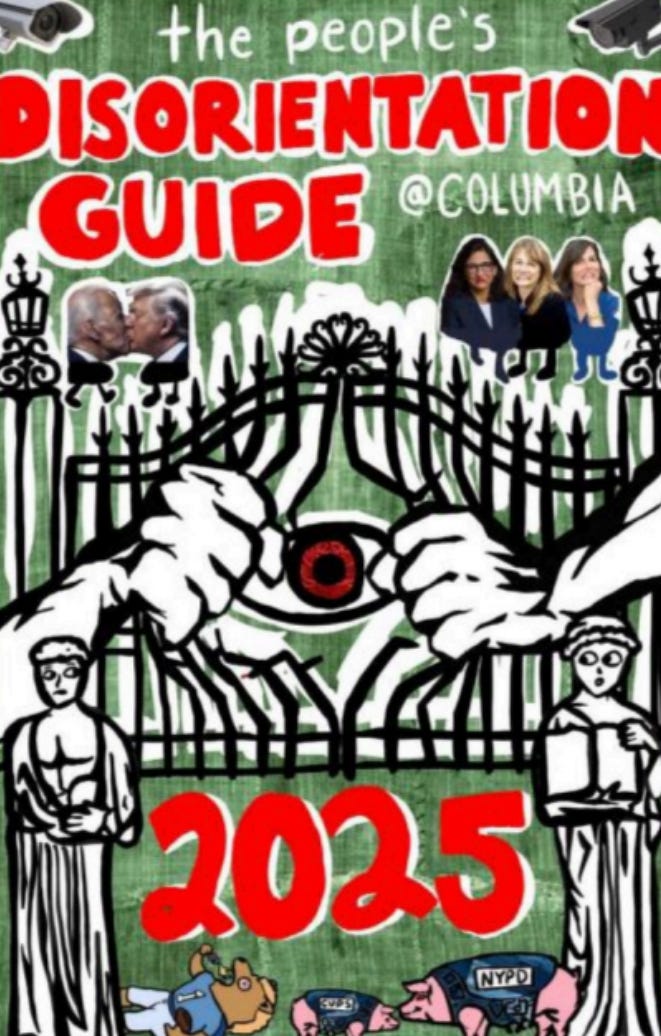
An essay in Sundial from fall 2025, “Orienting Ourselves With ‘Disorientation’,” reflects on an anonymous pamphlet distributed to new students during orientation week. The pamphlet, titled The People’s Disorientation Guide, presents itself as an activist’s survival manual—anti-administration, pro-Palestinian, and aimed at preparing students for life at Columbia. TJ Gill CC ’22, CLS ’27 contends that despite the pamphlet’s extremities, it reveals something larger: an uneasy, chilled state of campus dialogue following an administrative crackdown on student activism.
Gill defends the “current necessity” of the pamphlet, framing it as the vital continuation of an activist culture now chilled by administrative reprisal. Even if we’re critical of the pamphlet’s contents, he argues, we must be wary of suppressing an “activist ethos on campus,” since in his view, such activism enables students to meaningfully engage ideas and sharpen their convictions.
Yet this diagnosis misses the mark. The pamphlet is indeed a warning sign, though not in the way Gill imagines. It’s not evidence of silenced activist voices so much as a persistent reflex to shy away from critical dialogue. What must be safeguarded is not merely the presence of activism, but its quality. Quality activism operates in good faith, persuades through reason, and displays a willingness to engage opponents. Upholding that standard is ultimately the responsibility of students, not administrators.
To see why the author’s reflection misreads both the pamphlet and the state of campus dialogue, it’s worth looking closely at what the pamphlet actually contains:
A note equating Columbia with weapons manufacturers that “drive” colonial war;
Protesting tips advising students to conceal identifiable features;
A poem titled “Intifada Incantation”;
A QR code linking to a list of “anti-Zionist therapists”;
A disciplinary bingo card (“get interim suspended…”); and
“Critical thinking questions,” such as “How are you going to redistribute wealth?”
The document makes sweeping normative claims without substantiating them or engaging opposing views. The essayist, however, collapses the distinction between safeguarding the pamphlet as a form of expression and treating it as a meaningful contribution to dialogue.
To be sure, students should never feel restrained from peaceful activism within the bounds of law and university policy. Moreover, concern about administrative intervention in student advocacy is not altogether misplaced. Anxieties are understandable in light of the murky grounds on which the Department of Homeland Security intervened in activists’ immigration cases. Emotional or disruptive protests are not necessarily shallow, nor is Columbia an independent arbiter, given the donor and political pressures shaping its enforcement.
Nonetheless, Columbia’s policies aim to foster dialogue within the reasonable bounds of a shared intellectual community. The Code of Conduct affirms this purpose: “that all members of our community may engage in our cherished traditions of free expression… the right to demonstrate, for example, cannot come at the expense of the right of others to counter-demonstrate, to teach, or to engage in academic pursuits.” The administration’s recent updates to the rules—prohibiting disruptive protests in academic buildings and requiring participants to identify themselves when asked—are reasonable measures to uphold that principle. The past year has shown that without clear bounds, activism can become a monopoly of space and ideas rather than a means of persuasion.
Gill’s argument rests on a shaky assumption: that changing activist tactics reflects a dampened discourse. He writes: “this is why the guide is so vital in this moment: It exists as the most robust embodiment of the Palestinian cause right now at Columbia… However, an anxiety underpins the movement, stifling the shrill confidence that once defined it.” But the loss of “shrill confidence” doesn’t signal the silencing of activists; we should not conflate the vehemence of protest with the vitality of discourse. Nor should we lament its “stifling” without confronting the dysfunction it produced: occupation of academic buildings, vandalization of libraries, and, at times, the expression of open antisemitism.
Notwithstanding the claim of a “dissolution of the broader activist ethos on campus,” the culture of activism at Columbia remains vibrant. In recent months, students have hosted fundraisers and gatherings for Palestine, commemorated the victims of October 7, and championed causes ranging from environmental reform to healthcare justice. The University lists nearly thirty active student groups devoted to “Politics, Activism and Advocacy.” Off campus, Columbians campaign for mayoral candidates, protest throughout New York City, and push for reforms in Morningside Heights. Even the administration is exploring how emerging technologies might foster dialogue among students. The tone may be less brash, but the culture remains fertile for vigorous advocacy.
The People’s Disorientation Guide misses an opportunity to join that culture. Instead of provoking inquiry or persuasion, it offers conclusions without reasons and sidesteps the hard questions first-years should be asking—for example, about the nuance of administrative power in protest, the growth of the university bureaucracy, or the expanding use of AI in academia. Compare the Guide’s anonymity with Alexander Hamilton’s pseudonymous pamphlets at King’s College; though polemical and written in a different era, Hamilton used pseudonymity to strengthen a reasoned argument, whereas the Guide uses it to evade critique. Anonymity can be warranted when risks are material, but the Guide fails to offer basic mechanisms of accountability: citations, a signatory collective, or a channel for reply. In fact, versions of The People’s Disorientation Guide have circulated at Columbia for decades. Its reappearance, then, reveals less about the current climate of advocacy than a persistent temptation for dissent without the burden of critical thought.
To recalibrate toward a culture of meaningful dialogue, students must ultimately take responsibility; the administration is not the primary obstacle. Encouragingly, new student-run outlets like Sundial already model this spirit. Students could build additional forums for quality activism. Where, for example, is Columbia’s version of the Oxford Union? The University, for its part, can also adopt viewpoint-neutrality policies, define clearer disciplinary rubrics, and publish guidance for how it will or won’t support visa-holding students when their immigration status is challenged. But evolving the culture of activism on campus will ultimately depend on students’ willingness to operate in good faith, persuade through reason, and engage those with opposing views.
As new Columbians orient themselves on campus, their challenge is to build a culture of dialogue and activism that honors our university’s intellectual tradition.
Mr. Simler is a 2022 graduate of Columbia and a guest contributor for Sundial.
The opinions expressed in this article are solely those of the author and do not necessarily reflect the views of the Sundial editorial board as a whole or any other members of the staff.

Awesome read - well done