


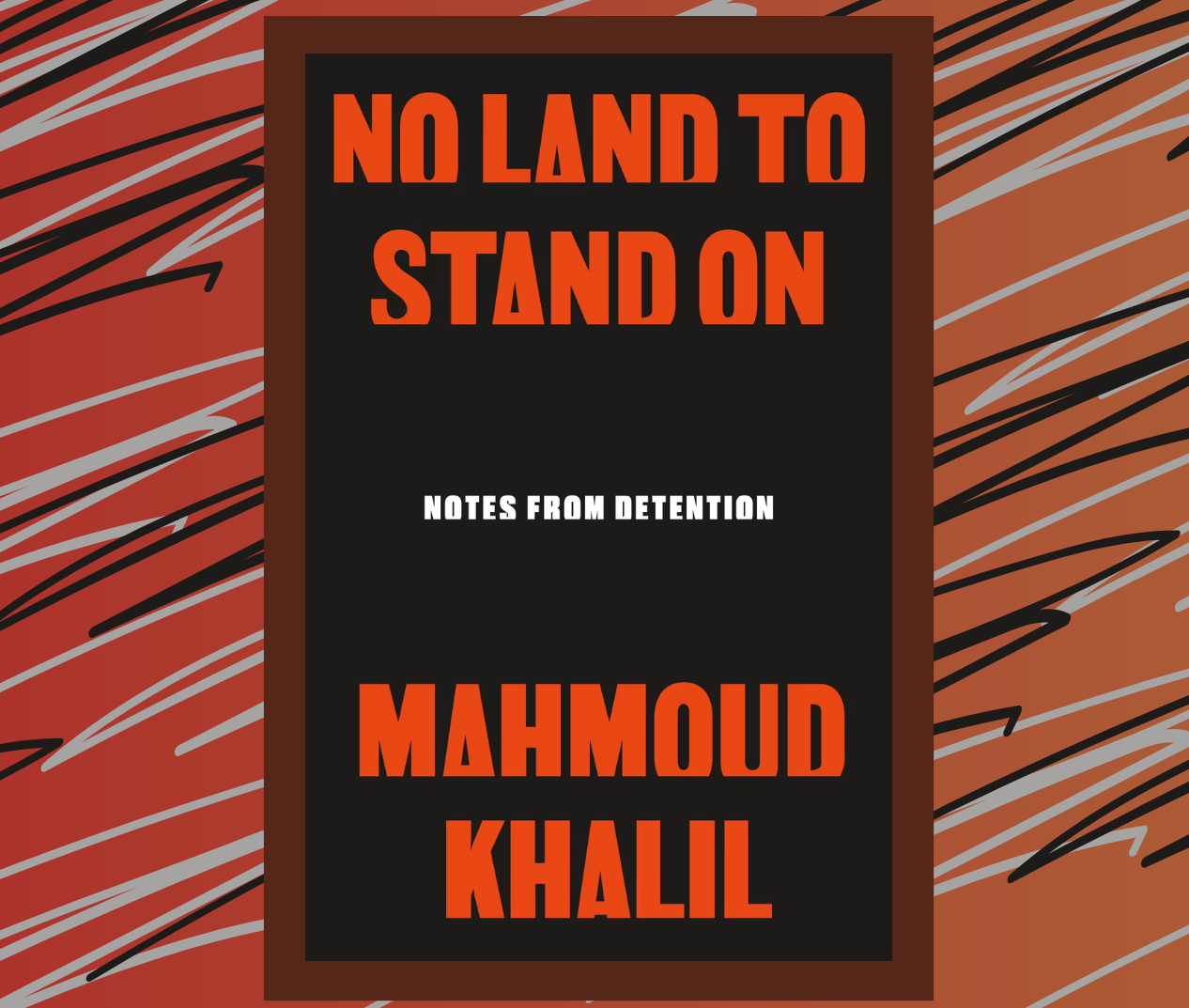
Mahmoud Khalil’s new memoir No Land to Stand On begins with a harrowing account of his participation in a march of return to Palestine on Nakba Day in 2011, when he was 16. Born into a family of Palestinian refugees in Syria, he recounts how, on the morning of Nakba Day, he had promised his father not to participate in the protests; he would leave his house only to take a trigonometry exam. Instead, urged by his teacher to participate in the commemoration of the 1948 “catastrophe” during which Israeli militia killed an estimated 13,000-15,000 Palestinians and displaced over 700,000, he went to the protest. He saw his father there and was shot in the leg before he could reach Majdal Shams, an Israeli-administered town that sits in the disputed Golan Heights region at the intersection of Syria, Lebanon, and Israel. His first thought upon getting shot was that his mother would be furious at him for getting blood on his pants.
The matter-of-factness with which this story is conveyed permeates the entire memoir. Khalil adopts an “aw-shucks” persona, writing of how he had, unwillingly, become “a living martyr,” even as his day-to-day preoccupations centered around his wife, Noor: whether she was safe, whether she could have him there for their baby’s birth. The memoir essentially functions as a personal drama, with the underlying political tension serving as mere backdrop.
To establish the arbitrariness of his detention, Khalil sets out, anecdote by anecdote, to prove, paradoxically, both his mundanity and his exceptionalism. He has a green card and is married to a U.S. citizen: mundane. The “Rubio determination” would seek to deport him for his “past, current, or expected beliefs, statements, or associations that are otherwise lawful”: exceptional. In pursuit of this juxtaposition, Khalil often downplays his rhetoric and involvement in activism, despite his insistence that he is not a martyr for free speech but a martyr for Palestine. To paint this as a free speech issue, he argues, would necessitate participating in the erasure of Palestine in public discourse that made possible the circumstances of his arrest.
Ironically, by emphasizing his absolute moderation and ordinariness while watering down his actual involvement in the pro-Palestine movement, his goal seems to be garnering mass sympathy for his specific situation rather than mounting a clear-eyed, principled defense of the pro-Palestine student movement for what it is. By retroactively selecting only the more palatable and mass-appealing parts of the movement to highlight, he does the whole endeavor a disservice.
What is more, Khalil never finds steady ground on Palestine. Beyond broad criticism of Israel, the memoir is absent of his more activist past. Even his involvement with UNRWA—the UN agency that provides humanitarian aid and social services to Palestinian refugees across the Levant, which detractors claim has a suspiciously close working relationship with Hamas—and his emails to administrators are told in a tightly-wound chain of story. Each point is followed immediately by defensive rhetoric seeking to mitigate all criticism, reasonable or otherwise. He defends, for example, the student movement’s use of “from the river to the sea” by claiming that the meaning of the phrase that Jewish students and administrators took issue with—that it could be construed as a “call for Jews to be eliminated”—is actually a call for freedom, justice, and equality. He leaves out his defense of the rallying cry “globalize the intifada,” which, in a New York Times interview with Ezra Klein in 2025, he simply described as a chant for “civil disobedience against the Israeli occupation.” Khalil also claimed that Jewish fears surrounding the phrase are based on “policing Palestinian thought and speech.”
The trouble with such an argument is twofold: One, that Hamas and other similarly militant Palestinian factions have indeed used these terms to incite violence against Israel and its Jewish citizens, and two, that Khalil goes on to similarly police Jewish and Zionist speech, all while claiming his pro-Palestinian speech should not be policed at all.
Near the end of the book, he recounts an anecdote in which he was eating at a restaurant with his wife Noor and was made to feel uncomfortable by a group singing “Am Yisrael Chai.” In a recent essay for New York Magazine, Khalil described “Am Yisrael Chai” as an “Israeli nationalist anthem often chanted by racist mobs while harassing Palestinians.” The song was originally composed as an anthem for Jewish solidarity for the Student Struggle for Soviet Jewry, a group dedicated to Jewish liberation in the Soviet Union. One could argue that the song is merely an expression of international Jewish solidarity in times of hardship and not a veiled racist threat to Palestinians; it is a common hymn in Israel and among the global Jewish community, and it hardly equates to “racism” in and of itself.
The point is that one can’t have it both ways—fear is more slippery than the black-and-white origins of a phrase. The circumstances in which a phrase evolves to become the slogan of different groups with different agendas and capacities for violence condition our reactions to it. Khalil ought to know this well; just as he has faced harassment from Jewish mobs singing “Am Yisrael Chai” in his face, so have Jewish people—especially at Columbia—faced violence and harassment from supporters of the Palestinian cause who chant “from the river to the sea” or “globalize the intifada.” To fully believe in the project of No Land to Stand On, one must pretend as if these contradictions are invisible.
This impulse toward sanitization extends beyond his rhetorical choices and into his legal record. He comfortably gets around the accusation from the State Department that he had failed to disclose his “membership” in Columbia University Apartheid Divest (CUAD) by claiming that he wasn’t a “member,” as CUAD is an “informal coalition” with no real roster. But the official question on the application for permanent residency asks, in the broadest possible terms, whether someone has “EVER been a member of, involved in, or in any way associated with any organization, association, fund, foundation, party, club, society, or similar group in the United States or in any other location in the world?”
The question is meant to serve as a screening against terrorist groups, foreign political associations, and those potentially involved in espionage activities. While one can argue for or against the inclusion of CUAD as an association worth flagging, by any honest measure, someone active in the movement for Palestine who has served as a go-between for CUAD and the Columbia administration should answer “yes” to that question. Khalil forgoes honesty and relative innocence in service of claiming absolute innocence, but the truth is more complicated than that.
There’s no question that the situation inside the ICE detention centers is inhumane: Many detainees have described filthy conditions, frequent beatings, moldy food, and other forms of abuse. However, that isn’t where the center of gravity of Khalil’s story lies—he spends considerable time trying to convince the reader of the infallibility of the student movement and the cleanliness of his own record. He claims that only the pro-Israel and Zionist students on campus provoke confrontations, conveniently leaving out the fact that the pro-Palestine faction at Columbia has its own share of controversial provocateurs, including the now-barred Khymani James, who has said that “Zionists don’t deserve to live.”
What these elisions and misdirections ultimately result in is a sense of vague aimlessness. It is not that Khalil does not have convictions: His work with the British Embassy in Beirut and UNRWA, as well as his participation in the CUAD sphere, proves that he has activist chops. The disappointment lies in the fact that, in pursuit of the appearance of moderation, he is willing to water down his actual commitments to Palestine. In essence, the rosy history he paints has made this memoir vulnerable to his own critique: He has made this an issue of free speech instead of Palestine.
While it’s easy to understand why Khalil has chosen to do so—he is still undergoing legal proceedings and trying to fight his deportation—the pressure of writing his innocence into legitimacy has made the memoir read more like a legal defense brief cloaked in the mere aesthetics of dissent than any real testament to the nuances and harsh realities of activism. It’s a shame, because there’s a strong case to be made that the deportation case against Khalil is unjust without needing to whitewash his history.
As Khalil himself has mentioned, he is a permanent resident and is offered First Amendment and due process protections per Supreme Court precedents Bridges v. Wixon and Kwong Hai Chew v. Colding. The law used to justify his deportation is sufficiently vague that it vests unilateral discretion in the executive branch, allowing it to bypass criminal courts entirely. Using this artifact of the McCarthyite era to suppress defensible non-citizen dissent sets a dangerous precedent. The Constitution, according to some legal scholars, should already protect Khalil’s right to speech, no matter how controversial, which makes the sanitization of his own narrative all the more unnecessary and frustrating.
Nowhere in the memoir does he pick a true hill to defend with any real stakes. All of the emphasis is on how peaceful the protestors are, how reasonable it is to want to express oneself in defense of Palestinian liberation, and how absurdly the government has misconstrued the case against him. It sets out to prove Khalil’s exceptionalism rather than to defend his rights despite commonplace and reasonable critiques. Through it all, there’s an inkling that’s reminiscent of when one retells a story over and over again, forgetting to include certain uncomfortable truths enough times until one truly believes that the abridged story is all there is.
No Land to Stand On never commits fully to being a manifesto for the Palestinian cause. It is deeply mired in its indecision between functioning as an apologia for moderates in the Palestinian activism scene—a role inescapably intertwined with protecting Khalil amidst his ongoing legal turmoil—and the expectation that, as a book authored by an activist, it must serve as some artifact of Palestinian resistance in a hostile and normatively pro-Israel Western society. Ultimately, it achieves neither.
Sundial received an advance reader’s copy courtesy of Picador.
Ms. Chen is a junior at Columbia College studying linguistics, economics, and East Asian languages & cultures. She is a deputy editor for Sundial.
The opinions expressed in this article are solely those of the author and do not necessarily reflect the views of the Sundial editorial board as a whole or any other members of the staff.
This is a brave, thoughtful, deeply analytical piece Cara. I am so proud of you and Sundial for continuing to step up to offer nuanced takes for our otherwise politically tribalist campus. This piece demonstrates such deep thoughtfulness that makes our conversations about hard topics like activism richer and more complex. Every point was thought out, every word was carefully selected, and ultimately, you produced some writing here that simply could not be done by any other publication at Columbia. Bravo.
Ms. Chen writes "...1948 “catastrophe” during which Israeli militia killed an estimated 13,000-15,000 Palestinians and displaced over 700,000..." without any context that this all occurred during an invasion by five Arab armies from surrounding states after the rejection of a UN proposed two state patrician that Israel had accepted, even though much of its portion was of Negev dessert in the south. Ms. Chen might have noted there was an almost equal displacement of Jews from Arab lands, communities that preexisted the Arab imperialist conquest of the region at numbers perhaps greater than the Arabs displaced. Unfortunately I'm reluctant to put all the blame on Ms. Chen as the Middle Eastern Studies at Columbia is notorious for its one-sided anti-Israel propaganda laced bias. If one is not critical of Hamas, Iran, Hezbollah and Qatar, also than one is not really pro-Palestinian,but simply anti Israel. With Iranian and Qatari support, Hamas stole perhaps a billion or more in funds and materials meant for the betterment of the people of Gaza to construct a vast military compound connected by miles of tunnels under residential and community buildings. Entrances were everywhere for Hamas fighters to emerge and attack, while other entrances were booby-trapped. This was a despicable strategy by Hamas leaders to make it impossible for them to be attacked in response to Oct 7 without casualties and destruction. Meanwhile Hamas tried to prevent civilians from leaving conflict areas and the "world" protested too. Egypt slammed its border shut without a peep from those that claimed to care about the civilians in Gaza. And the underground military complex could have been the worlds largest bomb shelter was closed to civillians by Hamas. Imagine what could have been built with these resources after Israel unilaterally left Gaza? I could go on for pages but will leave it here for now. This piece is just so representative of all the ill informed brainwashed protesters post Oct 7, whose self-righteous self-importance was only exceeded by their ignorance... I hope there can be some honest information-based reflection in the future. For now Columbia's reputation has been sadly but justifiably tarnished.
Eric SIPA 1984