


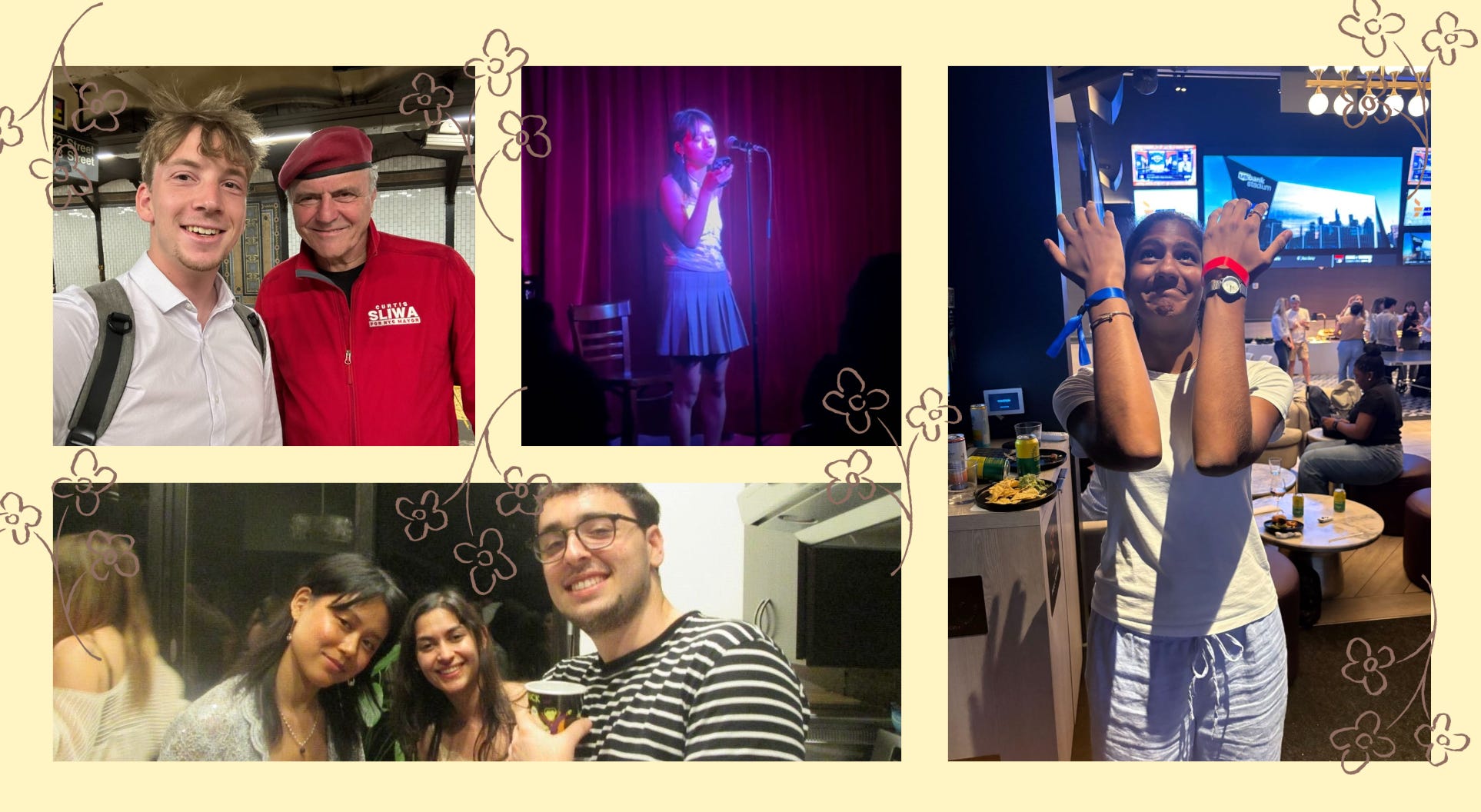
Summer! The best time of the year. When the sun is shining, the birds are chirping, and the stress of college life has all been thrown into the wind. Or perhaps that was how it was when we could still frolic and enjoy life without the need for a j*b looming over our shoulders.
As it seems, though, we have simply jumped from the frying pan into the fire. I have seen and heard it all: the 9 to 5, the LinkedIn-maxxing, the post-work slump. But add in vampire bats, Luddites, and robot performers, and that is what makes a Sundial summer truly special.
So let’s dive into their summertime infernos, and see what Sundial was up to for the past three months.
Sebi Galbenus, Staff Writer
Our resident Butlerian smoker entered the summer with one goal: do nothing.
By all accounts, he’s earned this reprieve from the grind. Since the summer after ninth grade, he hasn’t had a genuinely empty break to simply relax. College applications and career ambitions had come for the rest of them. But now, looking back, Sebi reports that he “can safely say [he] was just lazy,” highlighting a summer of playing guitar, watching cartoons and movies, and hanging out with friends and family.
Though, like a true Columbia student, even his “nothing” still meant doing something. He had an internship, one which required him to travel to Shenzhen, China for business. Nevertheless, the most insightful part of his journey abroad wasn’t the work: It was the relatable people, the rich culture, and the absolutely delectable food he got to experience in between trips to various factories.
At the Splendid China Folk Culture Village in Shenzhen, Sebi witnessed horse choreography, real explosions that left the stage on fire, and dancing robots prancing across the stage. Speaking with other under-30-year-olds in Shenzhen, the Silicon Valley of China, he also saw a rural to urban transition that mirrored his own journey from a village in Romania to the concrete jungle of New York City. And, underneath all the flashy shows, he learned that young people everywhere share similar struggles: maintaining a j*b, family pressure, marriage.
For Sebi, however, the biggest challenge this summer came in the form of two little human “batteries with f*cking unlimited life.” When he visited Italy for some family friends, he quickly realized he wasn’t as unflappable as he had thought. After three hours with their two children, a 7 and a 2-year-old, he quietly escaped for a smoke break, and “did not miss the kids” one bit after leaving Italy.
In the end, Sebi’s summer of nothingness was actually pretty eventful. It makes sense then, when asked if he’d change anything, he said he would’ve taken the chance to be “even more lazy.” Looking back, I might even have taken the chance too.
Nick Baum, Editor-in-Chief
Back in the good old Big Apple, Nick Baum was a man with a plan for the summer. He was going to be “super productive” for Sundial. He was going to train for the “New York Subway challenge,” the world record of hitting every New York Subway stop in the fastest possible time. In his words, he had “all these clear, big ambitions” for the summer.
Then he got an internship crunching numbers at an economic policy agency and discovered the couch.
“I underestimated how draining work would be,” he said. “By the time I got home, I just wanted to collapse and soak into the couch… it gave me a lot of insight into the average working person.” His days were also organized around the World Cup, which came on at 3 or 4 p.m. and functioned as a hard stop; the remaining hours he described as “taking a knee in football—you kind of just chew the rest of the clock down.”
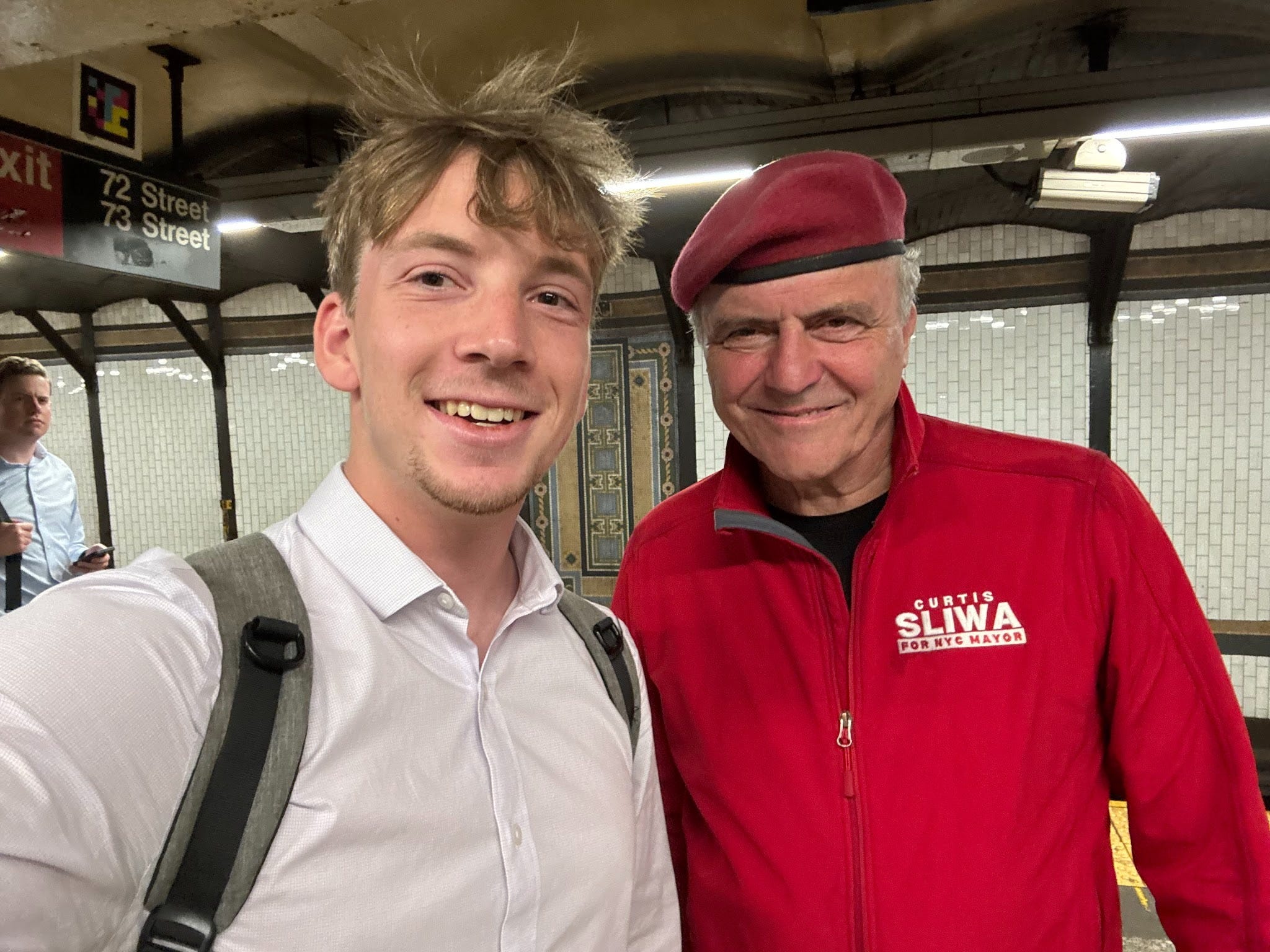
But with the Knicks winning the NBA championship, the World Cup fans pouring into the city, and the everyday craziness of New York City, Nick’s journey to and from work was a whole odyssey of its own. One day he’s fighting tooth and nail through a crowd of orange and blue blocking his way to work, and another he’s being recruited by Curtis Sliwa to become a Guardian Angel on the uptown 1 train.
And then, on a Saturday deep in Brooklyn, none of the planning mattered at all. He’d gone out to catch a group of Luddites walking the length of the borough (see Jayna below), arrived to find them halfway done already, and popped into a nearby bodega for a water, only to find everyone raptured by a World Cup game on the television. He stayed fifteen minutes, and in that short while “it didn’t matter that I was this preppy college student from the Upper West Side, and that they were local, working-class Hispanic residents who may not have known any English. We were united in our hatred of Argentina.”
Nick never did make it to every subway station. He did, however, make it to over 190 local coffee shops in the city, a number he volunteers as his big flex and which suggests the city got covered regardless. Indeed, that might have been the best part of his summer, even better than anything his original plan included.
Jayna Rohslau, Staff Writer
Also in New York over the summer was Jayna Rohslau. Despite not having a j*b, she had arguably the busiest, and most eventful, summer out of everyone here. When asked how she would characterize her summer in one sentence, Jayna responded with “a summer of exploration in terms of pursuing my passions and connecting over shared exploration with others.”
Jayna certainly explored a lot. She hostessed at a Chinese-American restaurant in Brooklyn located inside a historic funeral home before it shut down. She joined a drunk writing group in Williamsburg and started exchanging poems with Ukrainian drone pilots, oil reporters, and drunken quants. She attended an egg-themed party and hosted a murder mystery party. She walked across Brooklyn with a group of Luddites. And she has been writing and performing poetry about her complicated feelings toward monetary policy and her “fundamental misunderstanding of econ” at KGB and other open mics.

Jayna was also simultaneously taking summer classes at Columbia, and, for a science writing class with Claudia Dreifus, interviewing bat researchers. Along the way, she became a scholar of “the complex social lives of vampire bats.” She imparted upon me the knowledge that vampire bats evolved a form of reciprocity to survive: A bat that fed will regurgitate blood for another that didn’t get any. Over a discussion with a Princeton researcher, she even discussed whether they might have something to teach us about resilience and friendship of the human variety. The only force that stopped her from going to New Jersey for more bat experts was food poisoning.
Sometime in the middle of her eventful summer, The New York Times also published her letter in its opinion section. It was a response to a piece they ran arguing that our generation doesn’t care about ambition and can hardly be blamed. Her counterargument was that for most of the people she knows, ambition is simply too personal to show up in the places the Times goes looking for it.
All in all, Jayna spent 11 weeks demonstrating just how much one could do if they just pursued their passions full-time. Maybe that should be a lesson for us all too.
Uma Rajan, Senior Editor
Last year, Uma wrote the original summer recap article. Consider this one carrying the mantle.
Uma was, by a wide margin, the most professionally employed person I interviewed: two internships totaling close to 50 hours a week, one of them with the New York Road Runners, the nonprofit behind the NYC marathon, where she makes TikToks and Instagram stories out of the Columbus Circle office. She’s also the only person here whose summer doesn’t end—the internship runs straight through the marathon in November.
She is likewise training to qualify for that marathon, which produced the most impressive logistical maneuver of anyone’s break. Having signed up for races before she had the job, Uma found herself scheduled to both run and work two four-mile races on consecutive mornings. Her solution: arrive at 5 a.m. for an 8 a.m. start, film for three hours, film the starts of Corral A, B, and C, sneak into the queue for her own Corral D, run the race, grab a water, then film the finishes of E, F, G, and H. Then wake up and do it again.
She sublet an apartment with a fire escape. She learned to cook. She came away with a working respect for the 9-to-5 and a warning about it: “If you don’t make an effort to do something else after work, you can totally just kind of go through the 9-to-5 cycle, come back and maybe work out, eat, and then suddenly it’s like time to go to bed.”
In other words, she spent the summer functioning as an adult in every measurable respect. Unfortunately, her employer disagreed.
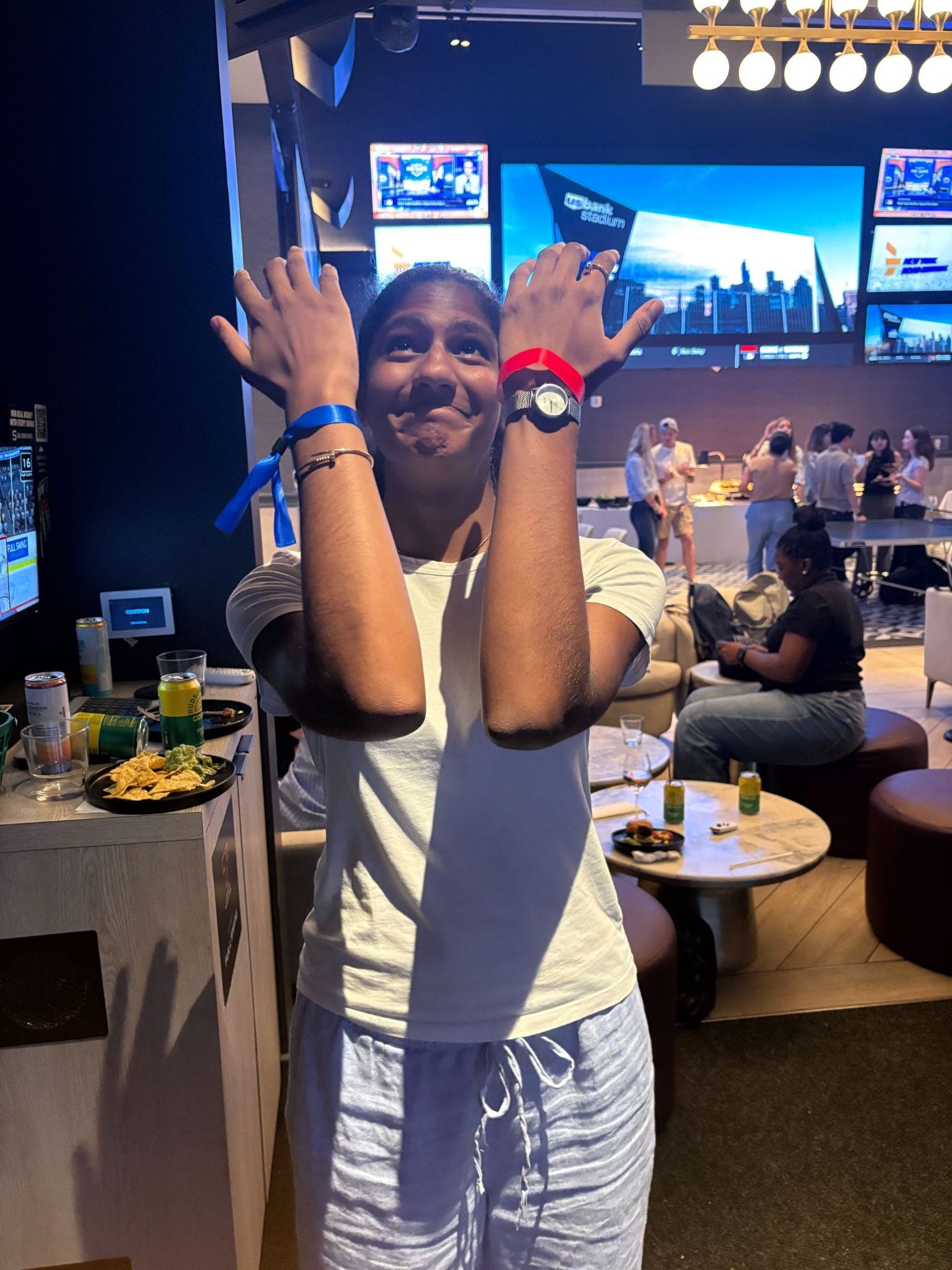
Despite being the youngest person at the New York Road Runners, she was invited to a company summer social event at a sports-bar/golf-simulator hybrid, where (surprise surprise) booze was present. Arriving there an hour late, she was promptly strapped with two wristbands for the evening, plus a personal conversation with the bartender requesting she not be served.
As consolation, though, she did almost win at bowling against coworkers who, sober, would have destroyed her.
Jessica Weinfeld, Staff Editor
Other summers were spent on a more serious note.
Jessica Weinfeld interned at a district attorney’s office in a unit where roughly 90% of the caseload is child sexual abuse and the rest serious abuse and homicide. Her first reaction was the reasonable one: “I don’t know if I can handle this.”
She spent the next three months finding out. She sat in on trials. She worked through evidence, transcribing interviews and jail calls. Her final days were spent reading hundreds of pages of medical records and psychological evaluations for an insanity claim. She went to a police training simulator and toured a minimum-security prison, which was valuable in her words because “you want to know where you’re sending people.”
What stayed with her throughout was the witnesses. “It was incredible to just be able to do the very meaningful work of holding people accountable,” she said. “You see all the victims, you hear their testimony, and you really feel like a part of something.” Not only justice for the people in the courtroom, she pointed out, but for the ones who now won’t have to be in one at all. She’s already taken the LSAT and prosecution is the plan.
So the answer to day one turned out to be yes. “I think I’m a bit tougher than I thought I was,” she said. Her only regret is not throwing herself in faster: “You’re only gonna be here for three months, so appreciate what you’re doing.”
Emeric Chang, Staff Editor
Last, but definitely not least, are my own summertime adventures.
The official version is that I spent it in the U.S. Attorney’s Office in D.C., in the division handling post-conviction litigation. Like Jessica, I drafted motions, scanned through thousands of pages of transcripts and prison records, and saw firsthand the responsibility of a prosecutor’s office to seek out justice for wronged victims. That experience also reaffirmed for me how law is one of the most human fields there is—a departing attorney described prosecutors as speakers for the dead, which is also coincidentally the name of one of my favorite books.
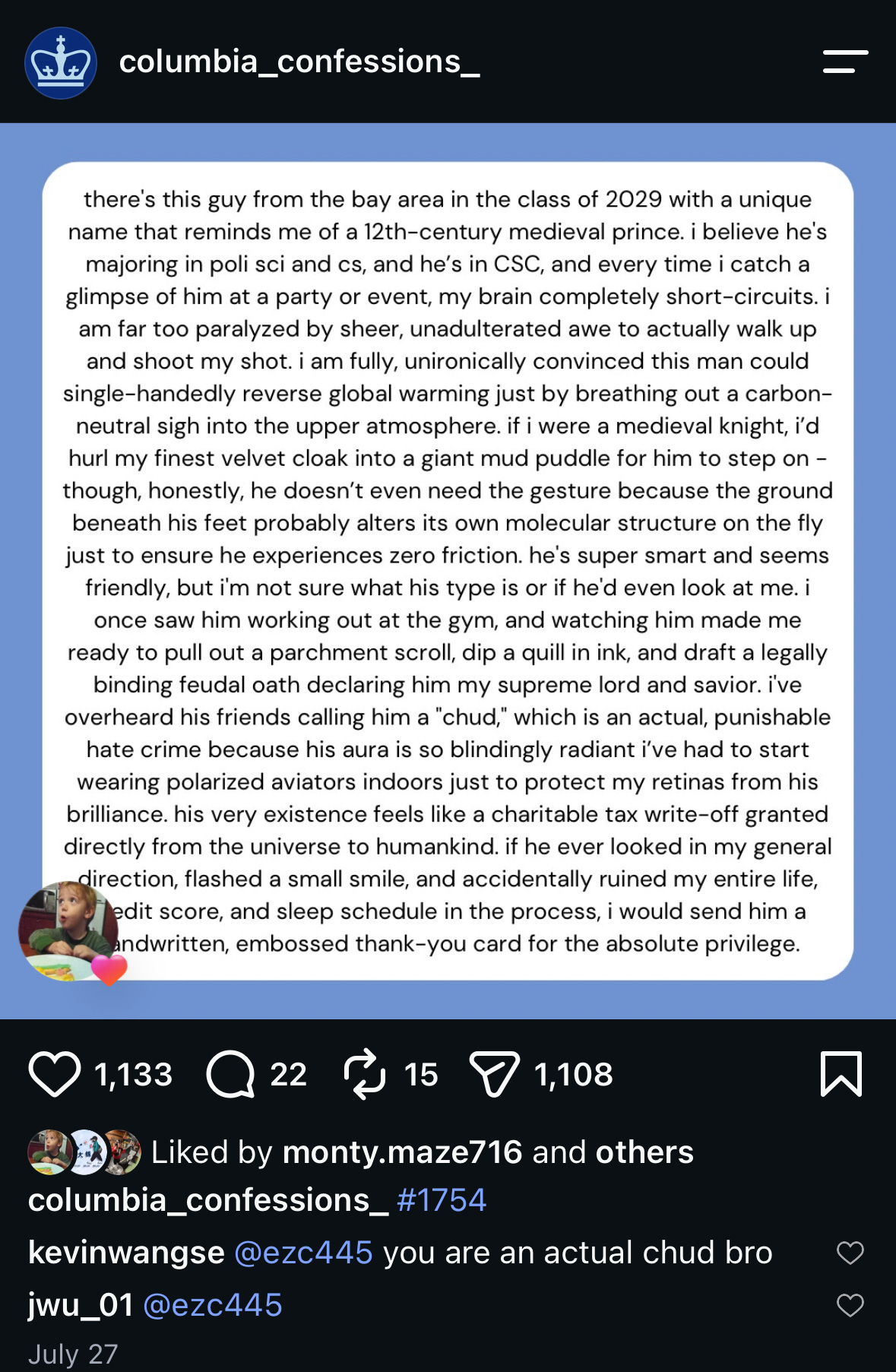
The unofficial version is that my summer revolved around various moments of danger and dubious people. On a night run through the D.C. Chinatown, I almost got mugged by a group of five. I was then accosted by a non-trivial amount of tweakers, some of whom were surprisingly politically literate as they followed me around the block. I went to my first hackathon, won, and was immediately offered an interview by a Palantir forward-deployed engineer. (I did not take the interview.) I also somehow landed on Columbia Confessions for a second time, this time due to some passing resemblance to a medieval knight.
But perhaps the best part of my summer was how on an otherwise ordinary afternoon inside a United States Attorney’s Office, I listened to my fellow interns—the future of American law enforcement, vetted and badged—make six-seven jokes. I knew I was already cooked, but to find out that we’re all equally cooked made it even better.
As my parting note, I’ll leave you with something I learned this past summer: the best parts of life are the ones you never planned for. Go on that random side-quest. Speak to that stranger. Wander someplace off the beaten path. Only then, will you see everything life can offer.
Mr. Chang is a sophomore at Columbia College studying political science and computer science. He is a staff editor for Sundial.
The opinions expressed in this article are solely those of the author and do not necessarily reflect the views of the Sundial editorial board as a whole or any other members of the staff.

Great to have Sundial back in my in-box! The awareness gained of the realities of the "j*b" (i.e., that mysterious gap between college and retirement) will serve you in good stead.
Honoring grandpa Nagin in the cover image I see