


To anyone who’s been paying attention to New York City politics over the past several months, it appears that the traditional welfare-capitalist Democratic order has been turned entirely on its head. Candidates who openly identify as socialists and are endorsed by the Democratic Socialists of America (DSA) have won victory after victory, catapulting their members into dozens of elected offices. In addition to Zohran Mamdani, the now-mayor of New York City, Darializa Chevalier—the Democratic candidate for Columbia’s own House of Representatives district—is also a card-carrying member of the DSA.
To hear the candidates themselves speak of their victories, their wave is part of a permanent change not only in New York, but across the country, with themselves as representatives of a growing coalition of the working-class and people of color. DSA-affiliated member of the New York State Assembly Diana Moreno declared she was running as a representative of an “organized coalition of a multiracial working-class base.” Chevalier, meanwhile, promised to “bring the values of working-class people of color here in Harlem and Washington Heights and Inwood and [T]he Bronx into the halls of Congress” and claimed her campaign centered “working people in this district.” In his victory speech, Mamdani promised to usher in a “generation of change,” championing the cause of “those earning $20 an hour” and standing up for minority groups including immigrants, trans people, and black women.
The new coalition, as its leaders define it, is of, by, and for the most marginalized and downtrodden groups in society. It is a manifestation of Barack Obama’s “coalition of the ascendant,” a term used to describe the unification of racial minorities, women, and young people that sent him to the White House in 2008 and 2012. At the time, David Gregory, an NBC television host, speculated that such a coalition could lead to a “permanent Democratic majority,” a common (and unrealized) liberal dream that, as demographic changes lead to the continued increase of the percentage of nonwhite Americans, those voters would consistently elect Democrats. Now, DSA supporters claim that the same demographic trends have swept them into victory and will continue to expand their reach.
To test this proposition against two recent elections, Sundial collected and analyzed data on Chevalier and Mamdani’s primary victories. Information on Chevalier’s vote share came from unofficial NYC Board of Elections data and was combined with data from the 2025 American Community Survey. Information on Mamdani’s primary vote totals was collected from New York Times reporting of results by neighborhood and compared to data from the 2020 census as listed by the New York City Department of City Planning.
A dispassionate examination of New York City’s new socialist coalition reveals that the DSA’s self-description is far removed from reality. The numbers contradict the narrative that socialism is a product of the poor and racially marginalized, and they hint at the cracks that could manifest over the coming years.
Take Columbia’s likely future House representative, Chevalier, who recently defeated longtime incumbent Adriano Espaillat to win the Democratic nomination and bragged so confidently about embodying the values of “working-class people of color.”
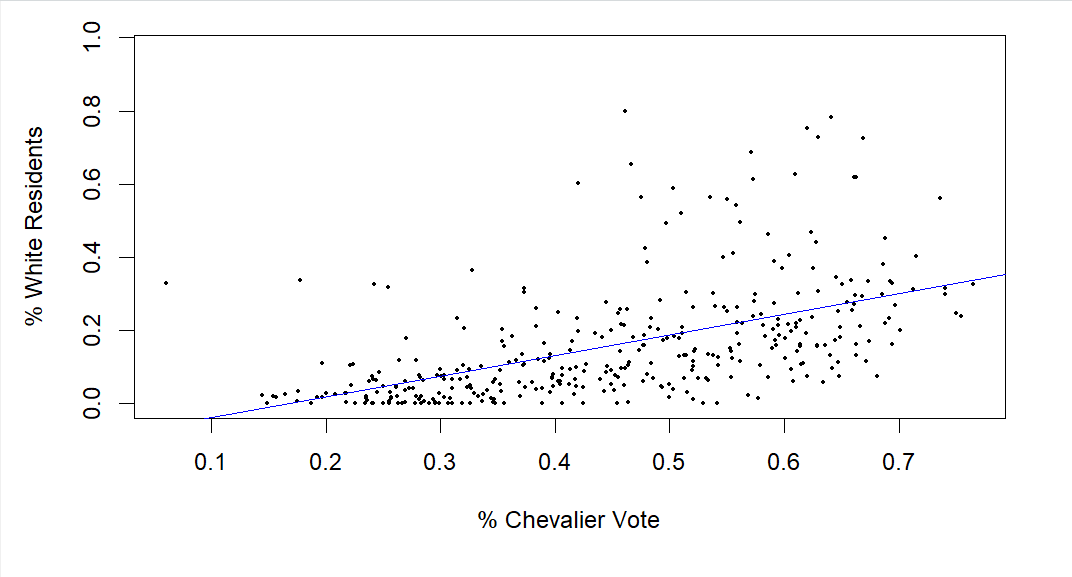
Contrary to her narrative, Chevalier’s election results show that if a neighborhood had more white residents, it was more likely to vote for her. According to the model, a 10 percent increase in a neighborhood’s white population was associated with a roughly five-point increase in Chevalier’s vote share.
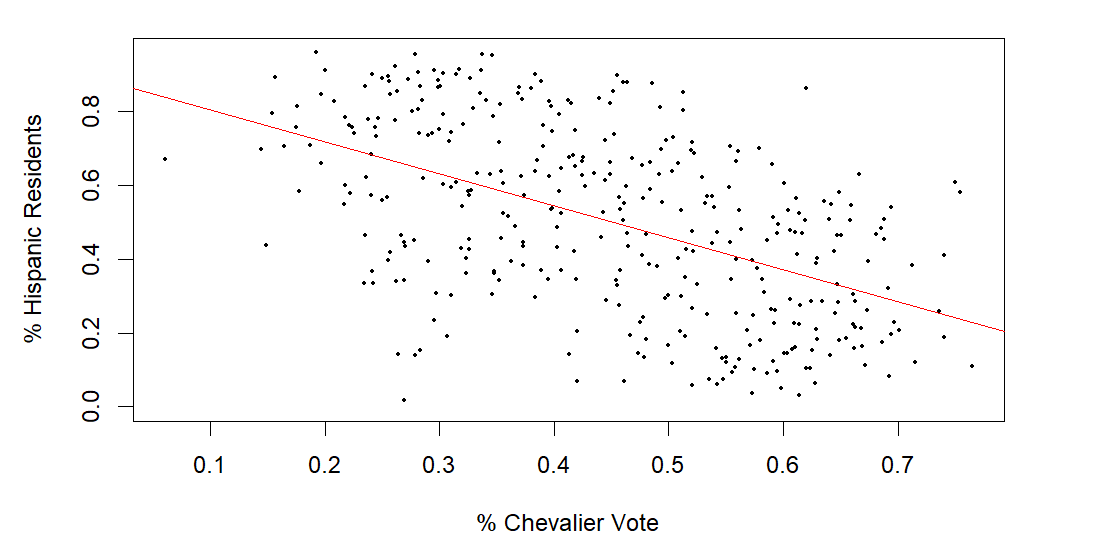
In contrast, if a given neighborhood had more black residents, there was no significant impact. And if a neighborhood had more Hispanic residents, that actually had a negative impact on Chevalier’s performance. An increase in the Hispanic population by 10 percent was associated with a roughly three-point decline in her vote share.
The only people of color whose population actually contributed to Chevalier’s increased performance in a given neighborhood were Asian, with an increase of 10 percent for the population being associated with around a full 8-point increase in Chevalier’s vote share.
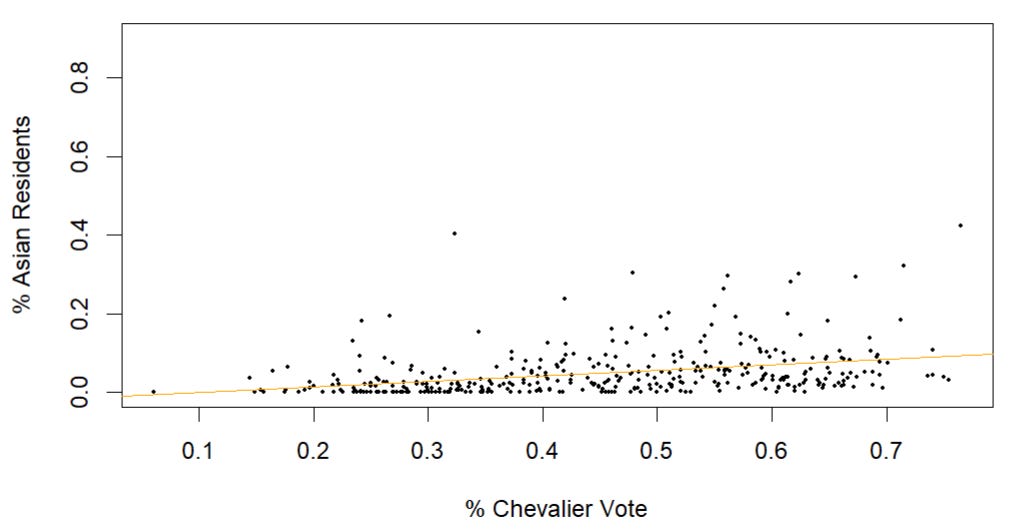
While significant, clear success with one minority group is certainly not a justification for Chevalier’s claim to be a representative of racial minorities broadly.
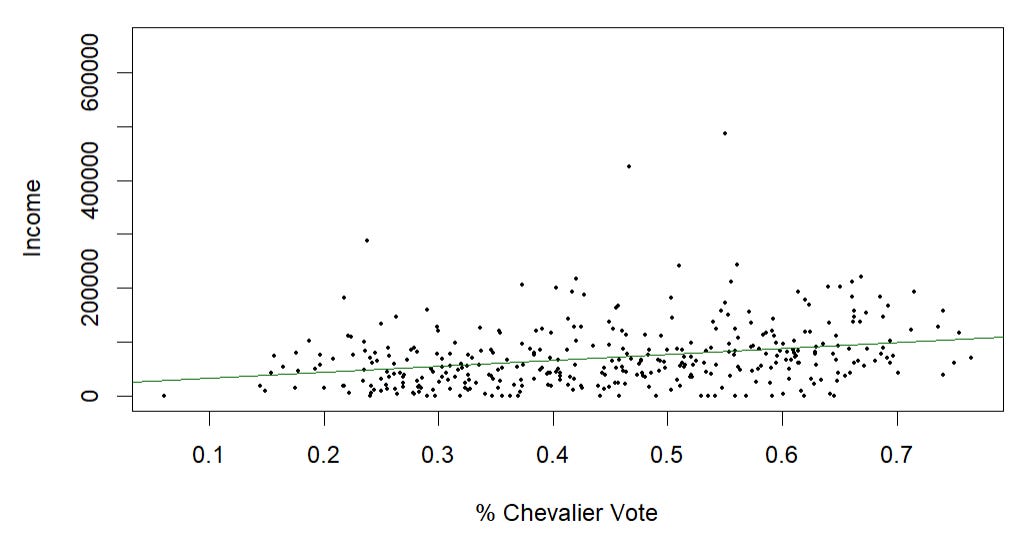
In terms of income, Chevalier’s results report a very slight positive association between income and her vote share, with a $10,000 increase in median neighborhood income associated with a 0.07 percent increase in her vote share. While very slight, this association is notable because it goes in the opposite direction of her narrative.
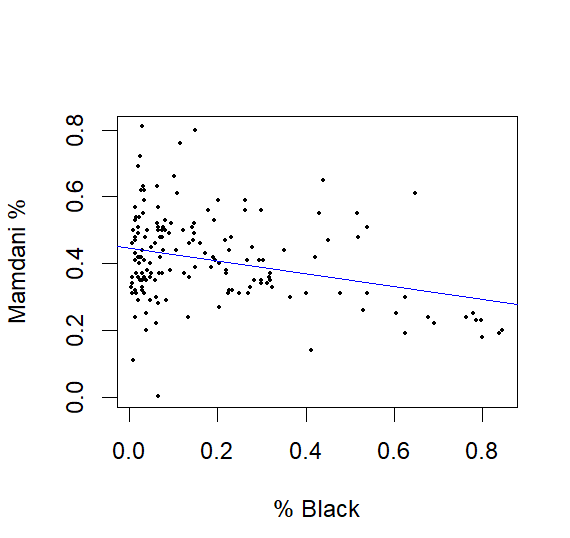
A similar dynamic is seen in Mayor Zohran Mamdani’s primary election results. While the percentage of white residents in a neighborhood had no statistically significant impact on Mamdani’s election share, an increased black population actually decreased his vote share.
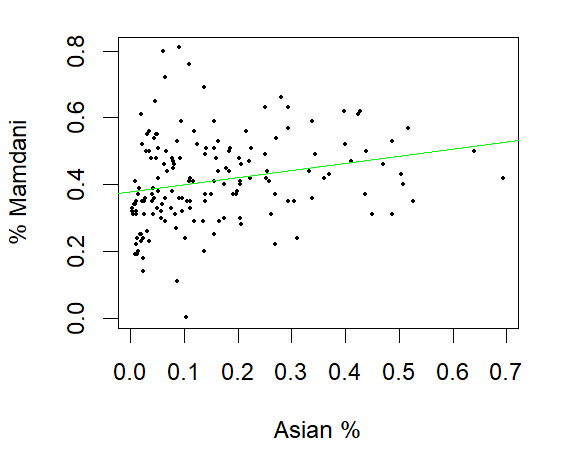
As for Chevalier’s results, the only racial minorities with a statistically significant positive impact on Mamdani’s vote share were Asian residents, though to a lesser extent. A 10 percent increase in the Asian population was associated with a roughly 2-point increase in Mamdani’s vote share.
As for Mamdani’s claim to be the representative of low-wage earners, his results similarly disprove his description. Wealthier New Yorkers voted in his favor, while those from poorer neighborhoods favored New York State’s former governor, and centrist Democrat, Andrew Cuomo. In an analysis published by RealClear Politics, Daniel Idfresne notes that New York neighborhoods where the median income is above $117,600 favored Mamdani by 13 points, whereas low-income areas favored Cuomo.
With all of these statistics in mind, why might the new wave of DSA candidates be so focused on describing their base as an imaginary coalition of the marginalized?
The answer, I believe, lies in the feelings of the leftists who vote not to improve their own lives, but in pursuit of their ideas of social and redistributive justice. It makes sense, then, for the new socialists to forgo campaigning for the working class that actually exists, but instead to symbolically display their devotion to the downtrodden in order to win points with upper-class whites. This dynamic would explain their consistent promotion of policies that have consistently failed to help the economically disadvantaged in the past, including government-run grocery stores, rent freezes, and higher local taxes. I suspect such policies’ primary purpose is not to help the downtrodden in the first place. As far as election-seeking DSA candidates are concerned, it does not matter if they actually work or even win favor in the communities they are ostensibly designed to help. It matters only that the core base of upper-class whites believes they are in the right in their course of action.
My analysis might sound depressing. After all, every hope that New York will move on from socialist policies depends on the people who voted for them noticing that such policies don’t actually improve their lives. If those who voted for socialism are not expecting to be personally uplifted by the politics they vote for, will they ever notice that such policies don’t work?
However, the numbers don’t just predict a harmful spiral of policies perpetuated by potentially nonresponsive upper-class saviors. They also chart a potential coalition that could serve as a moderating influence on the city. If non-socialist politicians seek to pull New York off of its downward socialist spiral, they should work to gain the support of the very people the DSA candidates claim to represent.
Ms. Weinfeld is a junior at Columbia College studying political science and creative writing. She is a senior editor for Sundial.
The opinions expressed in this article are solely those of the author and do not necessarily reflect the views of the Sundial editorial board as a whole or any other members of the staff.
Luxury Beliefs - we cannot have them, but the wealthy do. So they live one way and believe we should live another because they are educated, sophisticated and darn good people. https://www.robkhenderson.com/p/how-the-luxury-beliefs-of-an-educated?triedRedirect=true&utm_source=chatgpt.com
Very interesting analysis. The support of non-insignificant portions of New York's population for socialist candidates is quite remarkable. As is the fact that one-third of NYC's Jewish voters voted for the current mayor. I'm tempted to say, "you'll get what you voted for." But that would be self-defeating. The better resopnse would be, "we have to do a better job at educating these apparently clueless voters as to what socialism really is, and what it would bring them."