


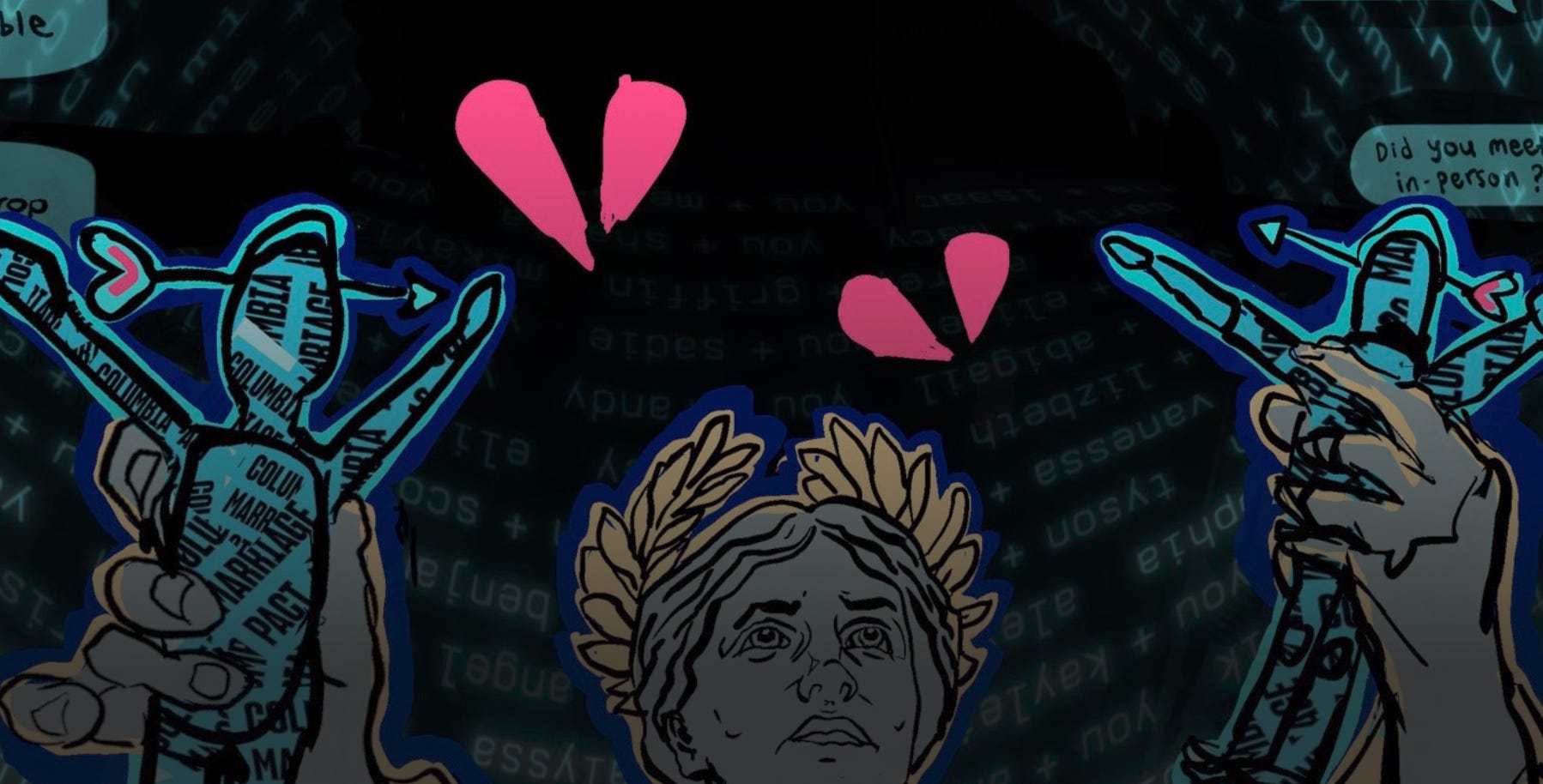
“Love is born into every human being; it calls back the halves of our original nature together; it tries to make one out of two and heal the wound of human nature.” - Aristophanes in Plato’s Symposium
Many of us at Columbia have read those exact words in our first semester Literature Humanities classes. Though Aristophanes’ portrayal of love—reuniting two halves to create a body with four arms, four legs, and one head with two faces—envisions a dubious image of humankind, it is nevertheless true that, for many college students, finding our partners in life remains an unstated priority. If the prevalence of dating apps and hook-up culture at Columbia are a signal of anything, it is that we are no stranger to the universal “wound of human nature,” even if we chase fleeting—and at times ineffective—methods of healing it.
Recently, however, a new strain of dating services targeting college students have popped up at universities across the United States. Each purports to match students based on their answers to a series of questions, using some hidden algorithm to compress compatibility into a percentage. Where are these coming from, and why? Should we trust these shady platforms with our data? And—more fundamentally—should we offload the very human journey of finding love to a very inhuman shortcut?
Date Drop, Marriage Pact, Yak Match
When I first came into Columbia, I was eager to find someone after 18 years of singlehood. I frequented Amity and 1020, joined a myriad of clubs, attended mixers and socials, and followed the oft-repeated advice to “put yourself out there.” While I ended up with plenty of friends, little came by way of love.
With encouragement from my newfound companions, I signed up for these novel matchmaking algorithms, going through the gamut of Marriage Pact, Yak Match, and Date Drop.
However, from the start, this matchmaking model of romance struck me as particularly strange, even as I readily created a digital profile of myself. Unlike modern matchmaking services, which boast high rates of success—and still require highly-experienced humans to vet potential matches and the personal commitment that goes along with financial investment—these platforms consistently marketed themselves as something frictionless and free.
For example, Marriage Pact’s website claims that finding love can be “easy”: “Answer our questionnaire, backed by the latest research on romantic compatibility. We’ll feed your likes, loves, and pickiest non-negotiables to our matching algorithm.” They also feed off of the disillusionment some people feel when it comes to other dating apps, such as Tinder or Hinge, where the pursuit of love can feel more commercialized, emotionally exhausting, and fraught with rejection. Date Drop’s website claims that “We swipe through more faces in an hour than our ancestors met in a lifetime, and somehow we’re lonelier than ever. It’s no wonder we’re all exhausted.” Truth be told, they’re not wrong—dating apps often do create a sense of dejection when it seems like all the swiping leads to nowhere. But are these new impersonal algorithms really the solution they market themselves to be?
When compared to the swipe-based logic of apps like Tinder or Hinge, or the slow burn of meeting people through online communities built around shared interests, this model delegates all romantic effort to a third party. Instead of being forced to navigate the ambiguity of attraction and social context, participants are offered a controlled experiment with a guaranteed match. In a campus environment where time feels scarce and social circles can feel closed off, that promise can seem attractive, and is, perhaps, why these algorithms are so popular.
Ava Blum BC ‘27, who co-organized the original Columbia launch of Marriage Pact, put it plainly: “I find there are very strong pockets of community on this campus, but as a campus culture collectively, it feels like we are isolated.” (Blum is also an illustrator for Sundial.) For Blum, that isolation is precisely what Marriage Pact was designed to address—not by replacing organic connection, but by giving students the excuse to pursue it. She told me that, “If you’re scared to talk to someone, you can just blame Marriage Pact,” as a neutral and convenient reason to start a conversation. “We both know why we’re here, and now we have something else to facilitate the initiative we take to reach out to each other.”
These campus matchmaking platforms all follow a similar model. After filling out a survey, often framed as a mix of personality questions, value assessments, and lifestyle preferences, your answers are then processed through an algorithm that claims to identify compatibility by pairing individuals whose answers maximize some measure of alignment. The platform later spits out a match, accompanied by an algorithmically-determined compatibility percentage or a mention of a shared interest. After that, you are given their contact information to reach out to, or placed into a group chat to communicate.
A BandAid over the Wound
My own matches were, on paper, perfectly reasonable. Similar interests, overlapping values—nothing obviously incompatible. But that was precisely the problem: There was no tension, no frission—nothing to react to. These shared qualities were so generic and shallow as to be meaningless. There was no story behind a meet-cute or a slow buildup of romantic tension over a semester’s worth of classes together; as a consequence of the sterile inception of the meeting, the pairing felt arbitrary and meaningless. The algorithm just provides a name, a profile, and the vague obligation to reach out. Without the organic buildup that usually precedes attraction, the effort to contact another person felt strangely hollow.
In my case, the conversation never really started. I never talked to my Marriage Pact match, partly due to my busy schedule, and partly because my match percentage was pretty abysmal (43.06% compatibility) and I felt there was no point in meeting someone I wasn’t “compatible” with. Similarly, Yak Match never resulted in a message because the anonymity of the platform removed any sense of personal investment. Even my first Date Drop match died quickly despite the far better 96% compatibility score: Though some games of Word Hunt were exchanged, they quickly tapered off. The second round of Date Drop fared no better. It became clear that neither of us felt particularly invested. There was no reason to be: We had not chosen each other out of our own will.
That is not to say that these algorithms never result in successful matches. Blum herself knows of couples who found something real through Marriage Pact and describes her own experience—though it did not progress beyond one date—as genuinely positive. Her match, knowing she was an actress, opened with a Shakespearean email: “so silly and dorky and fun,” she told me. She credits her experience less to the algorithm than to a mutual willingness to engage sincerely. A few friends, more the exception than the norm, have shared similarly positive outcomes. However, for the vast majority of my friends, I’ve seen a pattern of sparse contact or none at all between them and their pairings.
From my experiences with these platforms, I have found that, when a connection is handed to you fully formed, it removes the very process that gives it meaning. The awkward introductions, the gradual discovery of shared interests, even the uncertainty of whether the other person feels the same way—these are not obstacles to connection. They are the substance of it. The algorithm may be the impetus, but it does not supply the willingness to actually show up.
More broadly, I attribute a kind of passivity to these platforms. If the algorithm is responsible for finding your most compatible partner, then your role becomes evaluation rather than pursuit. You no longer actively engage with the social world around you but instead wait for it to deliver someone to you. And, without that commitment to the search, you lose any attachment to the results. Blum senses this too, lamenting that many students fill out the questionnaire for “shits and giggles” and that those who sign up while already in relationships quietly deflate the whole enterprise for everyone else.
Towards a Truer Romance
So then what actually works? What is the balm for our wound?
In my view, the answer is simple and perhaps boring: time, proximity, and repeated interaction. Compared to Tinder and Hinge’s endless swiping or Marriage Pact and Date Drop’s vacuous matches, these precursors to connection come best from daily interaction.
Real relationships tend to emerge from environments where people see each other consistently and without pressure. Classrooms, clubs, shared spaces—even casual routines like studying in the same library or attending the same events. These contexts allow for something that no algorithm can replicate, which is the gradual accumulation of familiarity.
Familiarity matters because it lowers the stakes. You are not meeting someone with the explicit goal of dating them, nor with your so-called “compatibility score” looming in the background. You are simply existing in the same space, over and over again, until conversation becomes natural. Attraction, if it develops, does so as a byproduct rather than an end goal.
This perspective also requires an uncomfortable but necessary component: becoming comfortable with being alone. The urgency to find someone often leads people to grasp at the most efficient available option, even if it is unsatisfying. But treating relationships as something that must be solved quickly can distort how we approach them in the first place. Being alone, in this sense, is what allows interactions to remain genuine rather than instrumental.
None of this is to say that matchmaking algorithms are inherently malignant. They reflect a real desire to break through the toxic campus culture that rejects romantic initiative and, for some, may even work—but they misunderstand the nature of what they are trying to produce. True compatibility expresses itself in a way that cannot be captured by a mere percentage. It emerges from the small moments, from the inside jokes developed over time, and the gradual baring of one’s soul to another.
Likewise, the wound of human nature is not something that can be healed by machine learning or mathematical assumptions. It requires something slower, less certain, and ultimately more human.
Mr. Chang is a freshman at Columbia College studying political science and computer science. He is a staff editor for Sundial.
The opinions expressed in this article are solely those of the author and do not necessarily reflect the views of the Sundial editorial board as a whole or any other members of the staff.
