


At Columbia, the concept of living in the moment is an archaic legend, like affordable tuition or the drunken anecdotal stories my uncle had told me about strippers in Butler during finals season in the ‘80s: nice to have, but also distinctly implausible. For most, it’s more common to have your attention span dragged in every which direction, constantly pinged by Slack notifications from your third unpaid internship and seventh evil situationship, stopping for a breath only to be submerged by a whirlpool of IG Reels parading as life advice from parentally-funded-peers-from-the-Midwest-turned-parasocialites.
Fun goes to die online: If we spend all our time worrying about our futures or our public image, we are left stranded in the void, a place even worse than hell or Ithaca. To be sure, a diagnosis of incurable try-hard syndrome is how we arrived at this college in the first place. Still, there is also a mythical quality of leaving this anxiety by the wayside that is appealing to those pursuing linear success. This summer, a certain intrepid Sundial writer decided to shut her phone down and partake in events centered around the Luddite community in New York that aspire to usher in connection rather than progression to Wall Street, Palantir, and death.
“Luddite” is a term that initially referred to the 19th-century labor movement of English artisans destroying machinery during the Industrial Revolution to deter their employers from replacing them with cheap labor. Today, its definition has expanded to almost anyone searching for a lifestyle outside of the Big Tech ecosystem that has monopolized our lives. In a time when our attention spans have become physically shortened, and policymakers haven’t been able to effect real change, young people are forming collectives to rescue themselves through what I would best describe as phoneless “side questing.” The real antidote to Columbia hustle culture lies in recovering forms of attention that make room for willful meandering.
Over the past three months, I’ve attended seminars and outdoor events organized by the Strother School for Radical Attention (SoRA), a nonprofit that turns public space into an outdoor philosophy seminar. They hold additional events during the Summer of Ludd, a week that aims to unite people at in-person events to get away from Big Tech, and other weird in-person events announced through the online NYC Off Tech newsletter.
I initially attended an Attention Lab seminar at SoRA not knowing what to expect. I was reassured by the modern and inviting atmosphere of the space in Dumbo, a studio where refreshments and snacks were served, and someone immediately engaged me in conversation about our favorite key lime pie spot in Brooklyn.
An assortment of around thirty people filled the room, a diverse grouping ranging from a pair of married attorneys to solemn children dragged to attend by their progressive, clog-wearing mothers. We completed strange exercises that included thinking about random objects in the room as problems to be solved for three minutes and then reconceived as poems. Later, we would draw abstract shapes, exchange them with partners, and then go out into the night to find our partners’ ill-conceived art in Dumbo. I ended up in a park squinting at the trees to make them look like squibbles before we reconvened to discuss our findings.
When I was asked about my past week, I felt weirdly enthusiastic as I detailed my experience at the event. “I stared at a pillow and made it into a poem with my mind,” I said, insanely. “It was great.” My employed Columbia friends told me that they were happy if I was happy in the tone that one addresses a small child that has drawn a subpar stick figure, before our conversation returned to their real-life complaints.
“They’re bringing a baseline level of practiced intentionality to regular life,” regular SoRA event participant and recent City College of New York graduate Koll Moss told me. “I think [the Luddite resurgence] makes perfect sense because there’s clearly a collective assault by Big Tech and it is only natural that we would begin to have some sort of collective resistance.”
At Columbia, constant stimulation feels like a prerequisite for belonging. We’re glued to screens for social connection, but our attention is monopolized by momentum itself.
Especially at college, there is pressure to always be working toward the next accomplishment. The pressure isn’t to succeed, but to package yourself into a marketable story. Tell me about yourself, the networker says in the bloodsport known as the coffee chat. Entertain me.
This summer, I didn’t work a prestigious internship. I value ambition and accomplishment. But I also found myself wondering what happens when every moment becomes something to optimize. Fresh off a breakup, I arrived at the Summer of Ludd looking for distraction, but I found myself intrigued by the people I met.
Although far from the most “brain-rotted” of my peers who speak fluent Gen Alpha at the expense of sanity, I still mourn the time wasted online when I could have been connecting with others. But at a time when we’re all more distracted than ever, I believe we should stop diagnosing distraction as an individual failure and begin recognizing attention as a shared practice cultivated by communities.
According to psychologist Gloria Mark, who studies attention in digital settings, the average amount of time people remain focused on a screen before switching tasks has shrunk dramatically over the past two decades. Summer of Ludd seemed interested in creating natural conditions where paying attention to other people became easier than being absorbed by my phone.
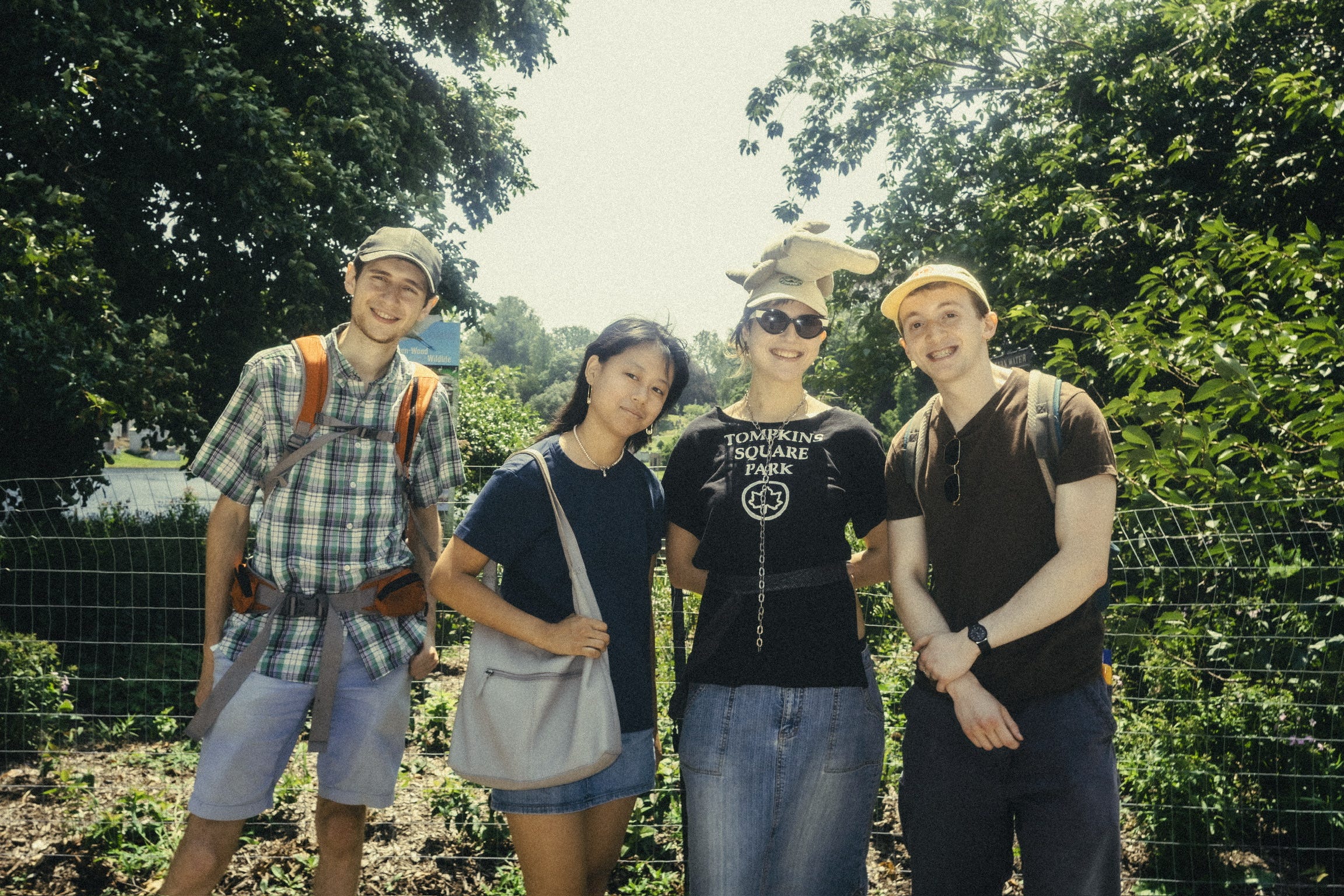
At a Summer of Ludd event, I stepped off the F train at Roosevelt Island and spotted a man in a gnome hat drawing with chalk, surrounded by New Yorkers young and old. I knew instinctively I had found the right place.
Rather than another productivity hack, Summer of Ludd offered something different. We read Sara Ahmed aloud over the sound of arriving trains and wandered Roosevelt Island with the intent of leaving a note with the instructions to care for something. The point wasn’t productivity, it was learning to pay attention together.
Walking along the water, I wondered why Roosevelt Island had escaped my notice as a lifelong New Yorker. Then I spotted a cat and promptly forgot the assignment as another participant, and I wandered over to investigate a cat sanctuary.
The event’s invitation to pay attention landed differently for everyone. As we wandered, conversations drifted toward exits, life, and love. I learned that hydrangeas change color depending on the pH of the soil, as well as the personal transitions everyone else in our group was navigating. Perhaps every exit is also an entrance into someone else’s story.
If shrinking attention is one of the defining problems of our generation, we can’t simply expect people to get off their phones. We need more spaces that invite people to disengage from algorithmically curated lives, where paying attention to one another is the activity itself. After all, attention is a social practice. I was surrounded by others navigating life transitions that day. Leaving, I didn’t feel less heartbroken, but I was aware that the discomfort would move and pass through me, dissipating into waves like the seafoam lapping the edge of Roosevelt Island.
This became a summer of side quests. Through listening, you notice idiosyncratic tendencies in yourself and others, and learn to appreciate your friends. Paying attention became infectious. One conversation led to a writing group; a chance encounter became a murder mystery party; a walk became reporting on vampire bats and friendship. The summer accumulated richness through curiosity.
It is a sentimental education that the classroom supplements but cannot replace. Speaking to Columbia students and alums, I was struck by how many others described similar experiences. “Stress culture is super prevalent on campus, so when I want to disconnect, I feel the best thing to do is physically remove myself from the space,” Jay Jacobson, GS ’28, told me. “The guilt of not being ever-productive is so omnipresent. We are all so “busy” we have no time to do things [like seeing friends].”
Blake Appleby, CC ’25, said he noticed benefits from living with a flip phone, slowing down to be more grounded in every aspect of his life, including his career—to the point where brain-rotting entailed listening to an album all the way through. “It felt monastic,” he enthused, adding he relished offline hobbies like rock-climbing.
I had long been tired of being told to be ‘true to myself,’ under the impression that it meant becoming a nun who goes to bed at a reasonable hour. Instead, I now understand authenticity as something you won’t find on any Pinterest board. To be cringe is to be free from the algorithm, constant self-curation, and wondering if every experience will look good on your CV.
Entering the college year, I know that pre-professionalism and constant action will be inevitable forces at work. Phones are also necessary for me and most others. “I don’t feel like it’s possible to even become a Luddite in the West, like how many of those off-the-grid people also have full-time social media accounts,” Lucian Mignone, CC ’26, said, writing to me from a corporate basement bathroom. Maybe so.
But I think it is possible—and worthwhile—to resist the blind buffalo stampede toward whatever comes next, to relish the smaller details rather than constantly ask if we’re there yet. The answer to heartbreak wasn’t another romance. It was paying attention.
Ms. Rohslau is a senior in the dual BA program with Trinity College Dublin and the School of General Studies. She is a staff editor for Sundial.
The opinions expressed in this article are solely those of the author and do not necessarily reflect the views of the Sundial editorial board as a whole or any other members of the staff.
