


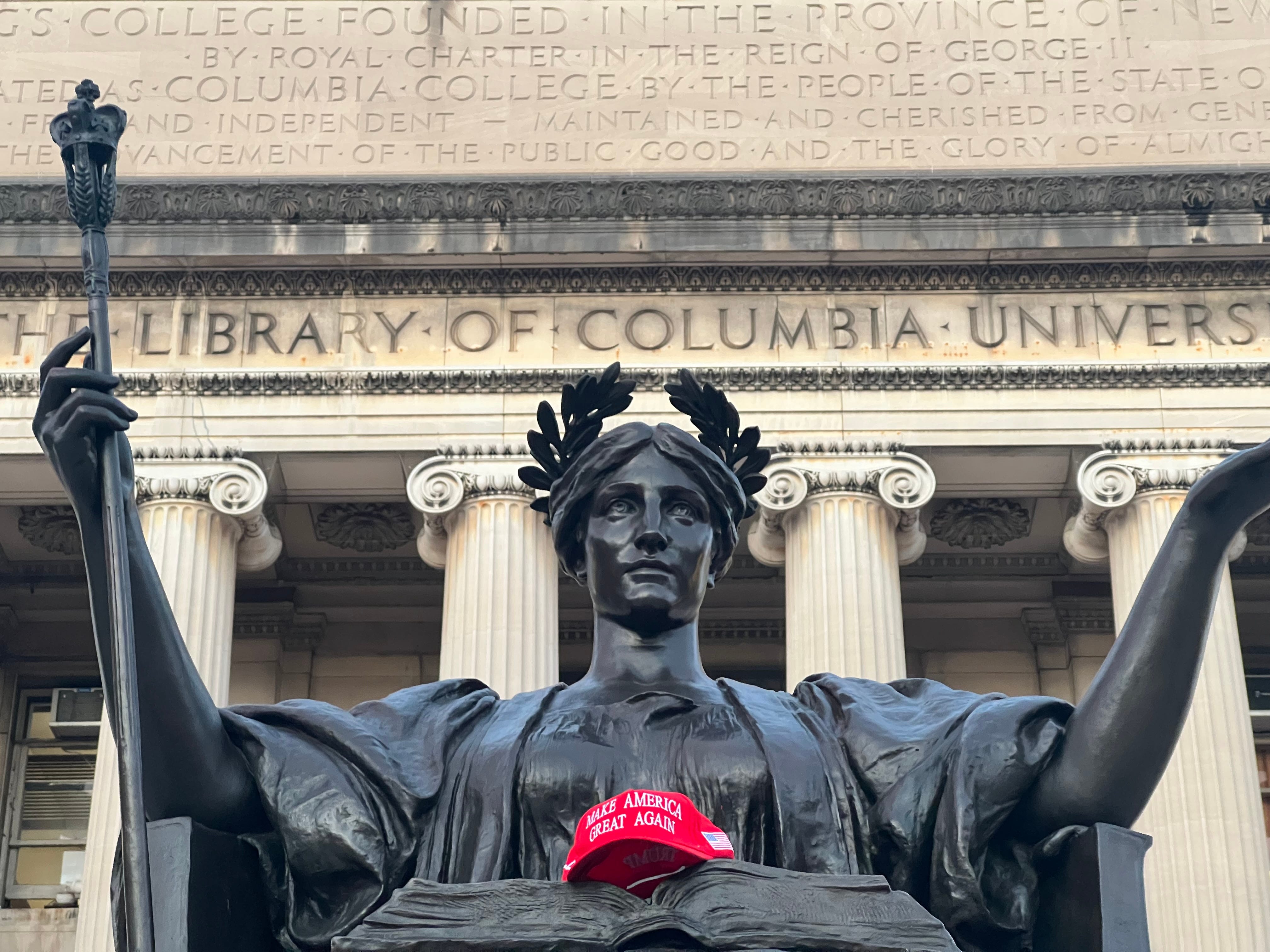
When you talk to conservative women at Columbia, they’re usually not your stereotypical “trad” woman. They aren’t performing the traditional script of normative femininity, faith, and nationalism.
Some of these right-wing girls may be religious, and some may openly identify as conservative. But they appear on the surface to be just like any other Columbian: attending an elite university and—contrary to the trad gospel—nearly all intend to obtain careers post-graduation. Past and current members of conservative clubs at Columbia have gone on to work in finance, law, and medicine—high-paying, ambitious, culturally feminist paths. Many are deeply embedded in the social life of college and the big city: frat parties, sorority events, nightclubs, networking, flirting, tight dresses, exposed collarbones, even the occasional strategic cleavage. Perfectly ordinary behavior for young women in the city—though likely enough to send a Christian conservative grandmother into a tiffy.
So, what actually separates a conservative woman on campus from a liberal feminist?
At Columbia, conservatism clearly isn’t about wearing long skirts, cross necklaces, or domesticity. It shows up in women who are ambitious, socially active, and modern, yet who are increasingly skeptical of progressive gender politics and institutional moral policing.
On campus, many of the most outspoken conservatives are women. The co-presidents of the College Republicans are women, and as vice president myself, I am acutely aware of the irony in my general defense of traditional norms. Conservative women are supposed to be something specific: soft, maternal, private. Instead, at Columbia, they are public, ambitious, and competitive.
The same contradiction appears nationally. Prominent GOP women are constantly criticized, often by their own side, for failing to live up to the ideal they are presumed to represent. Erika Kirk has been attacked for stepping into the role of CEO at Turning Point USA after her husband’s assassination—why wasn’t she home with her children? The comment sections of Candace Owens’ videos scold her for being outspoken and ambitious, while she has often criticized feminism. Similarly, Karoline Leavitt’s combative style hardly matches the imagined soft-spoken conservative woman.
The backlash is revealing. Conservative grievances about these women are almost never about policy (with the notable exception of Owens), but about their violation of the bonne femme archetype.
What does it mean, then, to be a “conservative woman” in 2026? Has she become just another careerist disillusioned with the left but not actually living conservatively? Just another “MAGA babe”? Or a corporate girly who votes Republican but lives indistinguishably from her cosmopolitan liberal peers?
To begin to understand what conservatism truly even entails in Morningside Heights, I interviewed four self-proclaimed right-wing women.
Stephanie, BC ‘27
Stephanie, a junior double-majoring in economics and English at Barnard, described being conservative in pretty conventional terms, such as “leaning towards traditional values—marriage, family, etc. Economically, it means things like lower taxes, free markets.”
When asked to name her top issues, her answers clustered tightly around education, gender ideology, foreign policy, and the limits of progressive moral enforcement rather than bread-and-butter economic populism. She supports “freeing Iran from [the] regime, supporting Israel, lowering taxes, and making college campuses more open-minded to [a] conservative perspective.”
Stephanie further insisted: “I 100 percent consider myself a feminist, in the sense that women and men are equally capable.” She elaborated that “feminism is built on agency, and women should be empowered to follow whichever path they choose.”
Leah, BC ‘27
Leah, a Barnard junior studying computer science, described conservatism as ‘“more logical, more rational” than the more “emotion-based” left.
She also told me that her politics are policy-based rather than identity-based, pointing to transnational continuity rather than American culture war tribalism. Her views are influenced by her family overseas, whose political system is different from the one here.
“They just think [being conservative] is living on the farm with the chicken eggs and whatever and baking the whole day,” Leah reflected, profoundly aware of the way many perceive conservative women. “I want to work…in finance specifically, but I don’t see myself staying in that forever,” she added, “It can be very easy to get sucked into that…You’re 40 and you haven’t had kids yet or you haven’t been able to prioritize your relationships.”
Anna, BC ‘28
Anna, a Barnard sophomore studying economics, resisted being flattened into a partisan label: “I make a strong distinction between conservative, right-wing, and Republican.” For her, American conservatism is not aesthetic or lifestyle-based, but a constitutional commitment. She argued that “true American conservatism is the protection of Enlightenment ideals of natural rights and separation of powers, as dictated by the Constitution.” Continuing, she commented that “much of our national political conflict today is a result of the federal government becoming too powerful.”
She is also unapologetic about her career ambitions. “Having a fulfilling career is very important to me,” she said, but added that “I know my future family will undoubtedly be the most important aspect of my life.”
When asked what issue she feels strongly about, Anna talked about how the “‘intersectionality’ of the LGBTQ movement and feminism in third-wave feminism has eroded women’s rights. The reason why women deserve to have their natural rights protected isn’t because women are the same as men. [It’s] Biology 101.”
Anna, still, identifies as a traditional feminist. She insisted that “third-wave feminism has deviated greatly from ‘true feminism.’”
Jennifer, GSAS ‘26
Jennifer, a student at Columbia’s Graduate School of Arts and Sciences, said that her “culture has helped shape [her] into someone that values pragmatic policies built on strong virtues.”
“I believe in equality between men and women,” she added. “I wouldn’t consider myself a modern feminist, because I think the movement has shifted from uplifting women to putting men down.”
These interviews point to something deeper than hypocrisy or confusion at the bottom of these women’s decisions to be conservative. They are not rejecting modern life, nor are they trying to fully reenact a pre-modern one. Instead, they are attempting to draw boundaries within modernity, accepting its freedoms while resisting its excesses. The question is not whether conservative women are hypocritical, but why this form of selective conservatism keeps appearing among elite women in particular.
What’s interesting here is that these women are not describing conservatism as a subculture or aesthetic, but as a way of reasoning about institutions, incentives, and limits—a framework often detached from American partisanship.
Stephanie’s primary political issues—“freeing Iran from [the] regime, supporting Israel, lowering taxes”—for example, highlight a broader problem in American politics: “conservative” has become a catch-all label for a cluster of contemporary right-wing positions that don’t necessarily stem from traditional social conservatism. Ask most self-identifying conservatives in 2026 what they care about, and you’ll hear a similar pairing of a geopolitical priority and an economic one. Support for certain foreign policy stances or tax cuts is now treated as inherently conservative, even when those positions reflect partisan alignment or strategic preference more than an inherited philosophy of traditionalism.
Indeed, one of the fundamental issues with American conservatism is that the big tent only coheres if political expedience outranks genuine value alignment. What does it actually mean for a socially liberal, fiscally conservative person to share a movement with a Christian socialist who is socially conservative and fiscally liberal? They might both be labeled “right-wing,” but they are not aligned except insofar as they need each other to win elections and don’t think President Trump is an existential threat to our country. Within that incoherent tent, the conservative woman becomes an especially unstable category.
There is also an implicit moral hierarchy embedded in contemporary conservative discourse: rural trad over suburban mom over urban conservative. Production-based femininity is often treated as more “moral” or “righteous” than domestic life alone or the life of a professional conservative woman. Yet reducing this hierarchy to the claim that “rural trad is superior” is too easy and avoids the deeper tensions at work.
Many women want the benefits of being modern and feminist—career, status mobility, sexual self-determination—while also possessing the political or psychological cachet of being “conservative.” Urban conservative women live lives materially indistinguishable from their liberal peers. They attend the same schools, pursue the same careers, delay family in the same ways, and navigate the same elite institutions. They structure their lives around ambition, education, and career. In other words, at an institution like Columbia, they ultimately succumb to the dogma of liberalism.
This produces an internal contradiction embedded in the phrase “conservative woman.” The image we have of a truly conservative woman would not be a politically adroit, world-beating girlboss. She would be a mother of four in a quiet farm town in the Midwest, embedded in her church. She would never be a public figure. She would not be at Columbia, running a political organization, debating Title IX policy, and networking in FiDi. And I would not be interviewing her.
But what these interviews reveal is that feminist conservatism is a structural contradiction, produced by historical changes that no individual woman can opt out of. The difficulty with modern “trad” or conservative women is rather Tocquevillian: Once subjects of a monarch become citizens of a republic, you cannot put the genie back in the bottle. You can almost never convince people to surrender power they have been given and have enjoyed wielding.
We are experiencing a historical transformation—women have already experienced post-suffrage politics, post-sexual revolution norms, and post-educational equality. The modern conservative movement can gesture toward tradition, but cannot reconstruct the social conditions that once made tradition organic.
Nowhere is this transformation more visible than on abortion, arguably America’s most contentious issue. Stephanie said simply, “I lean more towards pro-choice.” Jennifer echoed this position while grounding it in social consequences: “I don’t think making people that do not want to be parents, parents, is good for the child’s upbringing or society overall.” Anna, meanwhile, reframed abortion not as a moral crusade but as a constitutional question: “Our bodies are our most sacred form of private property. I don’t think abortion should be a major political debate topic.”
Leah was the only pro-lifer among the women I spoke to, although even here the position is bounded rather than absolutist: abortion, she said, “should be avoided unless the mother’s life is at risk.”
While we may not expect self-identified conservatives to be pro-choice, these opinions are not incoherent with the “traditionally conservative” values we hold conservatives to. At places like Columbia, where progressive sentiment dominates, rejecting the reigning gender orthodoxy becomes a form of boundary-setting rather than a return to 1950.
In elite institutions where there is no church culture, no localized social pressure, conservatism operates as a voluntary alignment and strategic signal, not an inherited role or place-bound obligation. These conservative women simply aren’t church-going, sourdough-making tradwives from the South.
It’s much easier for us to conceive of Columbia’s conservative women as either a “trad” woman or a secret feminist traitor. She is a third type—someone who values elite autonomy while enforcing conservative boundaries. What she ultimately reveals is that conservatism in elite America today has become less a way of life than a strategy for navigating modernity.
Ms. Ma is a sophomore at Barnard College studying English and Philosophy. She is a staff writer for Sundial.
The opinions expressed in this article are solely those of the author and do not necessarily reflect the views of the Sundial editorial board as a whole or any other members of the staff.
Seems like the prerequisite for the conservative label is to be a barking mad Zionist.
That isn’t really conservative. It’s neoconservative.
Great read and very insightful! What would conservative women at Columbia think about the Forward Party? They're trying to build a home for those who feel like they are in an "unstable category."
https://columbiaforward.vercel.app/