


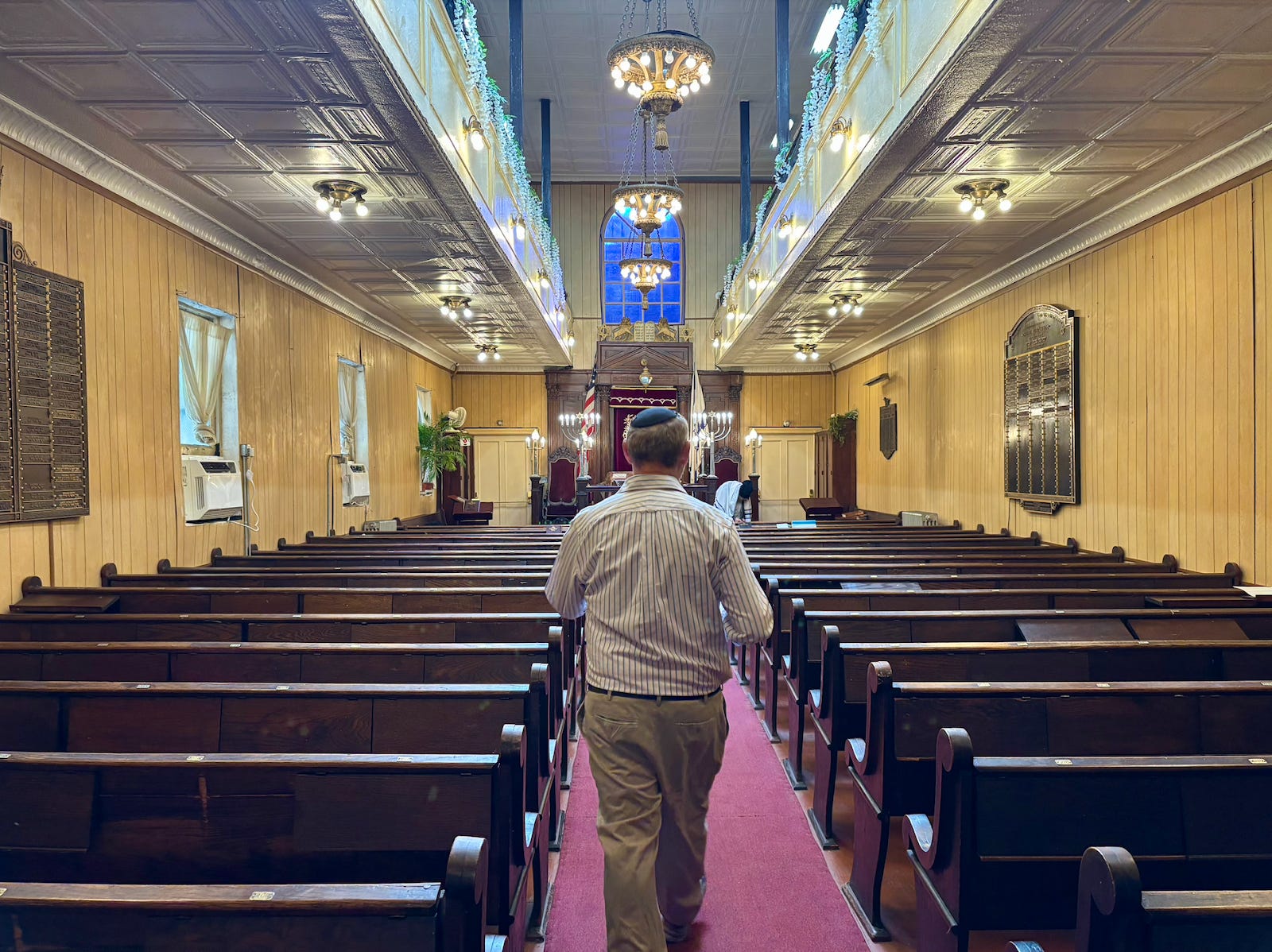
Behind the chaotic intersection of 125th Street and Broadway lies a relic of Harlem’s past. Tucked away on a slender, unassuming side street, squeezed between shuttered storefronts and colorful murals, the 114-year-old Old Broadway Synagogue draws in a small but dedicated group of worshippers.
Needless to say, the Synagogue’s surroundings have dramatically changed since it first opened. The Grant and Manhattanville Houses—public housing complexes with a history of inter-gang violence—tower over it in both directions. Around the corner, the crowded, traffic-jammed strip contrasts with the deserted side street. In the distance, Columbia’s sleek new Manhattanville Campus—home to the Business School—hovers over the area.
Harlem used to look radically different. In 1907, the neighborhood was home to the third-largest Jewish community in the world, behind only the Lower East Side and Warsaw, Poland. The opening of New York’s subway system in 1904 enabled Jewish, Italian, and Irish immigrants to flee the harsh, cramped tenements downtown in favor of more spacious living conditions uptown.
Harlem became a migrant destination, subdivided by different populations. East Harlem was the first place to be called “Little Italy” in Manhattan. The Harlem Renaissance, introduced by black newcomers from the South and the West Indies, largely defined the area north of 125th Street. Meanwhile, wealthier German Jews coexisted with German non-Jews in luxurious South Harlem, while poorer Eastern European Jews tended to live in cheaper Italian East Harlem.
It was around this time in 1911 that a group of Eastern European immigrants founded the Old Broadway Synagogue as a congregation. Lacking the money for a permanent physical space, they worshiped in storefronts and even speakeasies until they mustered enough funds to purchase the Synagogue’s eponymous site in 1923.
In the 1920s, Harlem was home to roughly 200 synagogues. Now, Old Broadway Synagogue is the only original one left.
“I think our history is a story of persistence and overcoming so many of the obstacles of neighborhood change,” congregation president Paul Radensky told me. The two of us were seated in the front of the sanctuary that serves as the Synagogue’s only room. Its cozy, narrow space felt suspended in time: yellow-stained-glass windows from the 1920s, wood-paneled walls from the 1970s, and tin chandeliers older than the Synagogue itself.
“These chandeliers have actually technically been lent to us for over a hundred years,” Paul remarked. “I have a letter that says that we have to give them back if this place ever closes. But I won’t let it close.”
Paul, from the Upper West Side, has been attending the Old Broadway Synagogue since the 1990s. Alongside scattered congregants who range from students and teachers at Columbia to long-term residents of Harlem, he makes the daily trek to morning services. In order for it to take place, Jewish law requires there to be a minimum of ten adult Jewish men. It’s an easy feat for most congregations. But that morning, Paul had managed to scrape together exactly ten.
The hundreds of empty seats suggested that turnout hadn’t always been a problem. In fact, Paul informed me of a blueprint from its early years that made plans for the Synagogue to expand a couple of floors. The tens of thousands of Jewish immigrants and their native-born descendants had sustained Harlem’s abundance of synagogues, and Old Broadway was no exception.
What ultimately unraveled Jewish Harlem, along with the neighborhood’s Irish, Italian, and German communities, were the same desires for even more space and comfort that had led their forefathers to Harlem in the first place.
The process of suburbanization and the increasing popularity of the automobile in the 1920s suddenly made it easier to live and commute from further away. The Immigration Act of 1924 heavily restricted the number of new immigrants, suspending the communities’ growth. Meanwhile, the growing influx of black economic migrants to Harlem sparked racial tensions with white immigrant communities.
The result was a mass exodus of white Harlemites to The Bronx, Brooklyn, Long Island, and New Jersey. While there were about 178,000 Jews in Harlem in 1920, that number dropped to 123,000 in 1925, just two years after Old Broadway was built. By 1930, that number had plummeted to just 5,000.
While this predictably spelled the end for most of the neighborhood’s synagogues, Old Broadway persevered. Its West Harlem location still attracted congregants from Morningside Heights and the Upper West Side, both of which still had a strong Jewish presence in the 1930s and 40s. Paul credited its survival to Jacob Kret, a Holocaust survivor who became Old Broadway’s head rabbi in 1950, leading the congregation all the way to 1997.
“Rabbi Kret was so great at guilt tripping you,” he chuckled. “I remember right after he met me for the first time in the 90s, he called me asking if I could make it to services the next morning. When I said no, the line went dead silent, as if I had just killed someone.”
It makes for a funny story, but to Paul, it exemplifies the persistence and religious devotion that have sustained the Synagogue against all odds. Many of the congregants I met had been attending for decades— some, their entire lives.
It had been hours since services ended when Paul gestured to the bottom floor. It was completely deserted except for one remaining man who was silently praying. He was a 97-year-old congregant named David, who had been regularly attending the Old Broadway Synagogue since he was a teenager in the 1940s.
“April 17, 1940,” David recounted to me, “that was the day my ship docked at the 54th Street pier en route from England.” David was born and raised in Nuremberg, Germany, and was five years old when he (literally) saw Adolf Hitler take power at a Nuremberg military parade. “He was standing there, about half a block or so away, but I was smart enough to not get too close.” Soon after, David and his family fled to England, and from England to Harlem, narrowly escaping the morbid fate of many of his German-Jewish friends and neighbors.
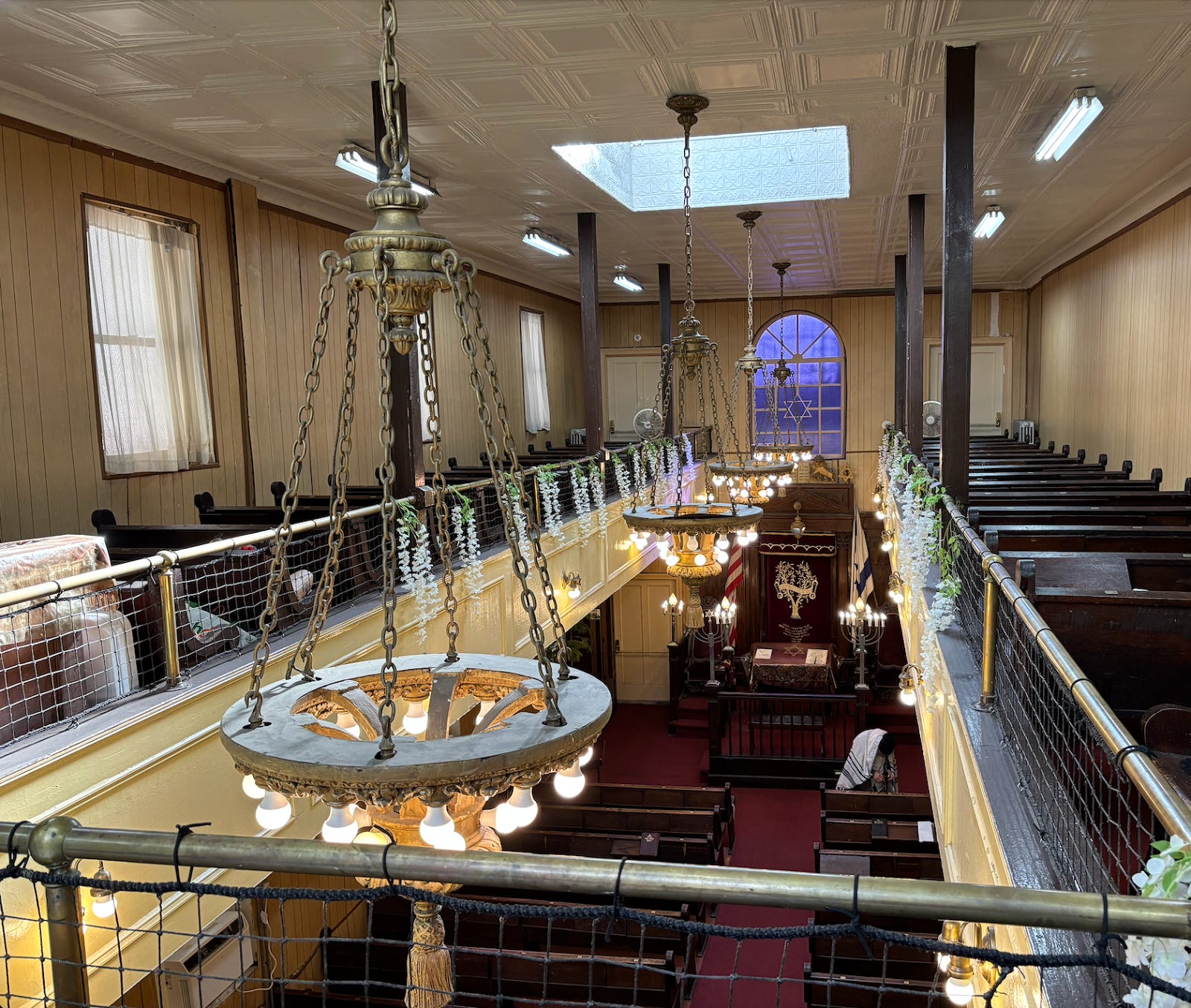
David is among the few remaining Holocaust survivors who, at one point, comprised a large portion of the Synagogue’s membership. While Harlem faced rising urban blight, crime, and poverty throughout the 1960s, 70s, and 80s, Rabbi Kret’s recruitment of many fellow survivors to the West Harlem area had supported the Synagogue at a time when functioning institutions, Jewish or otherwise, were hard to come by in Upper Manhattan.
Kret, who also tutored JTS students on the Talmud and supervised Barnard’s kosher dining hall, had a knack for inviting University students to come pray. To this day, Paul knows a few students and faculty who regularly attend Old Broadway. The majority of these students, however, stopped attending when Columbia’s Kraft Center for Jewish Life opened in 2000, providing a thriving center for Jews right across campus.
“Things haven’t really been the same since,” remarked Herschel, a lifetime congregant. “More Jews have now been moving back into the neighborhood, but most of them don’t go to weekly services at all, and those who do go to less religious places than ours.”
He joked about the large sums of money some of these families would offer to have their children’s bar and bat mitzvahs at the Synagogue, only to be turned off after learning they don’t allow photography or electronics on Saturdays.
However, as Harlem has undergone gentrification, and wealthier white residents have moved in over the last few decades, the neighborhood’s Jewish population has now resurged, from a mere 300 Jews in 1990 to 24,000 today. It’s a staggering increase, but only 35 percent of them belong to a synagogue, and just eight percent of them are Orthodox, which is Old Broadway’s denomination. Catering to this growing community, a second, non-denominational synagogue opened last year in Central Harlem, further drawing possible members away from Old Broadway.
The numbers paint some uncertainty over the Synagogue’s future, but uncertainty isn’t anything new to Paul and his congregation. From Ellis Island immigrants and Holocaust survivors to Columbia students, Old Broadway has always found a new generation to carry the torch while staying true to its traditions and principles.
It’s not easy staying in the same place or scraping together ten worshippers for morning services, but for Paul, it’s worth it. “We have an identity, and a tradition, and we share the same space and streets in West Harlem as our parents and, for some of us, our grandparents. It doesn’t get more meaningful than that.”
Mr. Baum is a junior in the joint degree program between the Jewish Theological Seminary and the School of General Studies. He is a senior editor for Sundial.
The opinions expressed in this article are solely those of the author and do not necessarily reflect the views of the Sundial editorial board as a whole or any other members of the staff.
Great article, Nick. Thank you. I didn’t think there were any synagogues left in Harlem. You’ve opened my eyes.