


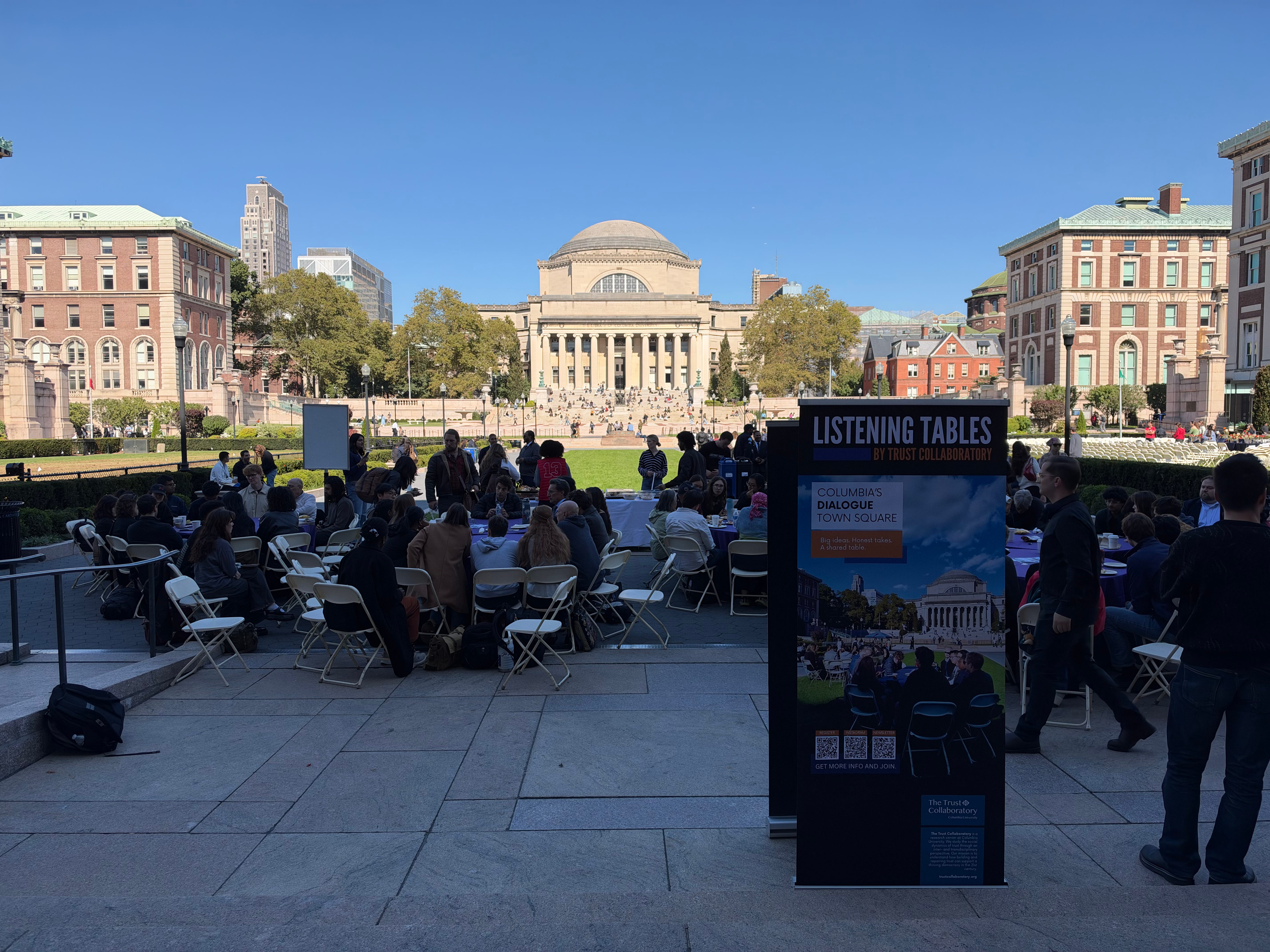
At one of the purple-covered tables near Columbia’s South Lawn on Wednesday, October 7, a participant asked what, exactly, everyone was supposed to talk about. The answer was fairly simple. There was no set topic, no assigned position to defend, and no particular resolution participants were expected to reach. They could discuss whatever they wanted.
That is the idea behind Columbia’s Listening Tables, a faculty-led initiative that brings students, faculty, and other members of the University community together to talk across disagreement. Launched in late summer 2024, Listening Tables is a project of the Trust Collaboratory, a Columbia-based research center that studies how trust is built and maintained. Gil Eyal, a sociology professor who directs the center, and Cristian Capotescu, the Trust Collaboratory’s associate director, launched the program. They now work alongside postdoctoral scholar Asya Tsaturyan and student fellows to create opportunities for members of the campus community to engage in conversations across differences.
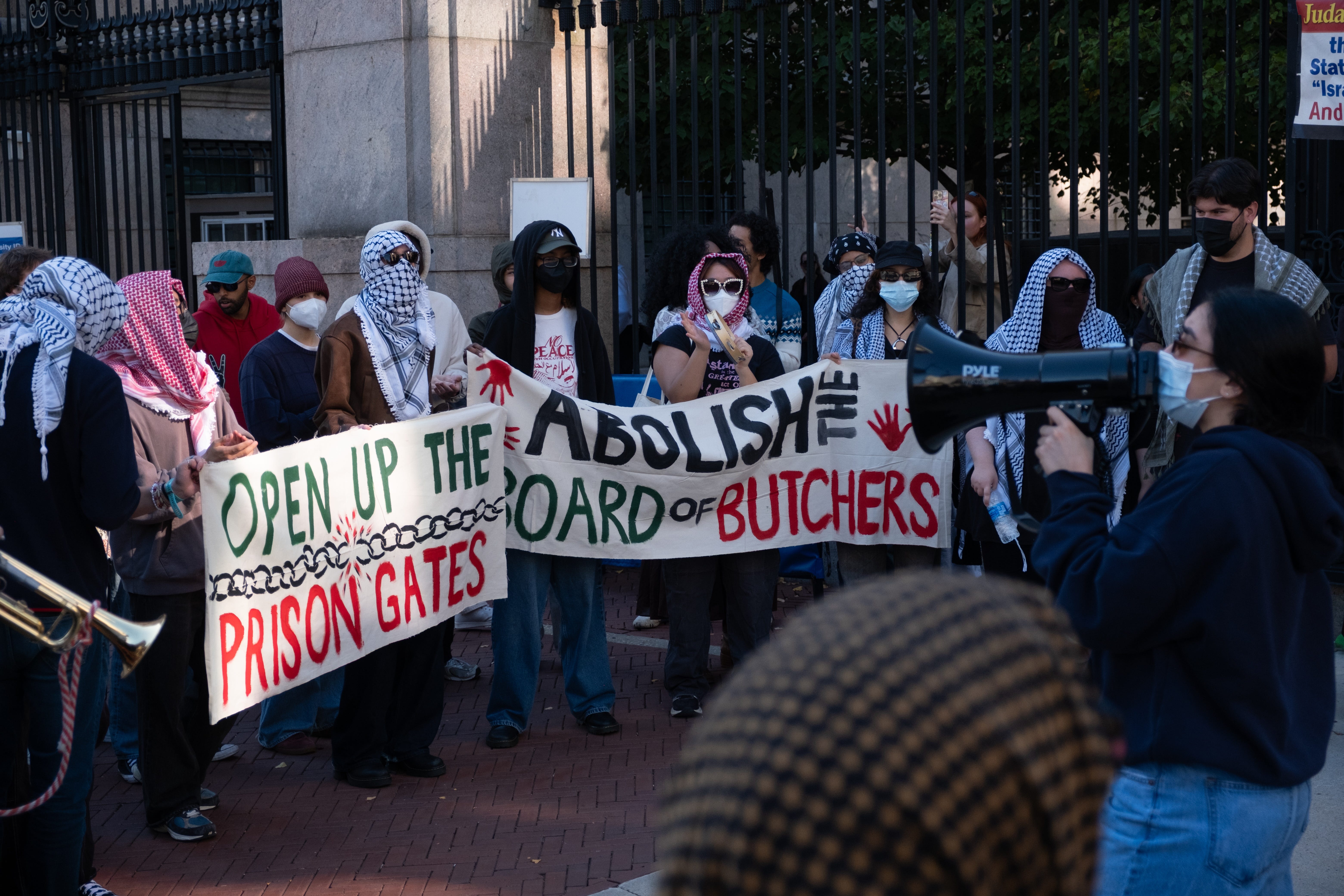
Wednesday’s gathering took place on the third anniversary of Hamas’ 2023 attack on Israel. In attendance were President Jennifer Mnookin and Trustee Keith Goggin, adding University participation to an initiative that the organizers said were largely devoid of administrative support. Nearby, rows of empty white chairs installed by Columbia/Barnard Hillel commemorated those killed in the attack. Later that afternoon, around 70 pro-Palestinian demonstrators gathered outside Columbia’s gates to march in support of what Students for Justice in Palestine (SJP) described as the Palestinian people’s “century-long struggle for sovereignty and liberation.”
The events of the day reflected the bitter tension that has shaped campus life in recent years, and the solution Listening Tables was attempting to offer.
Not everyone welcomed the effort. In an October 7 Instagram post (since removed) and a flyer circulated by SJP, the group condemned the gathering as a “worthless dialogue session.” SJP accused University administrators of promoting discussion as an alternative to ending what the group described as Columbia’s “complicity” in Israel’s war in Gaza.
SJP also wrote that the sessions “normalize three years of genocide” and declared, “We do not engage in dialogue with Zionists.”
Meanwhile, throughout the afternoon, participants frequently returned to the importance of dialogue itself, discussing the need for intellectual humility, openness to disagreement, and a willingness to listen. There was considerable agreement that these qualities were desirable. But much of the discussion remained focused on these principles, rather than progressing toward a more substantial examination of the contentious issues that arose during the conversations.
At one table, for instance, participants discussed the difficulty of relying on different, sometimes conflicting sources of information about Israel and Palestine. How could they have a productive conversation, they wondered, if they could not even agree on the basic facts? Yet, rather than examining particular disputed claims, much of the conversation remained focused on the difficulty of establishing a shared understanding in the first place.
One student who participated in the discussions expressed reservations about their productivity. Although she appreciated the opportunity for open conversation, she observed that participants spent much of the time “talking more about talking” rather than addressing the issues themselves.
Capotescu, the Listening Tables organizer, is no stranger to the challenges of operating such an initiative. In a written response to Sundial, he recalled that when the tables first began in 2024, even the mention of dialogue was met with “suspicion and skepticism.” Two years later, he has observed a change. Students now approach the tables, he wrote, with considerably more curiosity and openness, a development he described as “a remarkable shift in tone.”
Whether this reflects a broader shift in Columbia’s campus culture remains unclear. But for some of the students and faculty who have participated, the tables appear to offer something they have found lacking in their ordinary experience of university life.
A Different Kind of University Life
One international student in his senior year described arriving at Columbia with an idealized view of the American college experience. He had imagined an environment of open intellectual exchange, where students from different backgrounds could discuss unfamiliar ideas, challenge one another’s assumptions, and encounter perspectives quite different from their own.
His experience, as it turned out, had been considerably different. He described an atmosphere in which students sometimes felt pressured to withhold opinions that differed from prevailing views, whether among their peers or in the classroom. Recalling his experience in University Writing, he described wondering whether expressing a political position at odds with what he perceived to be his instructors’ views might affect his grades. “Should I take this position,” he recalled asking himself, “or should I just go with the status quo?”
Listening Tables represented something closer to what he had originally imagined. He had not planned to attend Wednesday’s gathering, but upon noticing the tables, he decided to join the discussion. For him, the opportunity to hear unfamiliar perspectives and participate in an environment where disagreement was welcomed, rather than immediately dismissed, was closer to what he believed university life ought to offer.
At the tables, Mnookin similarly acknowledged that the fear of condemnation from one’s peers can indeed discourage students from expressing their views, whether inside or outside the classroom. She emphasized that the proper role of universities should be to create the conditions necessary for students to explore contested questions, and cautioned that taking institutional positions on those disputes risks silencing students who might hold different views.
The organizers also envisioned something more enduring than a series of pleasant conversations. Capotescu distinguished between dialogue understood simply as a skill and what he called “dialogue-as-ethos,” which he described as “an ethos of democratic citizenship on campus.” It is an approach to disagreement that, in his account, develops through education, repeated encounters, and practice, rather than through a single training session or workshop.
“Dialogue knows no winners and losers,” Capotescu wrote to Sundial. Rather than approaching a conversation with the expectation of persuading another person or resolving disagreement, participants are encouraged to explore unfamiliar perspectives, question their own assumptions, and consider ideas that may be uncomfortable. Even a position previously regarded as settled, he suggested, may seem less certain when considered from another perspective. “That uncertainty is often the surest sign that we don’t see the entire picture,” he wrote.
Underlying this understanding of dialogue is the importance of familiarity and personal relationships. Capotescu emphasized that dialogue must be practiced in person, where students can encounter others beyond their political convictions and develop the social ties on which trust depends. Knowing someone beyond their politics can make it more difficult to reduce them to an ideological category, or to assume the worst about their intentions.
This is also part of the thinking behind the tables’ weekly format. The organizers do not expect a single conversation to overcome deeply held disagreements or establish trust between participants. Instead, they hope that repeated conversations will allow participants to become more familiar with one another, develop relationships, and learn to engage respectfully with views they do not share. The intended change, in other words, is not necessarily in what participants believe, but in how they interact with people who believe differently.
The First Step, and What Comes After
The larger question is what Listening Tables can accomplish beyond any individual conversation. If the project succeeds in making participants more comfortable with disagreement, will that openness extend beyond the tables themselves? Will students carry that willingness into classrooms, friendships, and encounters with people who might never attend such a gathering?
Capotescu himself describes dialogue as “a work in progress, requiring continuous attention and care.” For now, Listening Tables offers something more modest than a total transformation of Columbia’s campus culture. It provides a place where students and faculty who might otherwise remain strangers can sit together, speak openly, and perhaps begin to regard one another with greater understanding.
Whether such encounters will produce more enduring change remains uncertain. But the willingness of students and faculty to participate suggests that, at least among those who come to the tables, there is a genuine desire for a different kind of university life.
At Wednesday’s gathering, the initial question was what everyone was supposed to talk about. The more difficult question, and one that remains unanswered, is whether that willingness to talk can become part of everyday life at Columbia.
Mr. Sivieri is a sophomore in the School of General Studies studying political science and history. He is a staff writer for Sundial.
The opinions expressed in this article are solely those of the author and do not necessarily reflect the views of the Sundial editorial board as a whole or any other members of the staff.
