


Outside the closed gates, by the time students start thinking about what to eat for lunch, Auntie Li (李阿姨) has already been working for hours. Each morning at 7:30 a.m., she drives her pink malatang truck from Flushing, Queens, leaving early to beat traffic and reach Columbia by 9 a.m.
You’ve seen the truck—it’s impossible to miss with its bright pink color and its cute logo of a cartoon girl with a bubblegum-pink bob and blunt bangs (Auntie Li’s own creation).
“I designed it myself! It’s cute, isn’t it?” Auntie Li said with a big smile, wearing a cap with a silver ring dangling from the brim. Soon, students and passersby begin gathering around the truck, greeting Auntie Li as their eyes float around the menu. In between preparing orders and greeting customers, she always keeps a bright and easy smile. For customers, the exchange lasts just a couple of minutes before they move on with their days. But for Auntie Li and the many other food truck owners near Columbia, this interaction is just a snapshot of a long and difficult workday. We know our favorite orders and the locations of our go-to spots by heart, but how much do we know about the people behind the food trucks, and about the sweat and dreams that keep them going?
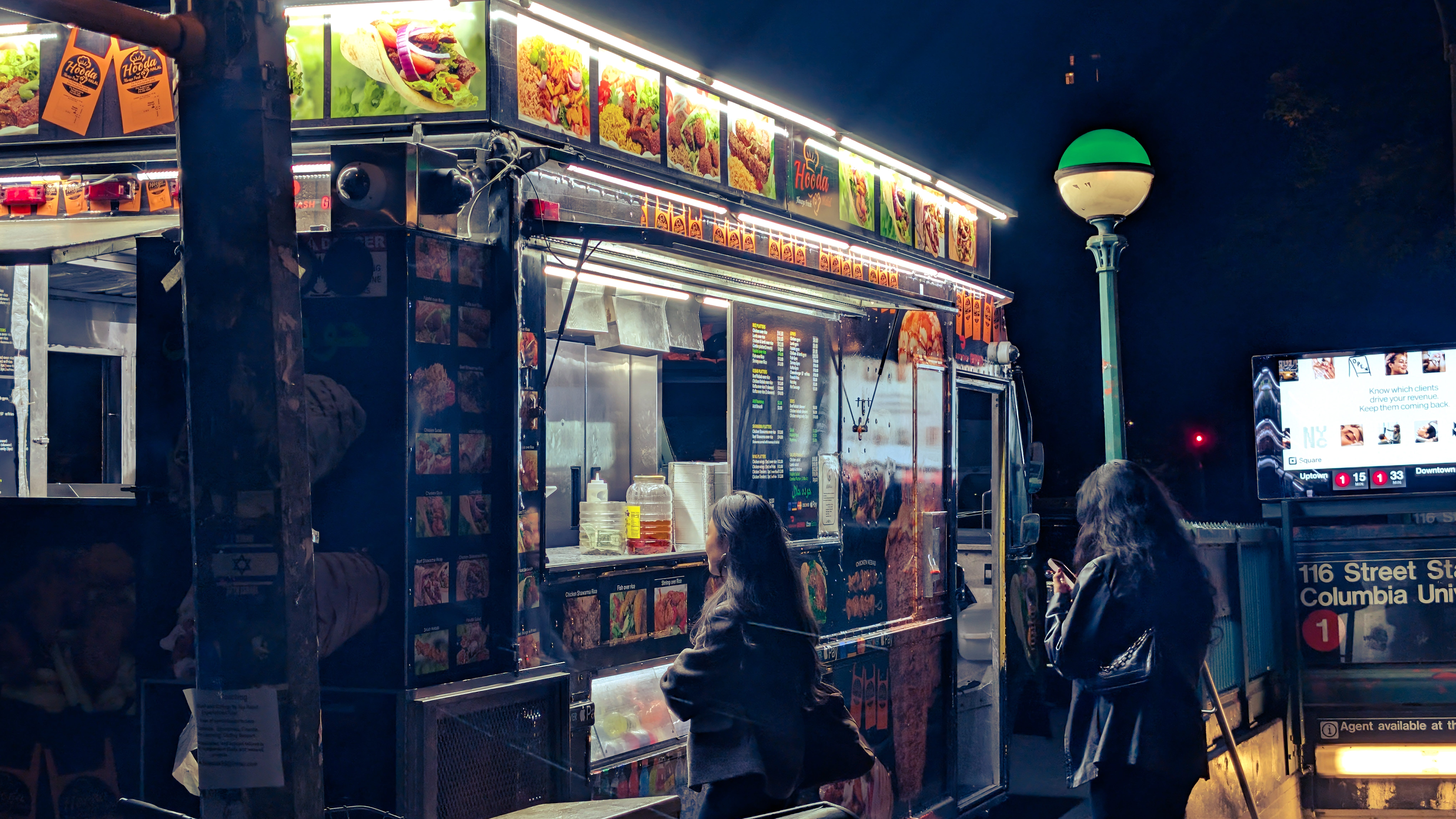
For many students, the diverse array of food trucks just outside the gates is as much a part of campus as Butler Library or the Low Steps. There’s Hooda Halal, Miracle Thai, the Korean truck, the malatang truck, trucks representing different regional Chinese cuisines, the Greek food truck farther down south, and more. They provide students and faculty alike with convenient and delicious alternatives for whatever variation of bland chicken or faux-ethnic foods the dining halls are serving that day.
To Nancy Xu CC ’29, food trucks might as well be her dining halls. She stops between classes to grab a bite and orders from food trucks almost every day of the week. Most of the time, she orders her go-to from the Korean food truck: stir-fried pork, rice, and broccoli—though she often orders from the green Chinese food truck outside Earl Hall and the malatang truck too.
Food trucks offer Nancy more than just convenience or affordability; they offer her familiar East Asian flavors absent from dining hall menus. This homey, heartwarming feeling extends past the food and the warmth of a full belly. Auntie Li reminds Nancy of her Chinese relatives: She often compliments Nancy’s outfits and new perm, and she never forgets a regular’s name or order.
“I love the students at Columbia. I got cards and a fruit basket from students who are about to graduate. Another time, on Lunar New Year, I got a red envelope (红包) from a student! I didn’t want to take it at first, but they are already Ph.D. students—they earn their own money!” Auntie Li says proudly.
Auntie Li has been feeding the Columbia community since 2018. She used to work at another Columbian food truck, the yellow Chinese truck, with Miracle Thai in between them blocking the awkwardness of seeing her old employer at work. She took a break after 2019 due to the pandemic and decided to open her own food truck afterward. Though her accent might suggest that she’s from northeastern China—something she picked up from her coworkers—Auntie Li is actually from Chongqing in southwestern China, the birthplace of malatang. Now, she brings a taste of her hometown to Columbia through the spicy, customizable soup, which diners fill with their choice of ingredients, from sliced beef and mushrooms to bean sprouts and noodles.
“I have been in the U.S for over a decade. My son is about to start college. Looking at you guys makes me feel like looking at my son!” Auntie Li said, laughing as she handed over an order.
Just a couple of steps from Auntie Li’s malatang truck is the Korean food truck, run by Kyongae Shin alongside her husband. Its most popular dishes change from time to time, though currently Kyongae says the pork, galbi, and kimchi fried rice are their bestsellers. Kyongae is from Jindo County, South Jeollanam province in Korea and has been running her truck with her husband for about six years.
To Kyongae, the Columbia community is lively—the students are all “handsome, pretty, and smart,” reminding her of her own children. Like Auntie Li, Kyongae has to wake up as early as 4 a.m. to beat the morning traffic and arrive at Columbia at 6 a.m. in order to open around 10 to 10:30 a.m. She and her husband close around 6 or 7 p.m. and arrive home at around 9 p.m., accumulating more than 12 working hours per day including traveling and preparation time.
Jeffrey Kim CC ’29 is also a regular at the food trucks. His favorite is, without a doubt, Hooda Halal—“the holy grail of Columbia University,” he says. At Hooda Halal, Jeffrey can get a fresh chicken over rice in exchange for a $10 bill.
But for Jeffrey, the appeal extends beyond the good deal. Food trucks fit the pace of New York City and Columbia—the simplicity and convenience of ordering at a food truck simply can’t be found anywhere else. As he puts it, “You don’t always have the time to swipe into a dining hall, wait in line, get the food, and then sit down. Sometimes you just want to pay in cash and get some Hooda and go back to eat while you study or while you talk with friends.”
Through his repeated visits, Jeffrey has become familiar with the friendly faces behind the window at Hooda Halal, proudly stating, “I know all my habibis at Hooda Halal.”
Farther down Broadway, past Lerner Hall, is Souvla, a Greek food truck run by Kostas. Kostas is from Kalamata, Greece, and he has been in the restaurant business since he was a kid. He began toying with the idea of starting his own food truck all the way back in 2009 after the economy crashed, when he began noticing food trucks being featured on blogs.
Kostas takes pride in making his food “the way [he] would eat it,” using fresh, never-frozen ingredients and extra-virgin olive oil. “You can taste the difference,” he stressed. Kostas has served Morningside Heights for more than four years. Because his food truck is the farthest down south on Broadway, Kostas has a more diverse mix of customers—not only does he serve students and faculty, but a good number of maintenance staff and hospital workers stop by his truck as well.
Jay Li, who runs the yellow truck with Auntie MinMin, used to be a chef at a hotel in Midtown Manhattan. The two met almost three decades ago, when they had just turned 18 and first came to the U.S. The truck specializes in dishes from Zhejiang, a coastal province in eastern China. Uncle Jay stir-fries the dishes on the spot, while Auntie MinMin handles ordering and packaging, as well as preparing the ingredients in the morning.
“We close after all the ingredients of the day are sold. We want to make sure the ingredients are always fresh,” Auntie MinMin said.
Their most popular dishes are kung pao chicken and red-braised pork belly, though Auntie MinMin added that Uncle Jay is actually better at Western cuisine than Chinese cuisine. But they decided to serve Chinese dishes to make up for what is missing from the dining halls.
While they enjoy being around the Columbia community, Auntie MinMin and Uncle Jay work long hours, like the other food truck owners. They wake up at 3:30 a.m. to prepare ingredients, get to the food truck, and drive from Flushing, Queens, returning home at around 9 p.m.
But long hours are not the only challenge food truck owners face. Auntie Li from the malatang truck described her work as “hot in the summer and cold in the winter,” with a resigned smile. Alongside traffic, Kyongae cited longstanding challenges with parking permits and ticketing. She also described a robust seniority system: Because location drives sales, those who have been here longer often get the better spots. When asked why she continues to run her food truck despite these challenges, Kyongae half-jokingly answered, “I have to live. There’s nothing else to do.”
Food trucks, despite not being recognized as members of Columbia University, have always had fates intertwined with the University’s unilateral decisions. Kostas moved across the street and even shut down his business temporarily during the 2023 pro-Palestine demonstrations because police barricaded the segment of the street where he used to park. Auntie MinMin and Uncle Jay also had to move across the street because of construction in their usual spot. Auntie Kyongae said the campus gates used to be open for food truck owners to use the bathrooms on campus; now, during their long working hours, they have to go farther in search of a bathroom, leaving their trucks and facing a higher risk of problems with parking permits, tickets, and traffic.
The food trucks on Broadway, just outside the campus gates, have become an essential part of student life at Columbia. Closed gates keep us safe, but by barring anything deemed dangerous and unknown, they also deny and alienate the community and relationships the University refuses to recognize. Many of the food trucks have been here for over a decade, longer than most Columbia students and many faculty members. They fill our mouths and hearts every day, yet how do we care for them?
Ms. Xu is a sophomore at Columbia College studying political science. She is a staff writer for Sundial.
Ms. Zhang is a senior at Barnard College studying anthropology. She is a staff writer for Sundial.
The opinions expressed in this article are solely those of the authors and do not necessarily reflect the views of the Sundial editorial board as a whole or any other members of the staff.

