



Walk into any Pupin basement classroom on a Friday afternoon, and you will witness a peculiar ritual. A TA stands behind a computer, reading through slides that regurgitate a lecture the room has already heard 24 hours prior. After 20 minutes, the TA asks, “Are there any questions?” and is met with deafening silence. The TA eventually relents, the clock hits the hour, and students file out with the nagging dread of having to do it all over again next week.
According to the International Student Guide to Columbia’s School of General Studies, discussion sections are an “intimate setting” to “build connections.” The University’s Center for Teaching and Learning claims they turn students into “co-constructors of their learning” by ensuring “they actively participate in their learning, rather than passively listen.” But based on that, the idea of imposing mandatory discussion sections, regardless of the course’s specific demands, feels less like a strong pedagogical philosophy and more like a performative attempt to maintain the optics of a liberal arts education.
The root of this failure is the University’s inability to properly distinguish between discussions intended for quantitative review, versus those aimed to genuinely foster dialogue. There is a sharp divide between subjective courses, where student-to-student discussion is the point of the class, and memorization-intensive ones, where the goal is to master a set of facts.
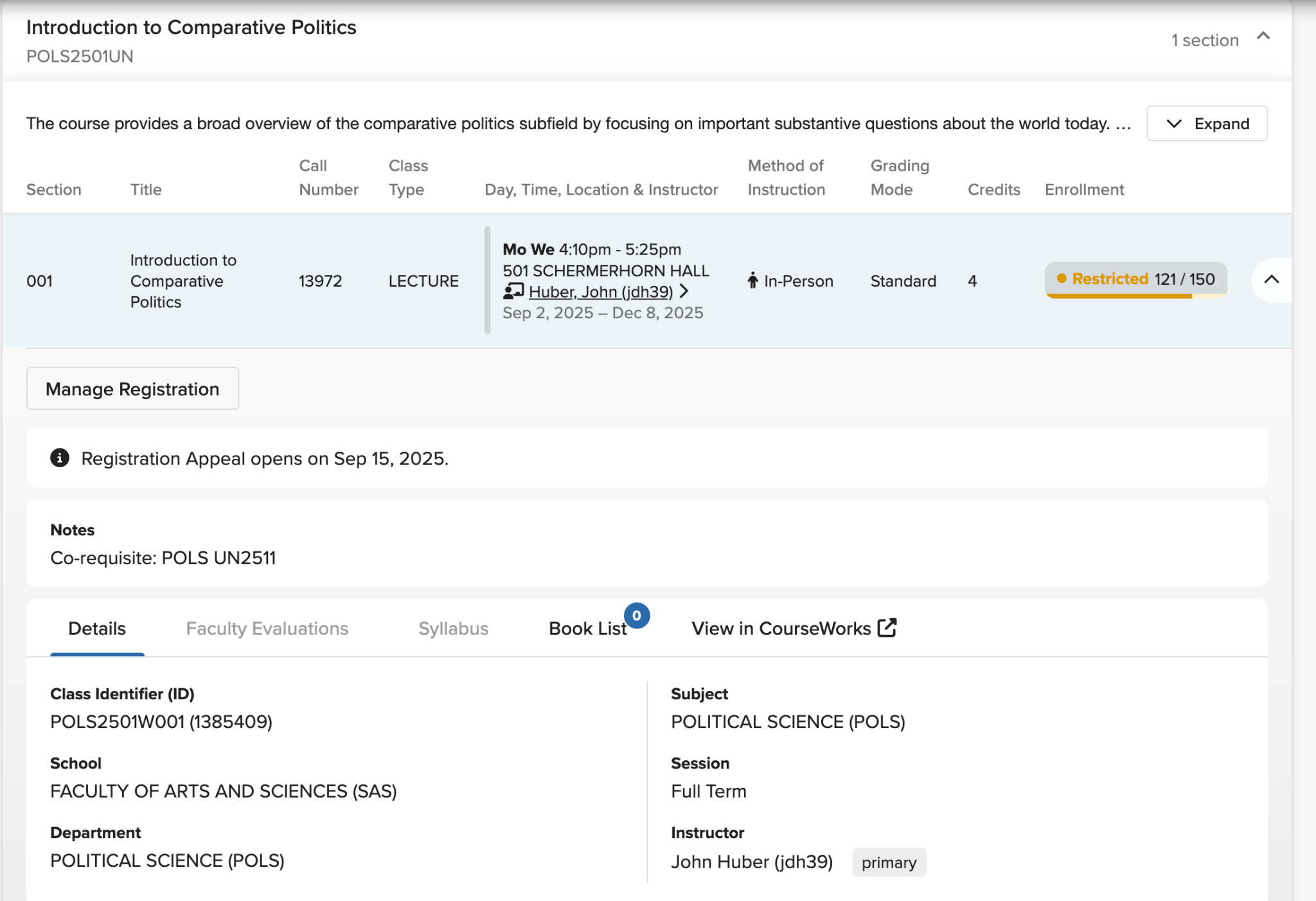
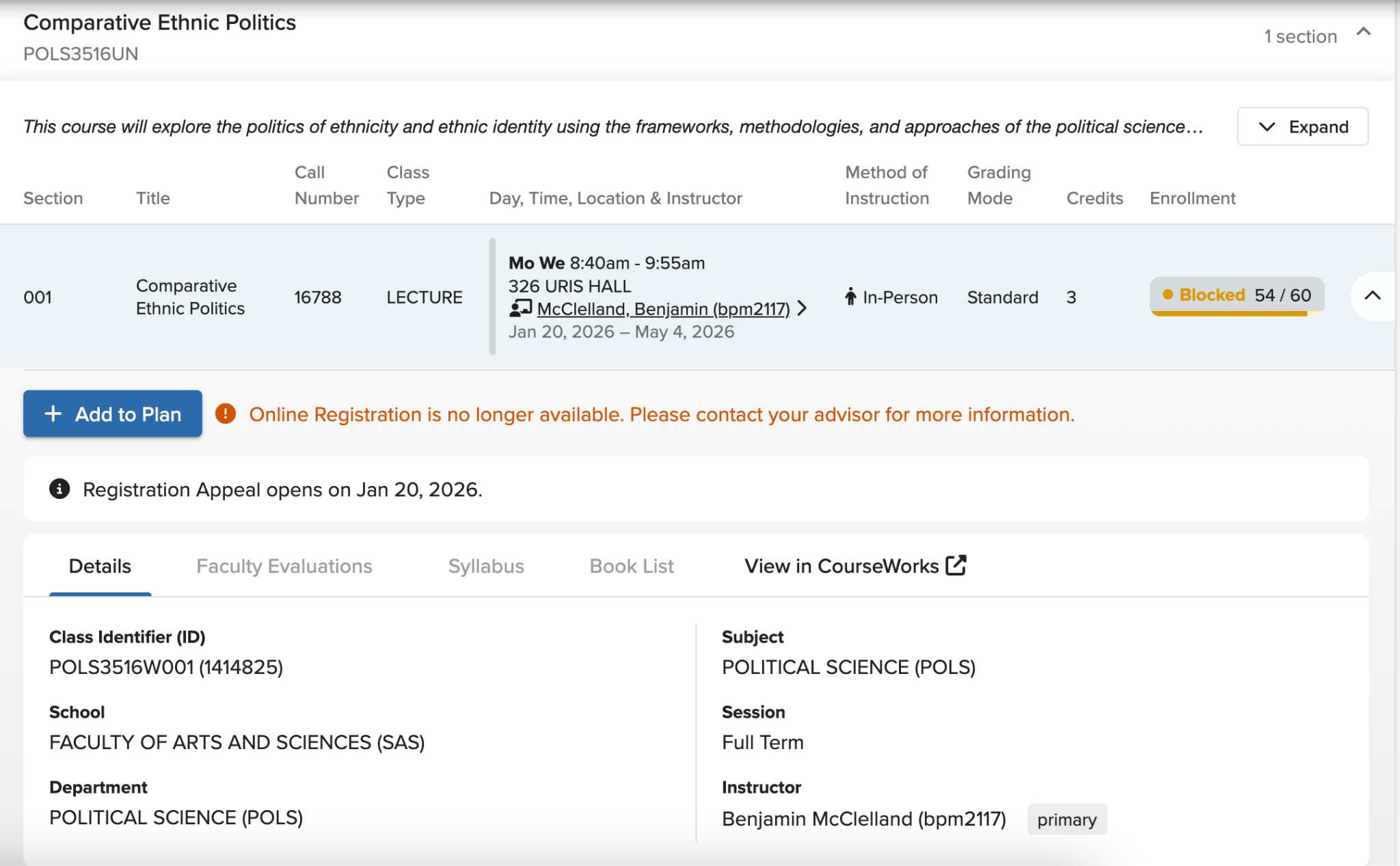
The irony of the University’s commitment to “intimacy” through discussions is most visible in the Department of Political Science. The Introduction to Comparative Politics class has around 120 students and includes a mandated weekly discussion section. Yet, move up to an advanced 3000-level comparative politics course with no prerequisites and 60 students, and the discussion section vanishes.
Disha Ghatak, a 2nd-year Political Science PhD student, TA’d for Intro to Comparative Politics last semester, and is currently a TA for a 3000-level Comparative Ethnic Politics class. “With 60 students, you know everyone’s not getting the material in the same way in class, but it’s harder to give individualized instruction [without sections],” she tells Sundial.
Ghatak adds, “I have a strong preference for sections being there because you get to monitor progress.”
The Political Science Department’s logic here is rooted in branding rather than needs. A 120-person lecture without a discussion section looks like a state school megaclass, while a 60-person lecture without a discussion section feels numerically palatable on a brochure, even if it is functionally just as impersonal. In reality, Columbia is using discussion sections to optimize for the appearance of a liberal arts college while ignoring the actual classroom experience.
However, simply adding discussion sections to every lecture course does not fix the underlying problem: often, the sections themselves are intellectual filler.
Michael Lee, a 3rd-year Economics PhD student and current Head TA for Intermediate Macroeconomics, argues for a flexible model: “I’m generally a fan of letting people decide what to do with their time and make their own judgment calls about where they are in the class.” For Intermediate Macroeconomics, recitations are optional. “I think if you understand what’s going on, then having to go to the recitations is a waste of time,” Lee says.
The abundance of other supplemental help options further complicates the purpose of discussion sections. First, all TAs are required to host office hours, which are dedicated spaces for students to ask specific questions and get targeted feedback. Lee’s Intermediate Macroeconomics class also has Ed Discussion, an online platform where students can ask questions to TAs anonymously. Beyond TAs, AI can also provide comprehensive answers instantly and at any time. Professor Martín Uribe, who teaches Lee’s Intermediate Macroeconomics class, has openly encouraged the use of AI to help students better understand the material. These other support channels eliminate the need for mandatory discussion sections in these fact-based classes, as students can get their questions answered through other means.
In Lee’s economic world of objective models and historical data, the value of the section is purely functional. He sees it as a space for “emphasis and re-emphasis” for lecture material. When the section is optional, the students who attend are engaged, as they are actively seeking extra review and practice. Yet, in introductory political science courses—which are also largely fact-intensive and review-based—the department uses mandatory discussions to fill rooms.
Although Ghatak prefers mandatory sections, she notes that “You can’t force people to engage, but you can force people to show up.” What is the value of a body in a seat? The active participation that discussion sections are meant to foster becomes an impossible dream when disengaged students are forced to attend for their grades, not their passion. Additionally, these students are not going to be motivated to engage with review material that they presumably already understood from the lecture.
The mandatory discussion section’s role should be relegated to courses where the material is more subjective and interpretable. As Lee points out, “For humanities classes or classes where there is more room for interpretation and levels of subjectivity, discussion is actually really important because part of the class is hearing the subjective… [and] being exposed to subjective analysis or the opinions of the reading that other people have. There’s not just one answer for the TA to give.”
In this type of course, the mandatory discussion creates a valuable environment with everyone bringing different perspectives to the table. But this same level of interaction is not the goal of courses with more fact-intensive material, such as lecture-style political science and economics classes.
Moreover, the optional discussions allow students to choose the TAs who put in the most effort for their classes. Most Columbia PhD departments require students to be a TA for two semesters (or alternatively be appointed as a teaching fellow). However, Lee noted that “The value and effort that TAs put in is not required. I’m going to get my stipend even if I get horrible reviews. I’m also not going to get fired as a TA, especially not midway through a semester.”
When a discussion section is mandatory, the students are at the mercy of the effort (or lack thereof) the TA is willing to put into the course. This is not too problematic for humanities-styled sections because the importance of the section rests much more in student-to-student interactions; however, for review-based discussion sections, this can trap a student with a poor TA for the entire semester, effectively wasting their time. Unlike with professors, ratings for TAs are not as readily available. This leaves students guessing which mandatory section to enroll in, and they can easily get stuck with subpar teaching for an entire semester as a result. However, when discussions are optional, students can attend different sections and choose the TA that best fits their learning needs.
The fear that optional sections will lead to empty rooms is overblown. Students will show up for difficult material and/or high-quality instruction. In his experience, Lee says, “it is not common” for his discussions to have few students. This also incentivizes TAs to put in good effort into their sections if they want students to show up. As a student in Lee’s class, I personally always attend his discussion session even when I understand the lecture, because he structures the review so efficiently that I always leave feeling even more confident about the material.
If Columbia expects its discussion sections to serve as “intimate” intellectual spaces, it needs to stop using them as an optical checkmark for creating small class sizes. Nowhere is this disconnect more apparent than in the Political Science Department. Rather than forcing attendance in fact-intensive, review-based courses, the department could reserve mandatory discussions for more humanities-style courses that greatly benefit from student-to-student interaction. Until then, we’ll continue to file into Pupin, silently staring at our TAs, and wait for the clock to hit the hour.
Ms. Rajan is a sophomore at Columbia College majoring in Economics and Political Science. She is a senior editor for Sundial.
The opinions expressed in this article are solely those of the author and do not necessarily reflect the views of the Sundial editorial board as a whole or any other members of the staff.