


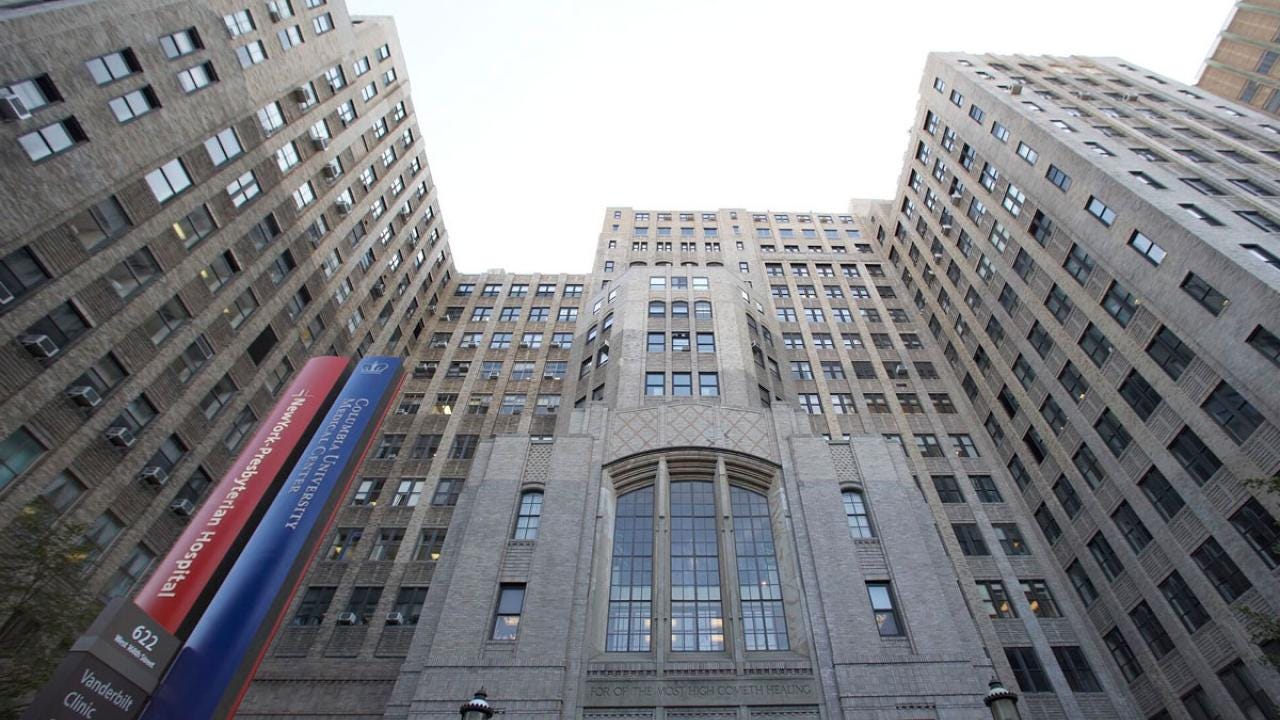
In a will signed two days before his death, Jeffrey Epstein bequeathed $100 million to his last known girlfriend and confidante, Karyna Shuliak, CDM ‘15, who moved to the United States from Belarus when she was 20 and he was 56. In Belarus, she had been studying for a degree in dentistry; when she moved to the U.S. to be with Epstein, he became increasingly involved with Columbia’s College of Dental Medicine (CDM). Based on files publicly available on the Department of Justice’s Epstein Files website, Sundial has established an implicit quid pro quo relationship that implicates several top-ranking administrators at CDM, based on the extensive contact Epstein had with then-Dean Ira B. Lamster, Dean Christian S. Stohler, Dr. Thomas Magnani, Dr. Richard Lichtenthal, Vice Dean and University Senator Letty Moss-Salentijn, and Senior Associate Dean for Finance Sara H. Patterson.
Prior to Shuliak’s transfer to Columbia, on February 6, 2012, Epstein’s assistant emailed Dr. Magnani—who appears to have already been personally acquainted with Epstein—“asking if [Magnani] and the Dean of Columbia Dental School would like to come to his home for drinks.” They scheduled it for 6:30 pm on February 15, a day before admissions decisions were released.
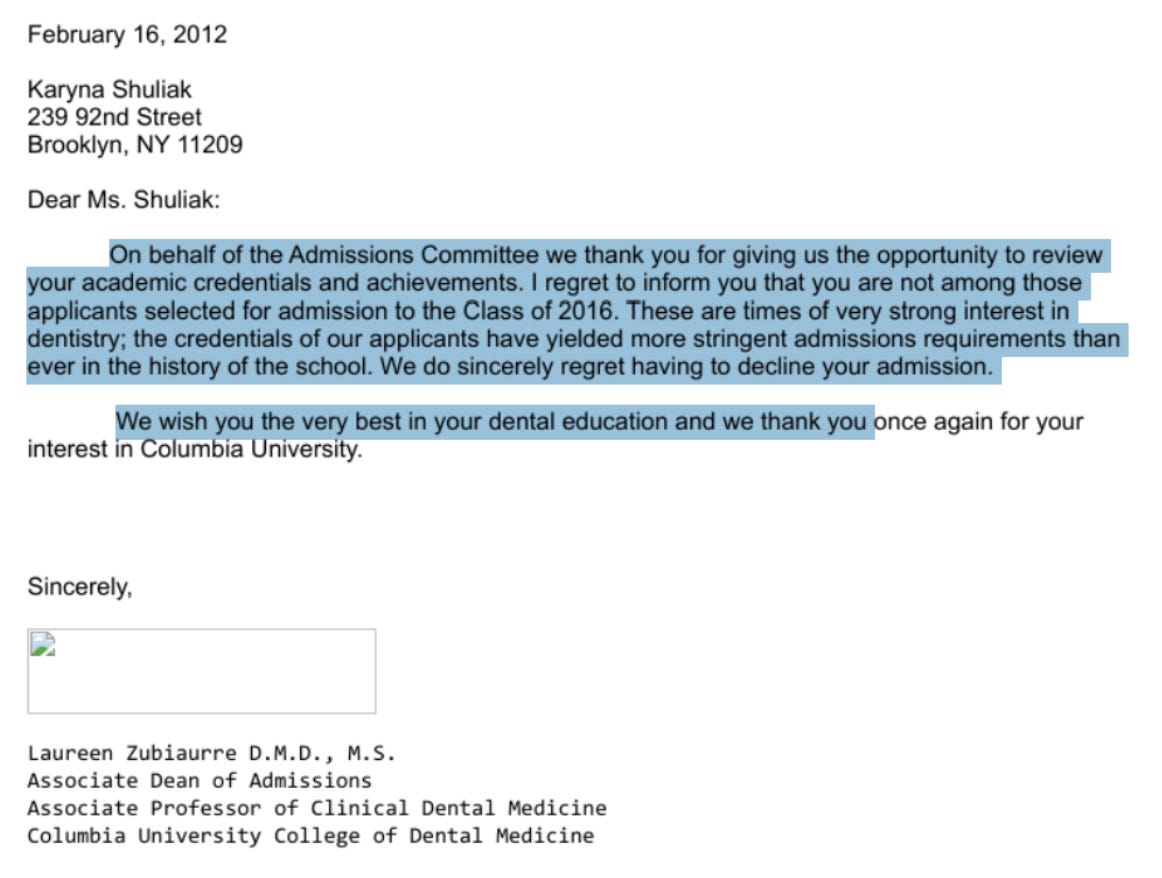
On February 16, Shuliak was rejected admission to CDM by Associate Dean Laureen Zubiaurre.
The day of the rejection, Magnani’s assistant emailed Epstein, saying she “gave fax to Dr. Magnani.” No communications are noted in the files Sundial examined between them again until February 23, when Epstein’s assistant emailed Magnani asking “if anyone was able to look at Karyna’s classes and determine how much credit she could be afforded.” Magnani responded that he “gave the transcript to the dean” and “he called and wants to meet with [him] on Monday.” According to Magnani, Lamster seemed “upbeat.”
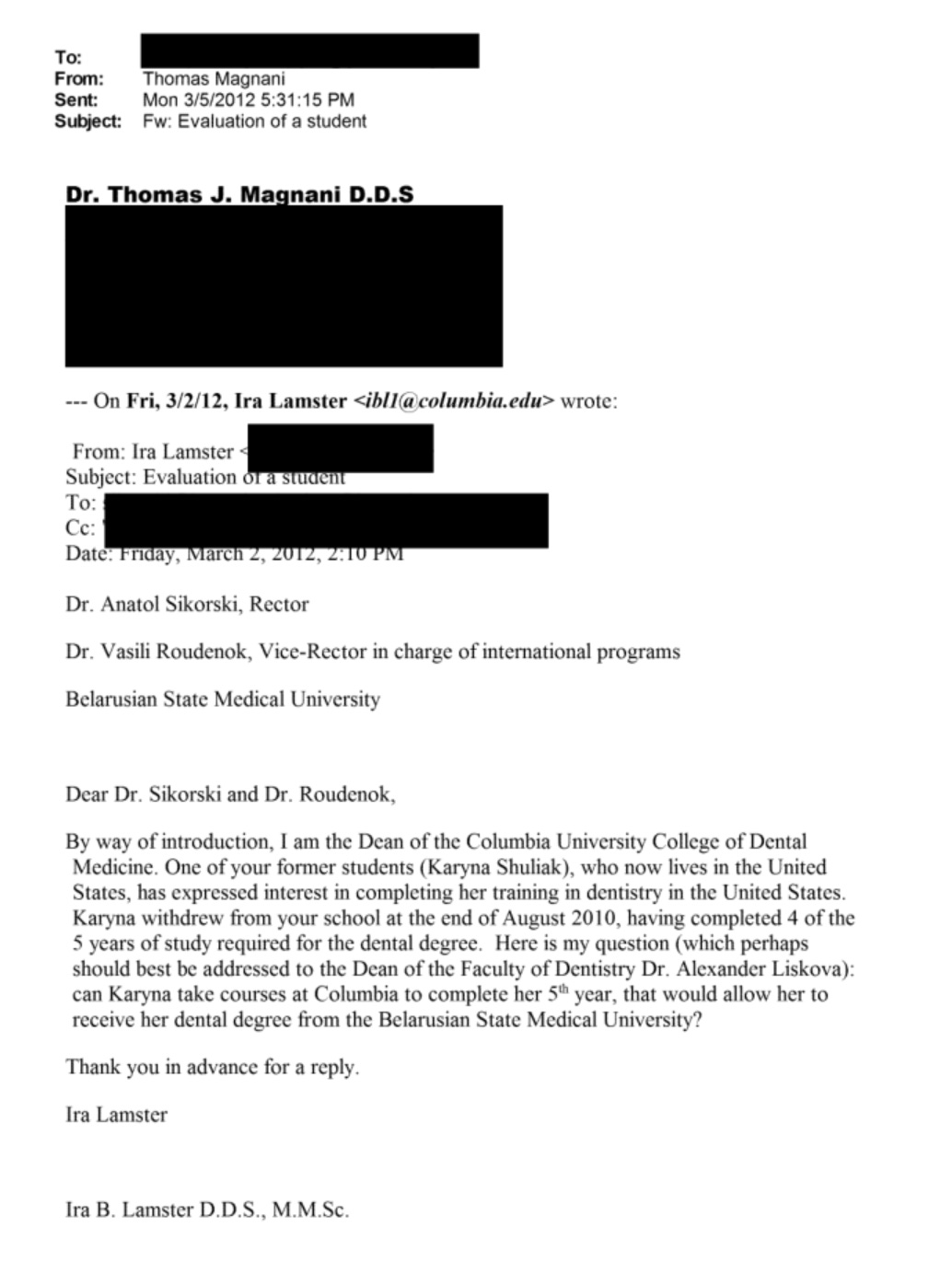
As first reported by Campus Reform, on March 2, Lamster wrote to Drs. Sikorski and Roudenok, Rector and Vice-Rector of Belarusian State Medical University, about Shuliak, who had “completed 4 of the 5 years of study required for the dental degree,” asking if she could “take courses at Columbia to complete her 5th year, that would allow her to receive her dental degree.”
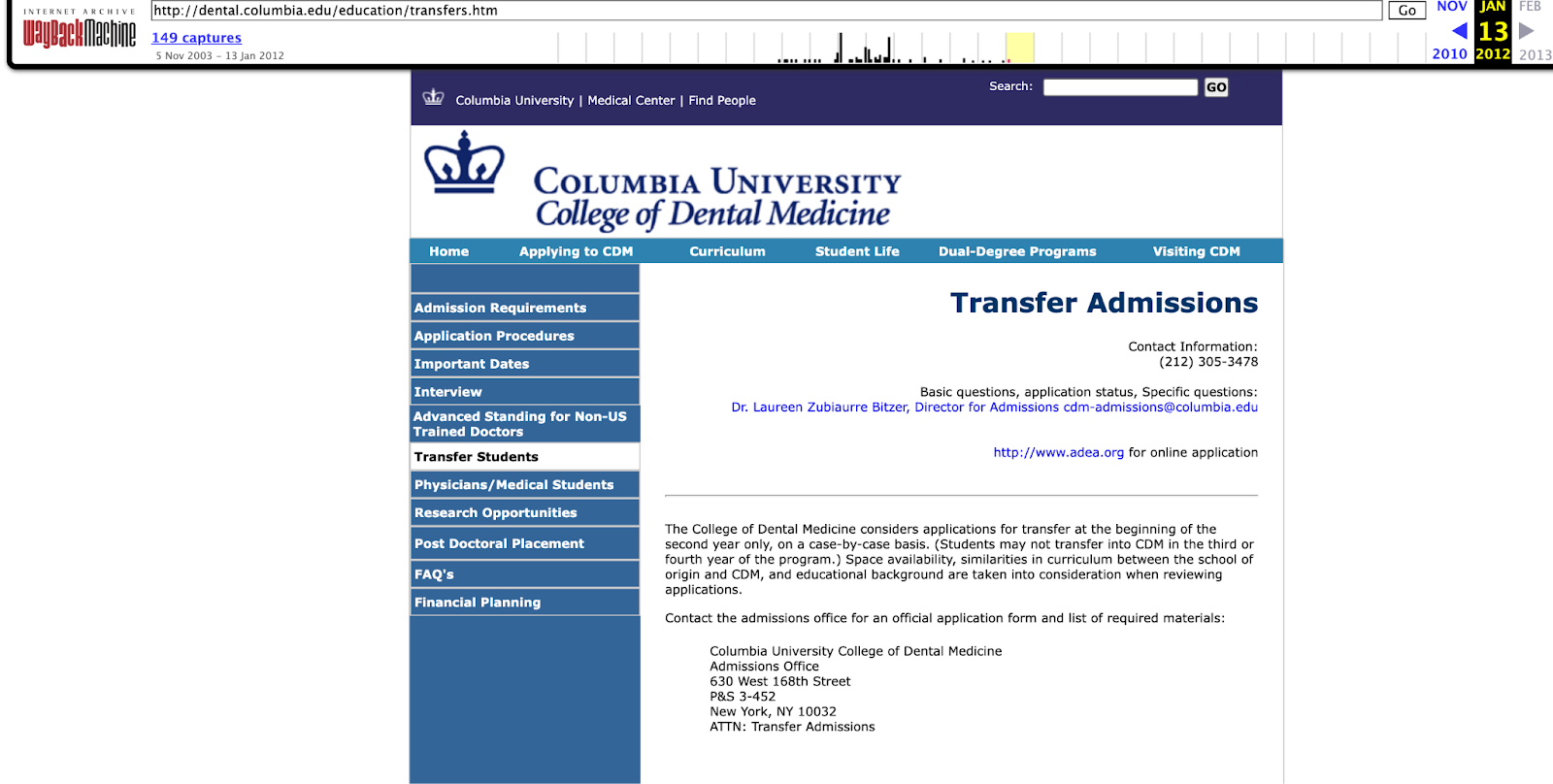
This request is highly unusual: according to the College of Dental Medicine’s own website, in 2012, students could “not transfer into CDM in the third or fourth year of the program.” As Shuliak was already in her fifth year, Lamster’s request—even disguised as a verification of qualifications from a prior institution—would have been unorthodox and a violation of CDM’s own transfer policy.
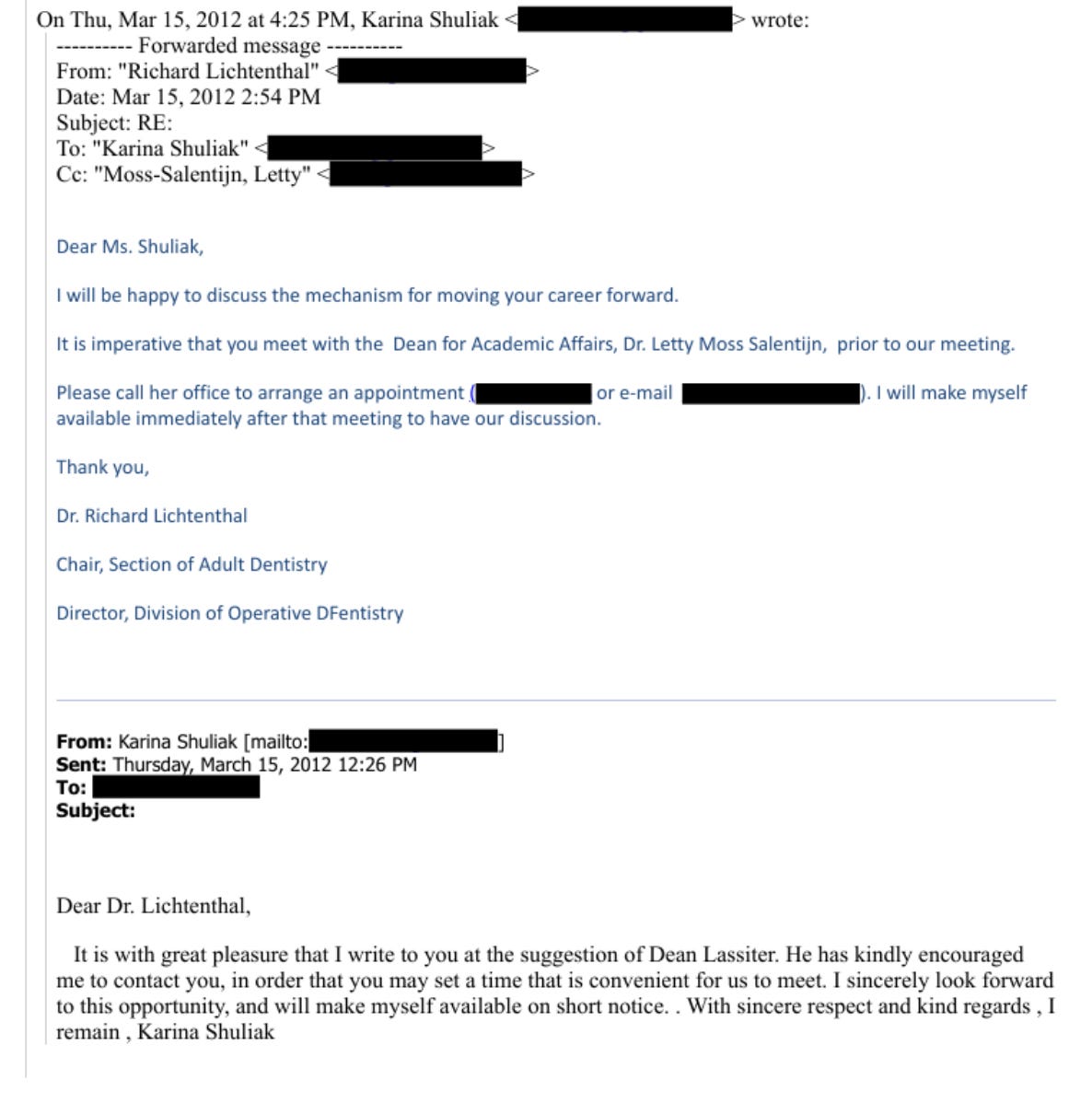
Even more unorthodox measures were taken to provide Shuliak with all the requisite resources to succeed in her application and her time at CDM: On March 15, she emailed Dr. Lichtenthal to set up a meeting. He told her to meet with Dr. Moss-Salentijn, then the Dean for Academic Affairs; four days later, Moss-Salentijn had scheduled an appointment with both Shuliak and Lichtenthal. Moreover, on April 3, Lichtenthal emailed Shuliak about the logistics of the admissions exam to CDM: Not only did he give her the basic details of when and where the exam would take place, but he also attached an exam outline and downloaded review materials “too large to e-mail” on a flash drive for her to pick up. These actions seem to go above and beyond what most high-ranking deans would do for their students, let alone for someone who has not yet become their student. Clearly, there was some interest in associating with Shuliak—and, by extension, Epstein—that went beyond the boundaries of casual generosity.
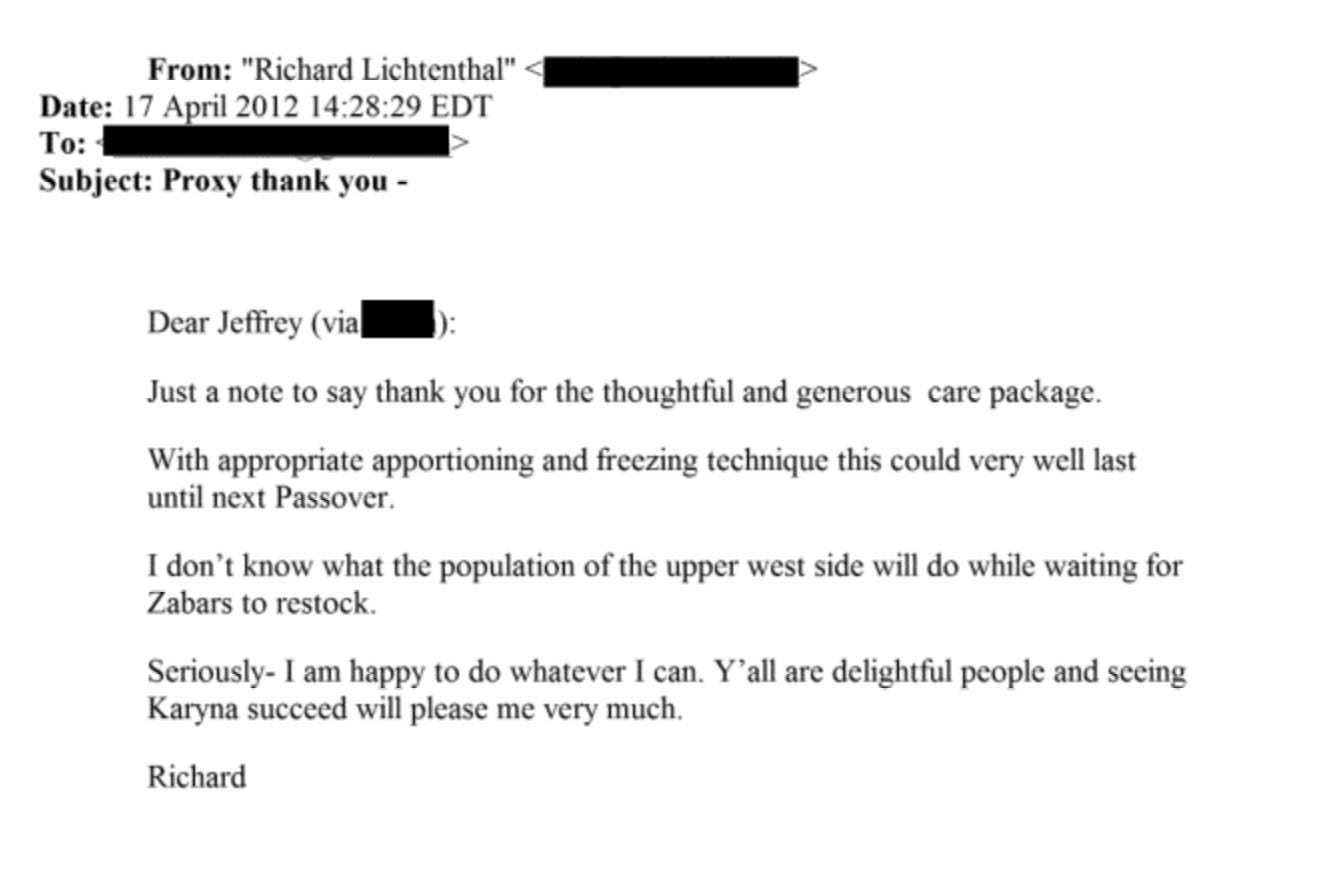
Then, on April 17, Lichtenthal received a “generous care package” (a Zabar’s gift basket) from Epstein and wrote to Shuliak as a “proxy thank you”: “I am happy to do whatever I can. Y’all are delightful people and seeing Karyna succeed will please me very much.”
On May 18, Lamster copied Dr. Zubiaurre—who had initially sent Shuliak the rejection letter—in an email to Epstein, saying, “We will be sending Karyna the letter she requires in the next few days. We have time, so please tell her not to worry.” Presumably, this was the admission letter Shuliak would require to officially register for classes.
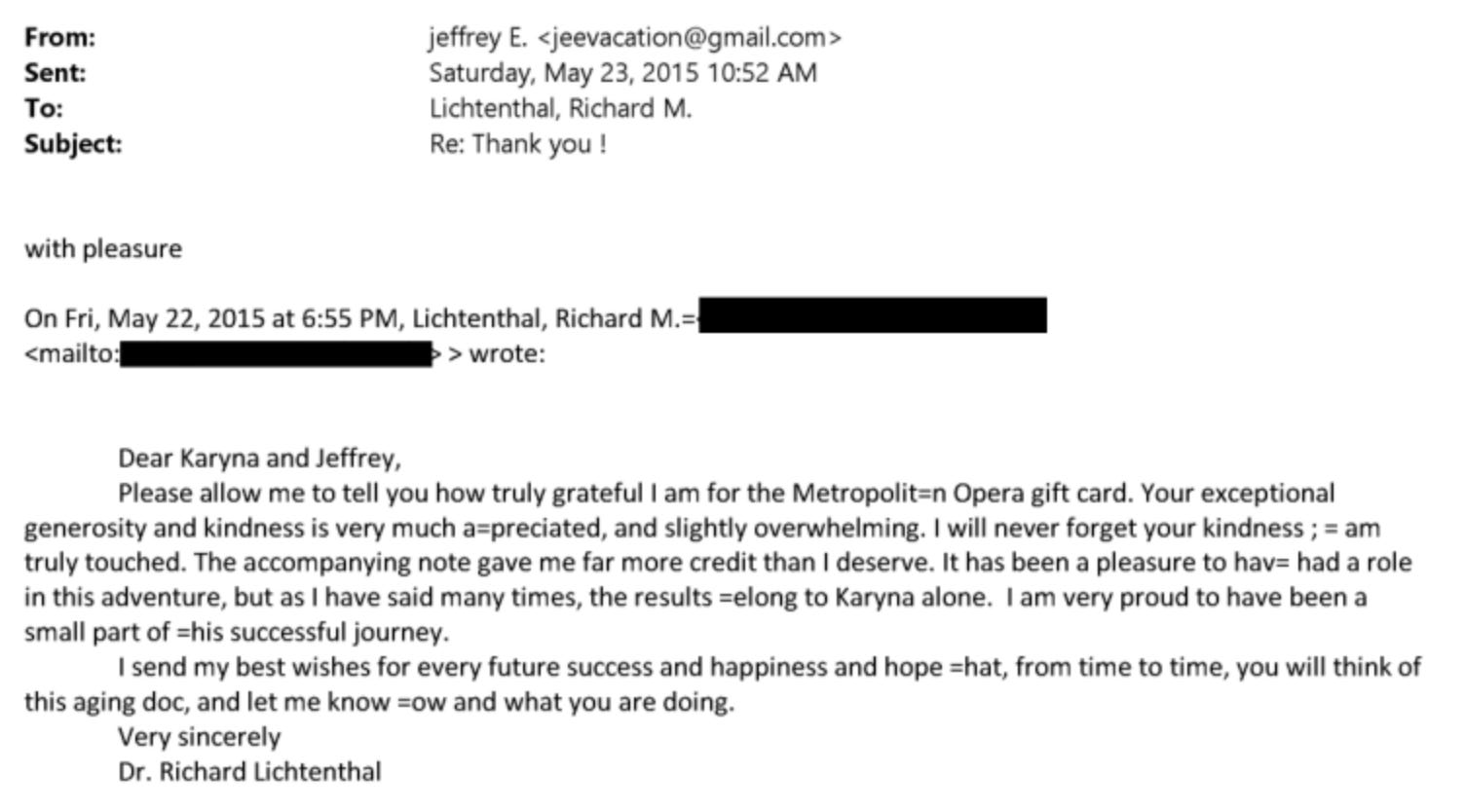
Lichtenthal continued to correspond with Epstein and Shuliak after Shuliak’s graduation, receiving a gift card to the Metropolitan Opera in May of 2015: “Your exceptional generosity and kindness is very much a=preciated [sic], and slightly overwhelming. I will never forget your kindness ; = [sic] am truly touched.” In the same thank-you email, he wrote effusively that he sends his “best wishes for every future success and happiness and hope[s] =hat [sic], from time to time, you will think of this aging doc.”
Lichtenthal could not be reached for comment.
Similarly, Lamster, Moss-Salentijn, and Magnani all kept in close touch with Epstein and Shuliak after Shuliak’s graduation.
When asked to comment on his involvement, Lamster wrote in an email to Sundial that he had been introduced to Jeffrey Epstein in 2012 “by his dentist, who was an alumni leader at the Columbia University College of Dental Medicine (CDM). He and [Epstein] were quite friendly, was told that [Epstein] was philanthropic, and was willing to discuss a major gift to the CDM.” Lamster said that he was aware of Epstein’s past, “which included a conviction for sexual misconduct, for which he had served time in prison and home confinement.” He claimed that Epstein was prepared to give between $5-10 million to CDM, but that “the Columbia University Medical Center would need to vet the donor.” Epstein’s background evidently didn’t stand up to scrutiny, because Lamster was told that “CDM could not pursue the ask.”
It must be noted that Epstein made donations to CDM from 2010 to 2012, and again in 2014; the site logging his contributions became unavailable after 2015. Clearly, CDM was taking money from Epstein during this period; how much is uncertain (Sundial reached out to CDM’s Sr. Director of Development, Geraldine Connors, about CDM’s donor records between 2012-2018, and did not receive a response), but it seems that the Medical Center’s qualms regarding taking money from Epstein was only limited to a matter of scale—if that.
“At about the same time [Epstein] asked me about someone who I believed to be in his employ who was a dental student in Belarus, did not complete her degree, and wished to complete dental school in the United States,” Lamster wrote. “As at that time we were pursuing a major gift from [Epstein], and it was logical to agree to [Epstein’s] request.”
“Let me emphasize that there was no quid pro quo in regard to admission to CDM and the gift,” Lamster wrote, “though I recognize now that the optics were not ideal.” Yet, it seems that—regardless of exactly which decision came first in the murky timeline—this would be the definition of quid pro quo: If the decision that Epstein would not be allowed to make a major donation to CDM came first, then there seems to have been no reason to break policy norms and admit Shuliak. If Shuliak’s admission was the result of Epstein’s promise of a major donation to CDM, then it would have been, in fact, “a favor or advantage granted or expected in return for something,”—the definition of “quid pro quo.”
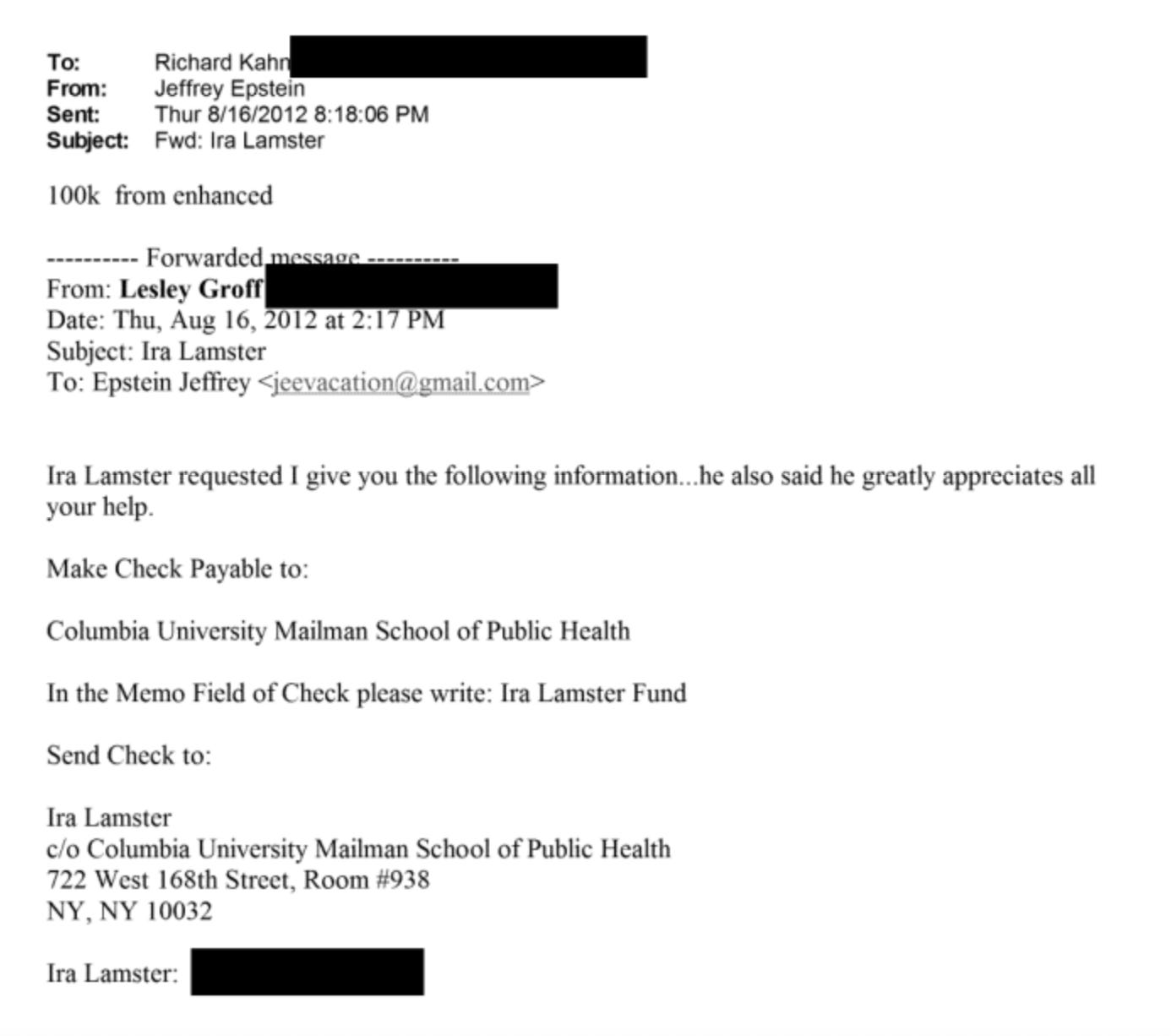
After Lamster transitioned from CDM to the Mailman School of Public Health, Epstein contributed $100,000 in August 2012 to establish an “Ira Lamster Fund” at the Mailman School. “I did not solicit this donation,” Lamster wrote. “I had been told that a gift from [Epstein] would not be accepted by Columbia. The Dean’s office at the Mailman school was contacted about this other proposed gift and I was told that the donation could be accepted.” It should be noted that Lamster claimed that he “did not solicit this donation” from Epstein, not that he has never solicited donations from Epstein—a distinction that will become relevant.
However, in a previous email to Epstein on May 11, 2012, Lamster had written that he was “concerned, and with good reason, about others having designs on your generosity” at the Columbia University Medical Center. It’s hard to see how others at the Medical Center would have “designs” on Epstein’s “generosity” if, as Lamster had earlier claimed, the Medical Center had previously rejected Epstein’s attempt to donate a significant amount to CDM.
Following a wave of allegations against Epstein in 2015 that began with survivor Virginia Giuffre suing Epstein associate Ghislaine Maxwell for defamation, Lamster said the following in a statement to Reuters: “Am I glad I didn’t go back for additional funding? I guess I am, but in my interactions with him, he was always a gentleman.”
The motivation for his endorsement of Epstein’s character became evident two years later. In January of 2017, Lamster sent Epstein an email with the subject line of “Need your help.” “As you recall, you were kind enough to provide me with an unrestricted gift when I began my work at the School of Public Health,” he wrote. “After 28 years, however, I have decided to leave Columbia to explore some other opportunities.” He requested that Epstein “move those funds to Stony Brook to support [his] work there.” In a later email, Lamster wrote, “it appears that Columbia will NOT release any remaining funds in the gift account…I am sorry to bother you with all this,” he added, “but this outcome does not surprise me. This is just not right, since the money was donated for my work. However, universities never like to part with funds.”
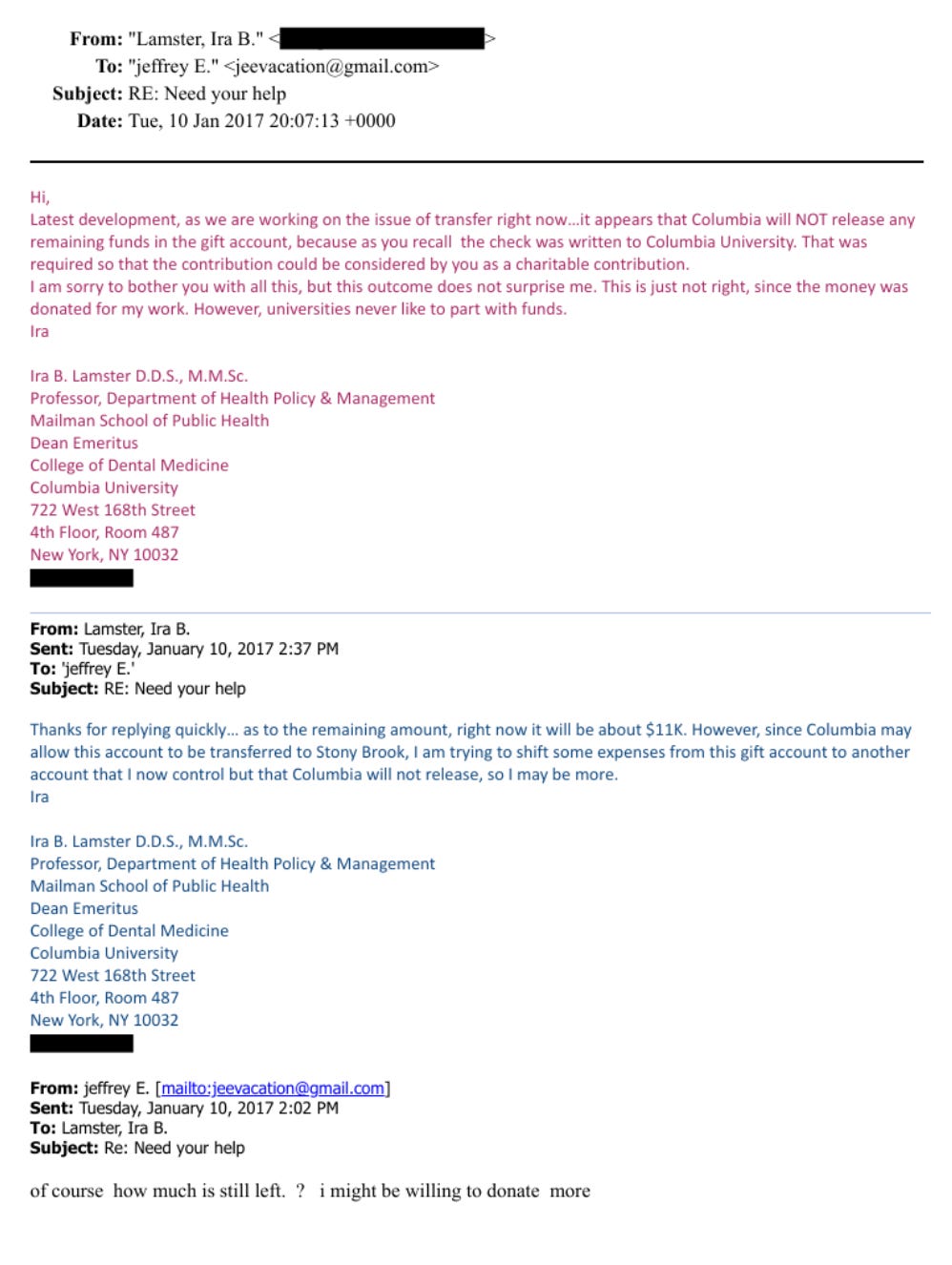
This, of course, read as a thinly-veiled request for more funding; Epstein responded with “how much is still left. ? i [sic] might be willing to donate more.” It is unclear whether Epstein donated to Stony Brook after Lamster began teaching there, as Sundial was unable to obtain records of Epstein’s donation patterns after 2015, but the intention behind these exchanges seems clear enough.
It wasn’t only Lamster who felt that Epstein’s money was clean enough to take. Sara Patterson, then the Associate Dean for Finance at CDM, wrote to Epstein in an email on June 7, 2012, about “an approved plan for a new building” for the School of Nursing at CDM. “CDM has a solid history of excellence and achievement,” Patterson wrote, “but we can’t ride a bicycle to the moon. I hope that we can inspire you to consider helping CDM to achieve a vision shared by all.” She referenced Lamster’s leaving, but said that she was sure he would “help in any way that he can going forward and be available 24/7.”
Similarly, Magnani, in coordination with Moss-Salentijn, asked Epstein for further donations after Shuliak had graduated. Magnani mentioned a new project that Moss-Salentijn was running and described her as “Karyna’s mentor” and the person who “did t=e [sic] most to help her get in and finish up dental school” in an email sent January 16, 2018. “A donation/gift of $450,000 would be appreciated,” he wrote. “I think you should do this for Dr. Salentijn and the school. Thanks Jeff.”
Epstein forwarded this email to Shuliak, who then consulted with Moss-Salentijn on the project proposal in July of 2018, only one year before Epstein’s final conviction and death.
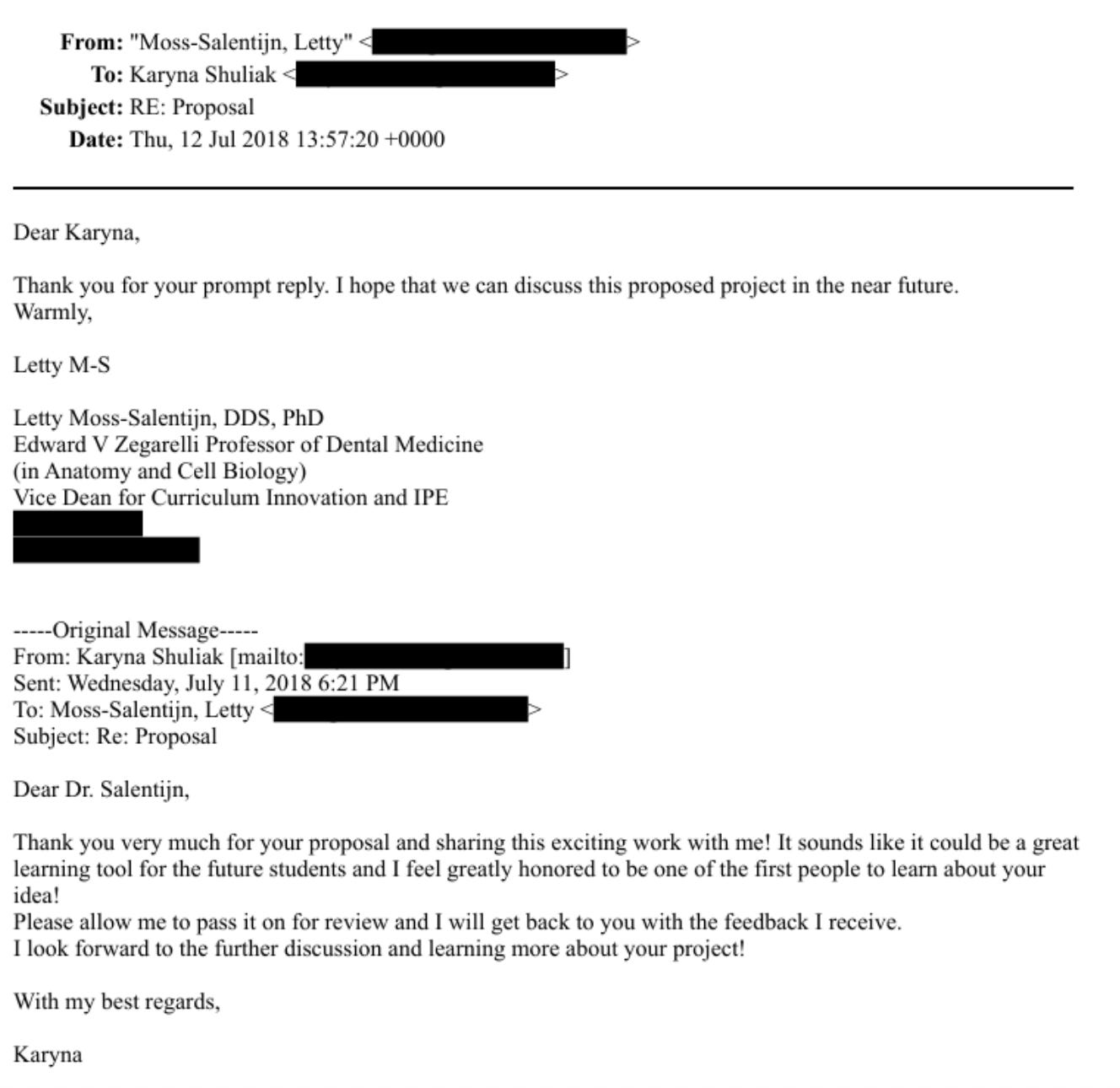
Moss-Salentijn is still a prominent figure at Columbia, serving on CDM’s executive committee and the University Senate. She has not responded to Sundial’s request for comment.
At what point does the institution become inseparable from the personal? How could “a gift from Epstein” simultaneously “not be accepted by Columbia,” while the people in charge of the various schools’ finances and visions continued to fraternize with—and indeed solicit donations from—Epstein?
All of Epstein’s recorded interactions with prominent Columbia faculty and administrators of CDM and the Medical Center occurred after his 2008 convictions of soliciting sex from children. Lamster admitted in a written statement to Sundial that he was aware of Epstein’s “conviction for sexual misconduct” (although that was underselling child molestation by a fair margin) in 2012, when he first interacted with Epstein. And yet: These key decision-makers in Columbia’s ecosystem agreed to play the parts of sycophants to gain access to Epstein’s wealth, disregarding all principles of conduct, barriers against conflicts of interest, and internal moral qualms regarding his character. Is the true mission of this University to make money, no matter how steep the cost?
“Our vision is a healthy and just world for everyone,” reads the mission statement of Columbia’s Mailman School of Public Health. “Our mission is to educate the next generation of public health leaders, conduct groundbreaking discovery, and deliver solutions to protect and improve health and wellbeing of people everywhere.” Columbia’s College of Dental Medicine says that “integrity and trustworthiness” are key “College Values.”
It doesn’t appear that Columbia has figured out what “integrity and trustworthiness” mean: Lichtenthal’s profile on the College of Dental Medicine’s page is unavailable. On Sunday, February 8, Lamster’s Professor Emeritus profile was taken down; it now redirects to the general Professors Emeritus page. His profile on the Mailman School of Public Health page was also taken down, but Sundial could not determine when. Both are now unsearchable, and one has to use the Wayback Machine website to access them.
Rather than holding them accountable for their mistakes, Columbia has decided to erase the history of association altogether—it’s difficult to believe that the erasure of these profiles just happened to coincide with increased pressure for justice and transparency following the release of the Epstein files. It would not have been egregiously difficult for Columbia to hold these actors with agency, power, and influence accountable while still maintaining its own relative innocence as an institution. Now, instead of choosing restitution and justice—however lately come—Columbia has decided to elide the truth in favor of protecting the undeserved.
Update: On February 11, one day after this story broke, the Columbia University Office of Public Affairs released a press statement regarding the College of Dental Medicine’s communications with Epstein. “In short, a student was admitted to the dental school through an irregular process,” the statement read, “coinciding with fundraising solicitations by former academic and alumni leadership of the school.” The fundraising was “undertaken by the then leadership of the dental school or individuals acting at their behest and not at the direction of the leadership of the medical center or the University.”
The University has removed Dr. Magnani “from the admissions review committee and from volunteer leadership roles,” terminated his “voluntary faculty appointment” and the “affiliation agreement with his private dental practice.” Additionally, “Dr. Letty Moss-Salentijn will step down from her administrative roles,” but will stay in her role as a tenured professor at CDM.
Furthermore, the University “will make a contribution, in the amount of $105,000 each, to two New York-based nonprofit organizations supporting survivors of sexual abuse and human trafficking”—a restitution of the $210,000 in donations from Epstein-related entities.
This is a developing story. Check back for updates.
Ms. Chen is a sophomore at Columbia College studying linguistics, economics, and East Asian languages & cultures. She is the incoming deputy editor of Sundial.
The opinions expressed in this article are solely those of the author and do not necessarily reflect the views of the Sundial editorial board as a whole or any other members of the staff.