


I changed as a person because Columbia mandates exposure to some of the greatest Christian works. When I encountered St. Augustine in Literature Humanities, I was struck by his total reliance on God—“our hearts are restless until they rest in you [God].”
It has been written that St. Thomas Aquinas, a successor of Augustine, “baptised Aristotle.” This is how I feel about Augustine. He redefined for me the conventional understanding of “humanism” within the liberal arts. He changed how I read the Greeks and everything that has come since then—it all leads to understanding ourselves in relation to God.
What draws me to Augustine is his union of faith and reason. His example raises a broader question for Columbia students: how should the pursuit of knowledge be reconciled with the Christian inheritance embedded in texts like Genesis, the Gospels, and Augustine’s Confessions?
Columbia’s pedagogical decision is exceedingly rare in higher education. Even when such texts are included on a syllabus, there is no guarantee they will be taught faithfully. Other sections taught students to dissect these works through modern ideologies or to intentionally undermine writers by aggressively reading “against the grain.” I was privileged to be in a section where we took the ideas and claims as serious and worthy of learning from as the author intended.
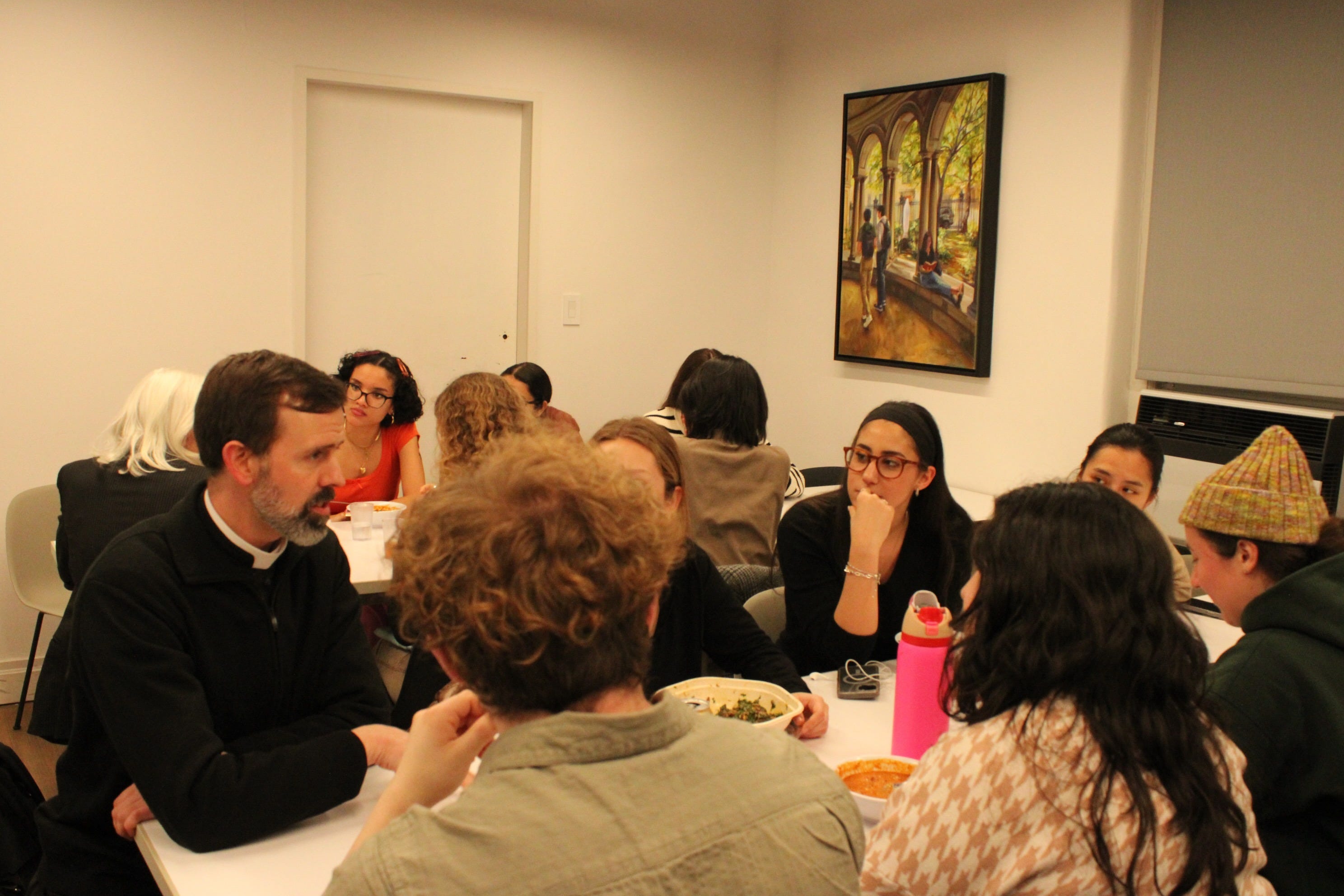
There is no one more primed to tackle the relationship between faith and reason in the Core than Columbia’s Catholic chaplain since summer 2025: the Rev. Father John Wilson. I sat down with him at the Thomas Merton Institute, named for the Columbia alum-turned-Trappist-Monk and the 20th-century’s ‘Augustine’ for his Seven Storey Mountain. We talked about his intellectual journey to the priesthood, the influence of faith and reason in the Thomistic tradition, and how he reads Scripture.
Early Intellectual Formation
Wilson grew up in a devout Catholic family in Eastern Connecticut and went to Claremont McKenna College, a small liberal arts school located in Los Angeles, graduating in 2007 with a degree in political science.
He began to think about the priesthood in college. Through the model of “some very holy priests,” including Pope John Paul II, Wilson recounts a “desire growing in my heart for that kind of service.”
He also credits the influence of the strong Catholic community on campus. There, he learned to “be” more Catholic—beginning to pray the rosary and returning to confession, a Catholic sacrament. After college, Wilson moved to New York to work as a journalist. But after working as one for three years, he felt that the calling to become a priest had not left him. So he responded in 2010, going through six years of training, and being ordained in 2016. Now, along with being the Columbia chaplain and parochial vicar at Corpus Christi-Notre Dame, he is a candidate for a Doctorate of Theology at the Pontifical University of St. Thomas Aquinas in Rome.
Along the way, he also credits intellectual influences, including Augustine.
Wilson encountered Confessions in a required freshman year class during his time at Claremont McKenna.
Wilson read Confessions when he was just starting to deepen his faith, so he found that “he knew St. Augustine” since the Saint’s story “echoed” his own in many ways.
“I was very struck by the way his conscience started to develop, even in the midst of a lot of sins and a lot of mistakes. He was very thoughtful about noticing those inner movements—those pangs of conscience, those moments of regret—which he began to see as the voice of God in his soul. And certainly his moment of conversion was very striking for me to read, because I had been there. I knew what it was like to be reaching out for God but not knowing how to get there, and then to realize all of a sudden, I can’t get there, but God can come meet me.”
Wilson credits Confessions for curing him of some of his “lazy assumptions about human progress.”
“All of a sudden, I was noticing a communion across the centuries—my life is no better than his in all of the fundamental ways. That to me was an experience of the ‘communion of the saints,’ which is a Catholic term that talks about the way that all believers are united in the body of Christ, even across cultures, across generations. And it also taught me what it was like to actually inherit a tradition that was a living thing.”
Throughout his time in college, Wilson looked to both explicitly Christian and non-Christian works as “real conversation partners” with whom he could wrestle over the human condition. In particular, he loves Shakespearean plays. As a political science major, he recalls an appreciation for Henry V. But for Columbia students, he especially recommends Hamlet and King Lear. He sees these two plays, in particular, as “beautiful meditations on what human beings are like and the ways that our sins get the better of us.” In that sense, he added, Shakespeare himself was in many ways a deeply Christian thinker: “I see in them [Shakespeare’s plays] all kinds of reasons why I need a savior.”
When I asked Wilson if he could add a required text to the Columbia Core that he believes all students should be exposed to—besides the Bible, Augustine, and Dante—he mentioned The Rule of Saint Benedict, written by the father of Western monasticism, Saint Benedict around 530.
Wilson made this choice because Benedict “purifies a lot of what is best about the classical Roman tradition.” In particular, he points to the Rule’s emphasis on producing order and regularity in life—not for personal gain or glory, but “to direct the soul to God.” Wilson finds that Benedict’s rule, with its emphasis on “building solid roads through your life on which the soul can more easily attain communion with God,” functioned as “the fundamental text for the rebuilding of civilization through the Dark Ages.”
A more recent thinker who impacted Wilson was Pope Benedict XVI. He learned from him that faith and reason “are both aspects of the search for truth, and that being a man of faith doesn’t mean setting your reason aside, and thinking deeply is not an offense against faith.”
Faith and Reason
Though Aquinas was less influential for Wilson at first, he has since become a central figure in his intellectual journey.
He thinks a good place to start is the outline of the philosopher’s magnum opus, Summa Theologica. Judging the order of its contents, one notices how the Summa “talk[s] about how all truth proceeds from God.”
The people in the High Middle Ages were not so different from us, in that many rejected the complementary nature of faith and reason. Wilson explained that a common belief of the time was that there were truths of faith and truths of reason, with no real connection to one another—as if one could live two different lives governed by two different intellectual principles.
Aquinas rejected this completely: “If we believe that truth is truth, then truth is one,” Wilson said. Expanding on this, he paraphrased Aquinas’s “beautiful definition of truth” as “the correspondence of the intellect to reality.
“I can actually make a judgment that corresponds to things as they are outside of my mind. To know the truth is actually a beautiful way of being in communion with reality. To know the truth is just to be who we are as human beings and to be, in a sense, at one with what’s around us.”
Thus, “both by faith and by reason, everything that exists comes from God.” This means that God willed the existence of things outside of Himself. When we study those things—when we study nature through scientific means—we are studying something that ultimately comes from God, since no truth can exist outside of Him. As Wilson put it, this is how “God teaches us truth, by giving things natures that we can discover.”
An important caveat is needed. Though reason is important, it is not sufficient for either Wilson or Aquinas. God gives us the laws of nature to discover through reason, but He has also revealed Himself to us. A core Christian claim is that God is personal and desires a relationship with His creation to the point where “He had to come chase us down.”
Through revelation, God speaks to humanity about who He is and how we are meant to live. This, according to Wilson’s understanding of Aquinas, is the essence of faith: to “believe God when He talks to us.”
The Columbia Core
These moments of revelation occur “in a series of beautiful stages over the course of human history. These stages are narrated in the Hebrew Bible, starting from the book of Genesis” and then culminating “in the ultimate self-revelation.” Genesis and the Gospels, two quintessential works from Literature Humanities, led me to ask Wilson how he understands the reading of sacred texts in a classroom setting.
Though Wilson candidly admits that “I want non-Christians to read them because I want them to encounter Jesus,” he pushes back on the idea of there being a religious versus secular way of reading any text.
The liberal arts education trains students “to have a conversation with the author” and “with someone who disagrees with you.” Regardless of the text’s content, you need to converse with the text so that you may take “the text as it presents itself.” This includes asking: “What is the author trying to do? What is the author trying to say?” And once you do, you can ask, “Does this conform to my experience?”
In that sense, Wilson believes that though one does not need to share Augustine’s faith, an intellectually honest reader cannot do a purely secular reading of the Confessions, since, first and foremost, Augustine is writing about his relationship with God. To ignore that he is “writing as a deeply convicted Christian thinker” would be, to Wilson, to “do violence to the text.”
Similarly, if he were to read the Quran, Wilson explained, he would need “to take very seriously the idea that this text is presented to be the revelation of God to Muhammad.” Otherwise, it would be pointless to read without accepting the goal of the author.
Students are often taught to think of Scripture as “good literature.” Wilson doesn’t disagree. He said Genesis, for example, is “deeply gripping,” something he hopes students recognize “even when it’s mysterious.
“But it would be a mistake to reduce it to its literary form if what it’s actually intending to do is communicate fundamental truths from God about who human beings are and what our relationship with God is supposed to be. So you can look at the stories as stories, but you’re going to start going wrong if you try to yank them out of context and pretend that they’re nothing but stories.”
However, Wilson believes “it’s always a temptation to bring to any work of literature our own presuppositions.” As a fan of Jane Austen, he compared anachronistically reading Genesis to reading Pride and Prejudice as an economic text. Though there are certain insights to be gleaned from a careful socioeconomic analysis, Pride and Prejudice is a love story, and to do otherwise will bring to the text a slew of false assumptions.
This is similar to how Wilson feels about creation stories from other cultures. The Literature Humanities syllabus often includes other creation and flood narratives from ancient cultures, such as the Epic of Gilgamesh and the Atra-Hasis Epic. Wilson finds biblical literary comparisons to these other cultures fruitful “as long as they’re kept in their proper place.”
Wilson explains that in these comparisons, one will “discover that Genesis is actually pretty unique. It’s saying something about God, perhaps even in conversation with those other creation stories, and saying something like, our God is not like what those other texts describe the deity, the creator, to be.”
However, upon hearing Wilson’s explanation, an obvious charge against the Christian interpretation of Genesis came to mind: why is it not also anachronistic to read Genesis through the lens of the Gospels?
Appreciating the challenge, Wilson put forth the Christian proposition. He does not “demand that those who aren’t Christians” accept this reading, but he finds it intellectually defensible if one returns to the first question that should be asked of a text: “What is the author trying to do? What is the author trying to say?”
For Wilson and for Christians, “all of the books of the Bible together are a united story, written by one divine author. It’s God’s story about himself and humanity.” Which means that “the best and deepest way to read the book of Genesis is as pointing forward to what happens in the Gospels,” since they form one narrative. For example, when one reads the first two chapters of Genesis as “pointing forward towards Jesus” other elements of the text begin to make sense. Wilson believes this is no coincidence but rather “stuff that’s actually in the text, because the author put it there.”
When asked about the purpose of a liberal arts education, his answer, I would wager, was not unlike what we have heard from faculty and from our Canon. The purpose is to form “a mind that is trained to be alive to reality.” The mind is important, Wilson explained, because “more than anything else, [it is] the thing that makes us human. It’s the highest expression of our spiritual power as human beings. To have a mind that is awake to reality is about being a flourishing human being.”
Though one can flourish and live a good life without a Columbia or liberal education, Wilson still finds it a “beautiful privilege to be able to think together with the greatest thinkers who have come before.” He added, however, that this conversation must “be in the pursuit of truth—not just the pursuit of clever arguments that you can use to get a good job or impress your friends, but to grasp what is real and what is true, what is good, what is beautiful.”
Our Columbia education can give us many things, but it can—unbeknownst to us—place us on the journey toward faith. I do not expect everyone to take Father Wilson’s Christian propositions at face value. But I hope this conversation fills you with the desire, however nascent, to build a relationship with the greatest story in the history of mankind—with your mind and your heart.
Ms. Chaudhry is a senior at Columbia College studying history. She is a deputy editor for Sundial.
The opinions expressed in this article are solely those of the author and do not necessarily reflect the views of the Sundial editorial board as a whole or any other members of the staff.