


A short walk down to 108th St. and Broadway reveals the economic forces quietly shaping—and threatening—Columbia’s backyard. In February 2019, a local diner on one of the corners closed and was converted into a Dunkin’. On the opposite corner, a local taqueria would close a year later and be replaced by Luckin Coffee, the Chinese coffee giant with over 24,000 locations. Meanwhile, on another corner, a small hot pot restaurant was recently traded in for another Chinese fast-food restaurant with plans to franchise.
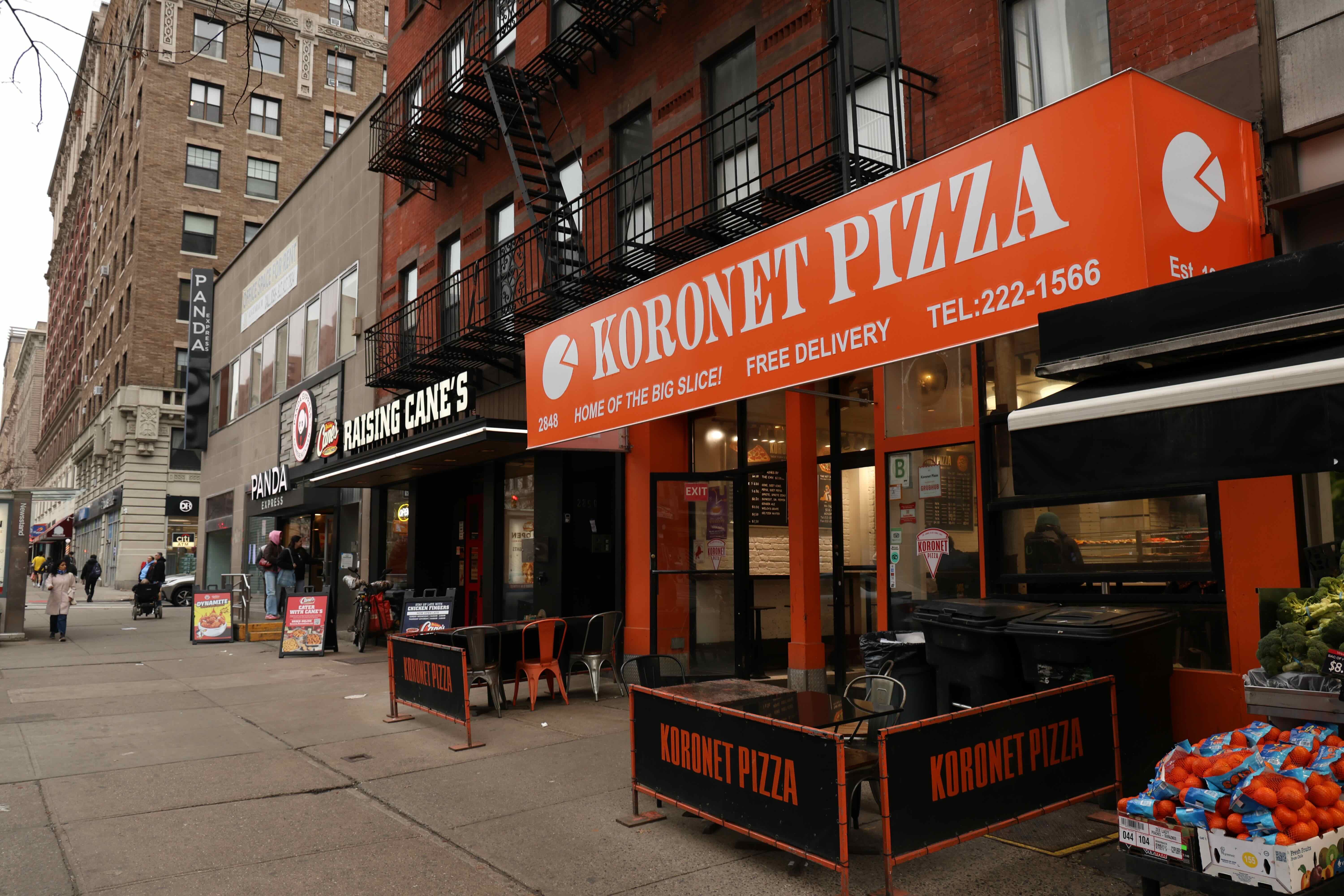
I’m talking, of course, about the arrival of large chains and big brand names to Morningside Heights, often at the expense of small, local businesses. 108th St. is far from the only casualty: Mel’s Burger Bar, a beloved Columbia nightlife spot, was replaced by a Raising Cane’s; Shakespeare & Co, a popular bookstore on 105th St., suddenly closed last year; and, across the street, Silver Moon Bakery forcibly relocated after disputes with its landlord over rent.
These are just the examples current Columbia students have witnessed. From Pret A Manger and Shake Shack to Hashi Market and Dos Toros, chances are your favorite chain store stands where a beloved local establishment once stood less than ten years ago.
This process of commercial gentrification, however, goes back much further in time. To understand the forces behind it, and how locals and students alike can address the problem, I spoke with Morningside Heights Community Coalition (MHCC) Program Director Dan McSweeney.
“I think the gentrification became very noticeable in the 1990s, not just for our neighborhood, but most or all of New York,” McSweeney explained. “I’ve known the neighborhood for about 55 years. As a kid, the vast majority of businesses were mom and pop shops, shoe repairs, diners… Now, Broadway is starting to resemble more of a mall or an airport food court. It’s not what we want in a New York neighborhood.”
Beyond the loss of local identity and an authentic array of options, replacing small businesses also comes with its economic costs: On Amsterdam Ave. and 108th St., Dan Cohen owns and operates Super Nice, a small bakery and restaurant. He explained that, as a local establishment, Super Nice “employs people who live locally, who spend locally, which promotes other small businesses and keeps money within the community.”
Economists refer to this idea as the local multiplier effect, in which locally owned businesses are more likely to re-circulate money within their neighborhood than national chains. Studies find that every $100 spent at a national retailer yields a $15 return for the local economy, while every $100 spent at a local business yields a $45 return.
New Yorkers likely understood this lesson at one point; during the 1970s and 1980s, the city was rather hostile to big, national brands such as fast-food chains. In 1974, Upper East Side residents collected more than 15,000 signatures to prevent a McDonald’s from opening in the neighborhood, and besides the local opposition, the city’s ongoing economic and crime issues turned off prospective chains. “Back then, all your local establishments were likely owned by your neighbors,” McSweeney told me. “You didn’t have to work for a large corporation to live in Morningside Heights.”
With declining crime rates and a resurging city economy over the 1990s into the 2000s, New York’s growing population, tourism, and foot traffic attracted a variety of chains. In many cases, chains’ greater access to investor money, marketing materials, and brand-name recognition jeopardized their small business competitors. The number of chain retailers and restaurants in the city has rocketed from about 5,400 in 2008 to over 8,000 in 2024—an almost 50 percent increase.
Beyond this citywide trend, several factors may be making it harder to do business in Morningside Heights specifically. Consider Columbia’s growing international student population: “As the University becomes more international, the commercial presence also becomes more international, it doesn’t reflect local ownership,” McSweeney argues. “For example, we’ve seen a lot of Asian-themed restaurants and shops open up, which is great, but I think many of them are not owned by local residents rather than multinational corporations.”
Then, there’s Columbia itself. The University holds a near-monopoly over its surroundings, owning two-thirds of Morningside Heights, yet neighboring businesses have struggled to effectively communicate their needs to the administration. “This new president has an opportunity to improve the tone. The most important thing to do is end the campus closure. It really hurts small businesses, annexing a large portion of the neighborhood and preventing passersby from going from one side to the other.”
Businesses that have voiced such complaints include Book Culture and Morton Williams, both of which are across the street from campus. McSweeney shared that Morton Williams even hired a lobbyist to take on the issue, while many other businesses have refrained from publicly dissenting out of fear of backlash or hostility from the Columbia administration.
That being said, Columbia’s relationship with its neighbors hasn’t been entirely negative. In fact, local businesses in the area have had “positive things to say about” the University as a landlord, citing its openness to businesses’ different operational decisions and how understanding it was with rent payments during COVID. “I believe Columbia wants to support local businesses, but does that mean they have the right to curate the commercial presence in the neighborhood? I don’t know.”
As the largest private landowner in New York City, much has been said about Columbia’s real estate conquest of Upper Manhattan. If the University really does value, as it claims, “its local community, its new friends and neighbors” and “the possibility for shared growth,” then at the very least, it should lease its growing portfolio of storefronts back into the community’s hands. In the past few years, however, it’s rewarded competitive retail space to Dos Toros and international chains Blue Bottle and Miznon.
Furthermore, the University can help work with the MHCC. McSweeney mentioned initiatives such as increased support for the employee ownership transition of local shops and restaurants, as well as the creation of a workforce development program for local residents.
Finally, New York City’s Department of Small Business Services has the power to designate areas as “Business Improvement Districts,” where money goes to maintaining public spaces while promoting local businesses. Alternatively, business associations are voluntary coalitions of primarily small businesses, used to pool together resources and lobbying power. While the Upper West Side has two Business Improvement Districts, and Harlem has a business association, Morningside Heights has neither.
For all of its real estate, wealth, and political power, the University can and should do much more to protect the local establishments that distinguish the neighborhood. In the face of rising rents, corporatizing tastes, and dissolving neighborhood identities, Columbia has the opportunity—and obligation—to be the patron of Morningside Heights’ unique character and small business scene.
Mr. Baum is a junior in the joint degree program between the Jewish Theological Seminary and the School of General Studies. He is a managing editor for Sundial.
The opinions expressed in this article are solely those of the author and do not necessarily reflect the views of the Sundial editorial board as a whole or any other members of the staff.
The other big businesses can go but Dunkin’ must stay
The good news is from 4 to 7 PM the 10-20 serves half price beer during Happy Hour.
C’mon in and say hi to Tim the bartender - every third round is usually buyback!
The 10-20 is at the corner of 110 St. and Amsterdam.
Cheers! 🍻