


I recall when my friends in General Studies were evicted from their Nussbaum dorms to make room for the largest ever incoming freshman class. At least one friendship was strained by the ensuing housing struggle, fretting over living prospects and frantically scouring the depths of StreetEasy for new shelter. From the sheer volume of complaining, you would assume they were doomed to end up on the moon, or worse, in the Bronx.
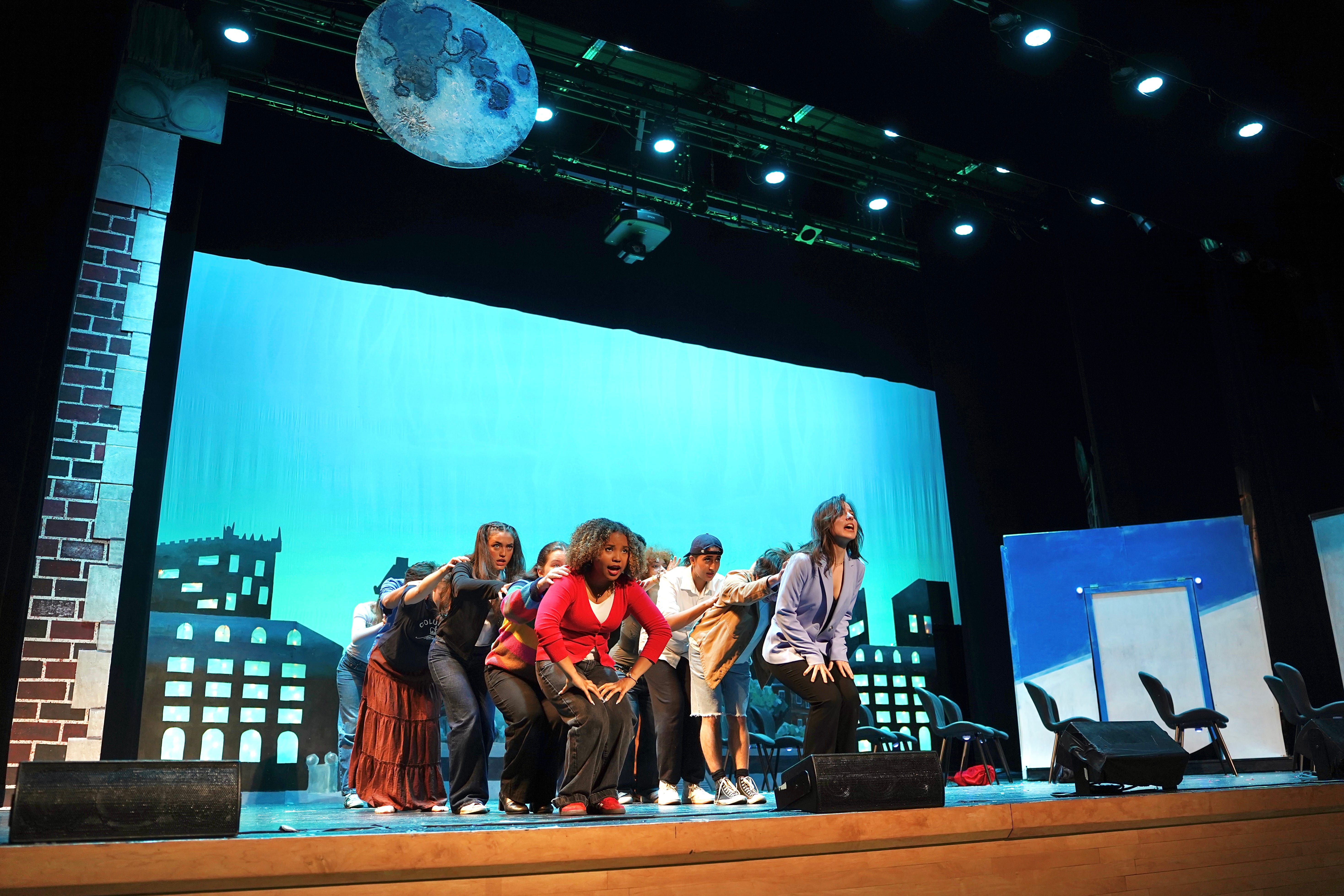
And so Columbia’s 132nd Varsity Show, titled Once on a Blue Moon, envisions an unusual solution to this year’s overcrowding issue: the establishment of a second, moon-based campus. Staged at Lerner’s Roone Arledge Theater from May 1 to 3, your favorite Sundial correspondent saw its final performance on Sunday evening. The musical makes for an enjoyable experience, compensating for a somewhat underbaked plot with wit, verve, and musical virtuosity that manages to elevate bureaucratic disputes to the level of theatrical art.
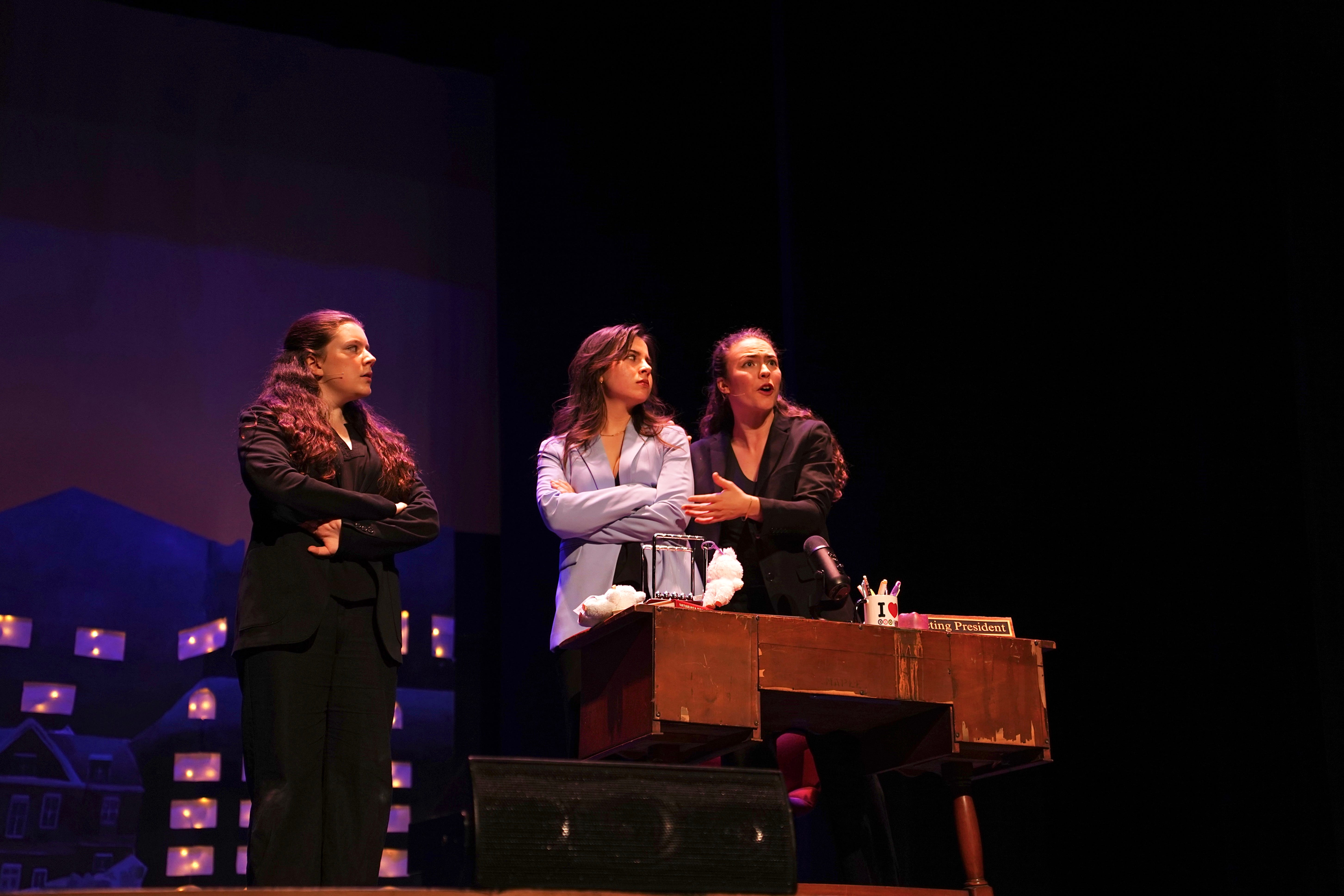
The lunar plan emerges from a spontaneously derived, lunatic solution from Acting President Claire Shipman (Ana Huesa CC ‘26). When questioned on her plans to resolve campus overcrowding, she announces that the moon is the answer, in the cartoonish manner of a Twitch streamer, blowing her eyes wide, a metaphorical lightbulb sprouting from her skull. The main body of the musical’s action—and all the heart—is to be found in the students that question and carry out this dubious action plan on Shipman’s behalf. Connie (Ariana Neal CC ‘26)—short for Concrete—and Socks (Luca Tuana i Guitart CC ‘27)—short for Socrates, naturally—are best friends and Columbia seniors who find themselves with opposing takes on the proposal that students blast off.
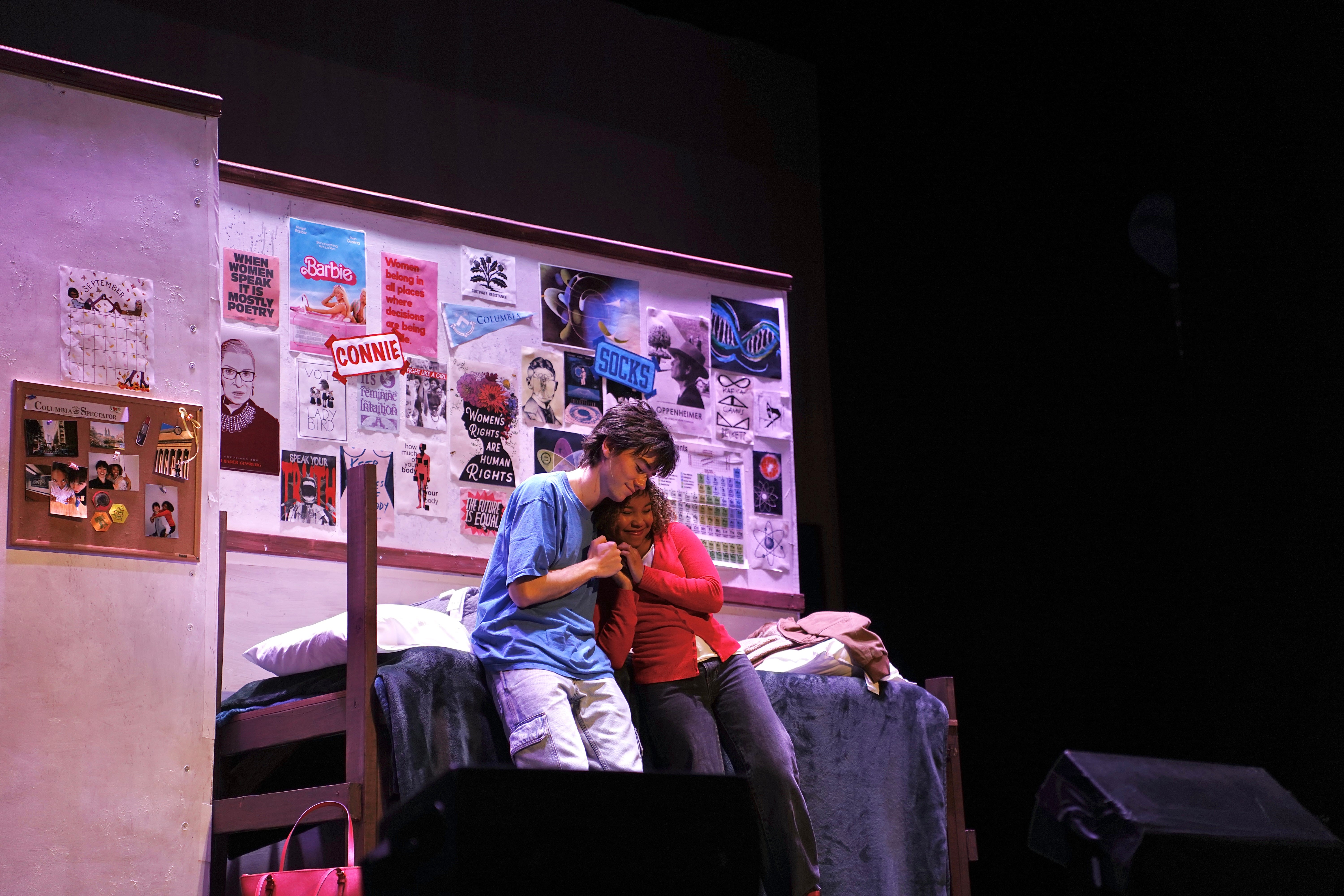
Socks, who has found himself disillusioned with the tedium and inertia of campus life, cannot wait for a semester abroad on the moon—a relatable, if otherworldly, take on seniors who can’t wait to depart for the real world. Connie, while initially full of enthusiasm as she volunteers to recruit students for the moon landing, comes to recant her initial support as she realizes—to her horror—that the plan is a ploy for Shipman to rid campus of “undesirable students”: misfits who won’t be missed by the greater student populace.
Further mayhem ensues after students are shipped away, attempting to form a community on the moon while their earthbound counterparts wrangle with a separate dilemma. It turns out that while liftoff goes smoothly, Shipman neglects to provide an engine other than the fans from John Jay dining hall. Thus, students and Professor Hart (Kai Joseph CC’26) are left to devise a solution to bring their friends home. Meanwhile, the students on the moon are faced with the question of whether returning to earth is worthwhile, given administrative faults that don’t exist in their newfound campus commune.
I found Socks’ words from the moon campus particularly resonant. He articulates his desire to escape or transfer to “NYU, Fordham, Pace… or anywhere that doesn’t feel like a competitive pressure cooker full of miserable overachievers and administrators who couldn’t care less if you were drowning.” In the catchy ballad “Moon Over Manhattan,” he belts his grandiose desire for community that he finds lacking in Morningside Heights.
Personally, as someone who has found herself frustrated with the state of Columbia and has spread the rumor that I was transferring to NYU solely to see my friends’ comically horrified expressions, I found the musical a dramatic profession of discontent that often turns ironic. Though people might not like it here, the idea of leaving is still anathema.
The musical features several catchy numbers, lampooning issues at Columbia with an eye for detail that reflects the affection that persists alongside exasperation. “Oh, the Humanities!” parodied the Core, detailing its conflation into one class called “Humhum” due to overcrowding. As Professor Hart proclaims in a song, “Mozart may seem very far from Marx / But put the two together: there are sparks!” The wit shines through with this number, addressing the irony in how the humanities are compressed to a generalizable object of scorn, compared to STEM fields and the pseudo-intellectualism characteristic of the Core of putting unrelated subjects “in conversation” with one another. In the Humhum class where Connie and Socks meet their classmates, various characters’ dilemmas—from a hapless freshman’s overdependence on AI (Josh Chang CC’29) to a Barnard student responsible for the Fakemink Bacchanal debacle (Gaia Di Mitri CC ‘27) to the chronicles of an arrogant finance-bound rower (Anoushka Sharma BC ‘27)—are tackled.
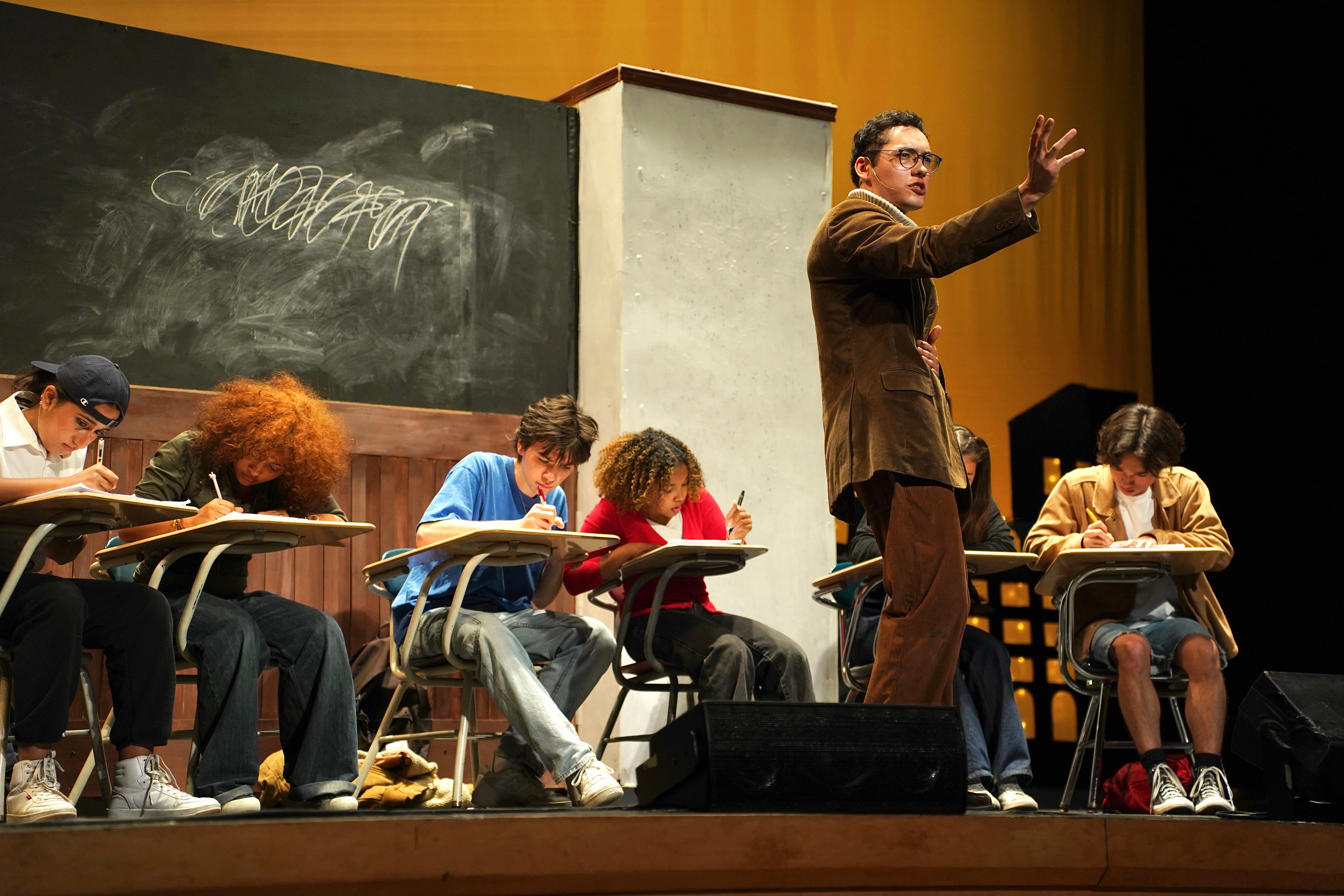
The musical strikes home the hardest at times like this—when specific details testify to the goofy, unique nature of Columbia: from the usage of fans from John Jay to launch the rocket to the uncommon friendships that emerge from Core classes. The show reflects both the desire for an idealized version of community as well as the genuine connections built on campus every day. The set design (Matthias Pridgeon CC ‘29) was also exemplary, seamlessly transitioning from campus building and dorm interiors to the moon and back.
Unfortunately, once half of the students arrive at the moon campus, the play’s vision becomes muddled. Save for the sky’s coloration, the moon location is essentially identical to the original earth campus—and while the point remains that students on the moon feel liberated by the lack of administrative oversight, the vision for how students actually develop solidarity doesn’t feel terribly fleshed out. The message of togetherness that unifies students on both campuses felt rather inauthentic and rushed.
Following the staging of the musical, one of the lead writers, HeeJee Yoon (CC ‘27), agreed to an exclusive interview with Sundial.
When asked about how the writers landed on the idea of relocating students to the moon, Yoon reflected that characters’ varying views of the moon mirrored its transitioning phases. The moon is first Socks’s transfer fantasy—a place he will finally belong, ripe for romanticization—and then a wonderful place for the students to study abroad in a place untouched by campus fatigue. “I really put myself in the shoes of the space students. If I found this wonderful, perfect version of Columbia, would I really want to leave? And I really liked the characters’ decision [to return to earth]. What is the point of utopia if not to share it with reality?”
She continued, “I feel like that touches on some of our beliefs in the Core Curriculum, too. Why do we learn such wonderful abstract values? Why do we take CC? Why do we take LitHum?” The core classes enable students to apply “the epitome of beauty… to the people around us.” Thus to Yoon, “the moon represents a lot of different things,” all managing to encapsulate “what an education at Columbia is to experience.”
Several facets of the show enabled Yoon and her fellow writers to examine elements of Columbia in closer detail. The decision to make Connie a University senator came from the writers’ desire to highlight an aspect of student government that many don’t know about, and the focus on Core classes came from Yoon’s apparent love for it, a passion which took me by surprise. “As a Core lover, I just feel like the Core Curriculum has opened me up to so many different possibilities, so many different understandings of the world,” she said. “I learned so that I can apply [what I’ve learned] to the world,” she said. This proclamation brought the phrase “you do you” to mind, as not every student would be so inclined to grant rave reviews to the Core.
The depiction of Columbia’s administration also came from real-life observations. Yoon found video communications from Shipman “very professional and scripted” rather than authentic and honest. She once attended a Senate Plenary meeting discussing a new policy that would require faculty to get approval “to put something on their door… Things could get taken down and a senator had raised this [concern] and Claire was just kind of like, ‘I didn’t know this was happening,’” Yoon reflected. “That level of incompetence and irresponsibility is dangerous and has genuinely harmed students’ lives.” Thereby, the choice to depict the acting president as a Twitch streamer “would kind of meld all these traits” she’d observed of Columbia’s outgoing president (interim president?).
Speaking on the unification of students at the end, she expressed that the ending was not intended to feel unrealistically hopeful but to profess a more grounded sense of optimism, one that “really has to come from the students and not from up there, I believe. And it’s also not naive hope that the student government can fix everything alone.” She said she wanted viewers to walk away with hope, as difficult as it is to come by these days.
According to Yoon, the Varsity Show is “saying that the only alternative to institutional loneliness is mutual investment. Characters like Connie should not just have to martyr themselves and characters like Socks should not have to disappear to feel seen,” she told me. “Students shouldn’t have to wait until, I don’t know, a spaceship has launched, to realize that they matter to each other.”
How political should the Varsity Show be, and how is one to balance addressing serious subjects that have emerged this year with the levity of a satirical musical tradition? Yoon said this was something that the writers wrangled with throughout the process, deciding to veer away from addressing the tricky subject of ICE detainments while not steering clear of difficult truths. “The show is a lot about collective responsibility, and that doesn’t mean everybody suddenly becomes the senator or reads every governance document. It really means refusing to let people do the work of care isolated.” She added, it was about “understanding that community isn’t just school spirit, it’s a really intentional practice of attention.”
Institutional fatalism is indeed endemic to Columbia. The concept, as defined by the feminist scholar Sara Ahmed, refers to the desire of institutions to quash rebellion by making confrontation seem pointless, deterring students from lodging complaints. The truth is that, even if complaints and objections to campus policies are disregarded by the administration, their mere existences will build on each other. Collectives are ultimately the solution to dismantling institutional fatigue and exhaustion.
Although the show’s signaling became muddled at times, I thought the message reflected an admirable attitude of care for our school. The solution espoused by the Varsity Show is not only to point fingers at the tiresome administration, but to link arms. Yoon recalled starting a tradition of dressing up for Halloween in an inflatable dinosaur costume and handing out chocolate kisses in Butler; I can think of several notable moments of my own. Complain we shall, yet we won’t transfer to Brown or Hogwarts or any other fictional institution, as Connie lambasts our ostensible rivals in the show.
Those of us who aren’t graduating will fly home for summer break, but we’ll be back to play among the stars. Just you wait.
Ms. Rohslau is a senior in the dual BA program with Trinity College Dublin and the School of General Studies. She is a staff writer for Sundial.
The opinions expressed in this article are solely those of the author and do not necessarily reflect the views of the Sundial editorial board as a whole or any other members of the staff.

Great review. Wish I’d seen the production.