


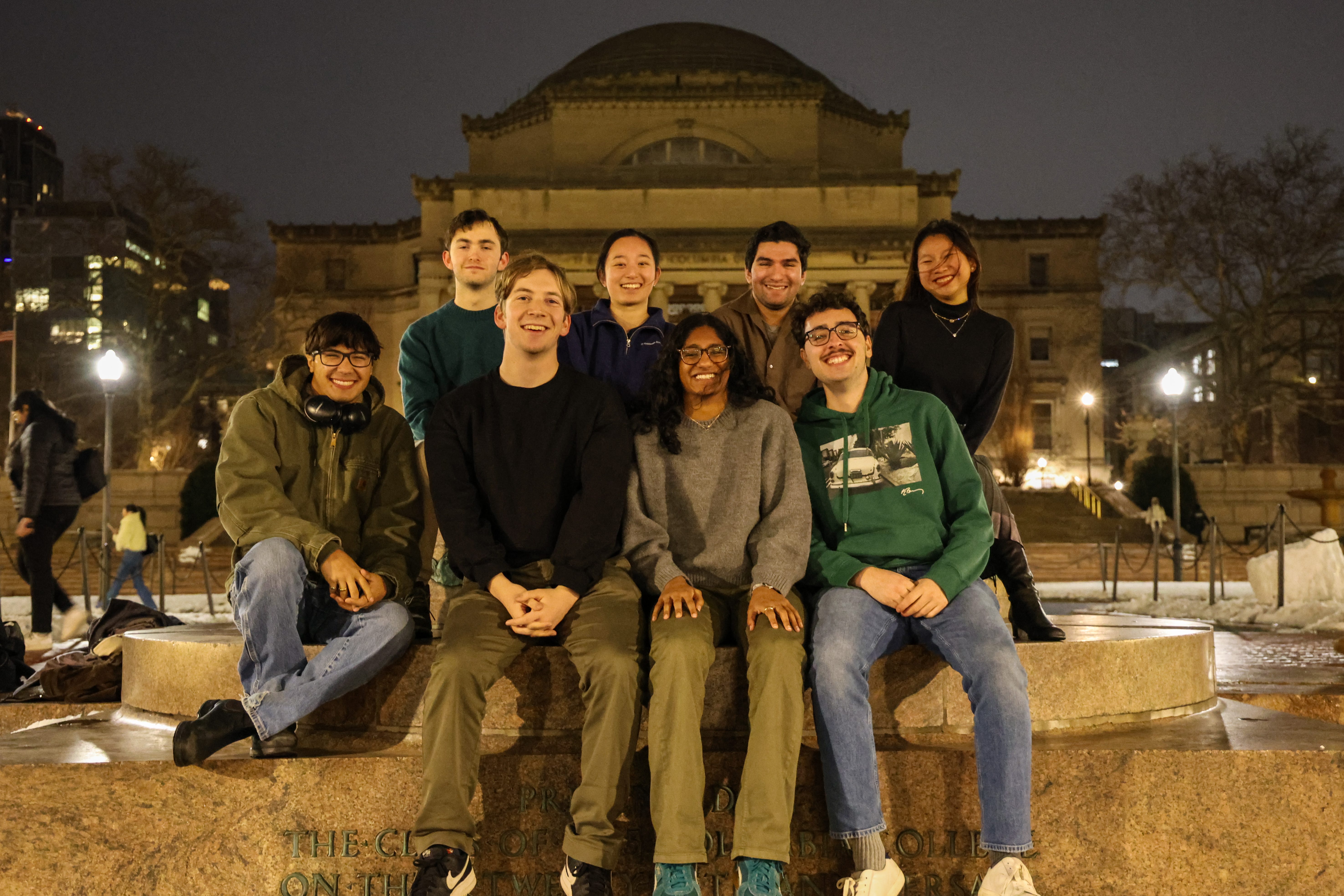
Editor’s note:
This is the first time Sundial has profiled our staff. In these pages, our writers are usually reacting to campus news or social events. This is especially true in this edition. In contrast, the details below are things our senior staff members feel no obligation to share. They are personal in the sense that they are the kinds of conversational matters that one willingly reveals to peers and friends. That, we would say, sums up the spirit of Sundial.
Beyond the diverse intellectual influences and interests of our editors, it is glaringly obvious to us—and I hope it is to you too, dear reader—that we spend our days writing and editing for Sundial because of the community and the types of people who join. All our senior staff members make some reference to the unique culture at Sundial that makes writing for this publication worthwhile. We hope these profiles give you a taste of what Sundial has to offer—and, if you find yourself in need, some reading recommendations.
Why do you write for Sundial?
What’s the biggest challenge facing Columbia in your view?
Who is your biggest intellectual influence?
What is one piece of media or literature you would recommend to the Columbia community, and why?
—Imaan Chaudhry, Deputy Editor
Alex Nagin, Editor-in-Chief
I believe firmly that intellectual comfort is antithetical to higher education. First and foremost, I apply this belief to myself. I spent my time before Sundial in leftist echo chambers—first my New York bubble, then for my first two years of college in Ireland. I never had a problem with this—then came Sundial. It was refreshing to join a college newsroom that didn’t settle for “acceptable” ideas, and one that challenged me to articulate myself beyond platitudes.
Columbia’s biggest challenge is our institutional integrity. It’s deeply regrettable and ignominious to me that our leaders did not react to Trump’s assault on our university the way Harvard did.
My father. He is a bibliophile, lawyer, and family comedian wrapped into one. What I draw most from him is his humor—like any good journalist, he is deeply observant of the world around him. To see the world through humor and use it as a vehicle for truth is something I seek to emulate.
From Beirut to Jerusalem by Thomas L. Friedman. Friedman accounts for his time as a journalist living in both Beirut and Jerusalem as a reporter for The New York Times in the ‘80s. As an American Jew, he wrestles with the propaganda machines of both the Israeli government and the Palestine Liberation Organization, reflecting on how their respective legacies impact their progeny. This book changed the way I think about the Middle East.
Imaan Chaudhry, Deputy Editor
I have a good time. I’ve been involved since Sundial’s inception, and I enjoy that we do not take ourselves too seriously. This creates a collegial environment where one is free to think, argue, write, and repeat. If Alex, let’s say, started running a tighter ship—forcing us to take LinkedIn-esque headshots or begin thinking about “our brand image”—I would have left a long time ago.
Columbia needs to operate less like a business and instead prioritize the moral development of their students. The solution is right under our noses—an increased emphasis on the Core. This makes the problem all the more frustrating.
G.K. Chesterton. He was a classical conservative, Christian apologist, and novelist.
Literature Humanities is unfortunately wasted on the young. If we are serious about the claim that a liberal education can turn us into better versions of ourselves, we actually have to live up to it. I would hate for any Columbia student to forget what they learned here and be uncritically shaped by popular culture. For seniors especially, reread (or read for the first time) texts from the course outside of an academic context. Over break, I reread St. Augustine’s Confessions.
Emma Shen, Deputy Editor
For me, being part of Sundial goes beyond what I write and is more about the people who choose to join our publication. We all come from different backgrounds and hold vastly different beliefs, yet we share one thing in common: our openness to new ideas. Even though we’ve had many lively disagreements, I’ve never felt more comfortable sharing my opinions because I know they will be evaluated in good faith.
“Ivy League Syndrome”
Definition: the fear of being wrong; the unwillingness to be proven wrong
Columbia supposedly selects the best students from around the world who are accustomed to being the smartest in the room. This becomes a problem when trying to engage in honest discussions with one another. Honest conversations require a certain amount of humility since the goal is to learn from the other person rather than prove them wrong.
Viktor Frankl. Man’s Search for Meaning is by far the most powerful book I’ve ever read. Frankl’s reframing of the question, “What is the meaning of life?” to “What is life asking of me?” is a very effective response to the nihilism that affects a lot of people today.
Amusing Ourselves to Death by Neil Postman. He contends that our culture is dominated by media forms that prioritize entertainment, which weakens public discourse and our capacity for critical thought. The Great Divorce by C.S. Lewis is also a great read. I find it to be a deeply thoughtful exploration of heaven and hell.
Oren Hartstein, Senior Editor, Incoming Editor-in-Chief
I like to see if ideas can hold up under scrutiny. Sundial is the same way. We have fostered a community that’s passionate about a host of topics and understands how to respectfully discuss them. I love engaging in these debates and have enjoyed publishing pieces on everything from Critical Theory to AI to the war in Gaza.
Columbia is facing an identity crisis. Historically, the University has been defined by two things: a culture of activism and the production of well-rounded students. Both have been hollowed out. Performative activism has stifled opportunities for honest discussions on key issues, prioritizing outrage and emotion over intellectualism. Worse, the student body seems to have traded curiosity for employability. We are less interested in becoming interesting people and more focused on becoming hirable ones. The pressure of the job market is quietly dismantling the mission of the Core.
The philosopher and logician Bertrand Russell. A giant of formal mathematics, Russell distilled math into pure logic. His dedication to rigorous truth-seeking holds lessons for mathematicians and non-mathematicians alike. But what truly inspires me is his versatility. He didn’t hide in the ivory tower; he was a public intellectual who applied the same rigor to global politics and morality as he did to mathematics.
Remains of the Day by Kazuo Ishiguro. I love his writing style. He has this incredible, minimalist way of packing a huge emotional punch without being overly dramatic. Remains of the Day is a beautiful—albeit depressing—account of loyalty and regret.
Xinyan Chen, Staff Editor, Incoming Deputy Editor
I wanted a space where I could explore ideas freely without the expectations of pursuing an assigned pitch—Sundial makes room for my thoughts to breathe and evolve. I appreciate how other writers in our newsroom tease out ideas in a way that is challenging but not antagonistic.
I feel like we’re all too scared to approach each other in person. We’ve become too accepting of social isolation. The times when I’ve risked approaching others have been the catalyst for some of my most fulfilling friendships; I think if we were all less scared of rejection, Columbia would be a much happier place.
Joan Didion. The way she saw right through the world as if it were transparent inspired me to start writing essays and nonfiction. I deeply admire the inimitable way she made her internal experiences legible, her intolerance for the lies that we often tell ourselves to feel better, and her atmospheric descriptions of real people and places.
The Dispossessed: An Ambiguous Utopia by Ursula K. Le Guin. Her narrative sleight-of-hand subverts the traditional “good vs. evil” taxonomy and focuses on what “revolution” actually entails: “I want the walls down. I want solidarity, human solidarity.” In a world often blind to nuance, I urge everyone to read this book and be reminded that, while we are not privy to the telos of history, it is upon us—and only us—to steer the wheel.
Nick Baum, Senior Editor, Incoming Managing Editor
In what other magazine can I go from explaining the history of Riverside Park to analyzing Columbia’s free speech problem to interviewing the head of a Harlem synagogue? Unlike most publications, Sundial doesn’t confine its writers to a particular department or subject area. Instead, I have the liberty to incorporate my various interests into stories that I think the Columbia community can enjoy and learn from.
Whatever happened to doing the things that genuinely interest you? Our college lives are more than just the sum total of everything that can be squeezed into an 8.5” by 11” resume. The liberal arts education is not just about becoming more marketable, but also about becoming more human. One of the best choices I’ve made at Columbia was joining Sundial and actually writing about the things that fascinate me.
Easily John Stuart Mill. A free speech absolutist, he contends that even if we’re 99 percent sure a given idea is wrong, it still ought to be heard, as “the clearer perception and livelier impression of truth” is “produced by its collision with error.” This introduces foreign concepts like humility and listening to those we disagree with. Talk about Sundial-coded.
I took that above quote from Mill’s 1859 essay On Liberty, a brilliant argument for the free and open exchange of ideas, as well as required reading for the Columbia Core. If you skipped it, this is your sign to go back and read it!
Uma Rajan, Senior Editor
Sundial is one of the few environments on Columbia’s campus where there is true ideological diversity. I’ve had very productive conversations with staff members whose opinions differ from mine, and have become a better listener and writer as a result. Sundial also emphasizes covering a writer’s interests rather than assigning prescribed beats. This freedom to pursue any idea I may have also made Sundial more appealing to me.
Columbia’s biggest challenge is ideological siloing and the impact it has on individual thinking. As some of the smartest young minds, we not only live in echo chambers but prefer them to being challenged by different perspectives. This unwillingness to listen reduces curiosity and civic trust in others.
George Orwell. 1984 is a classic book for good reason, and its warnings of surveillance, institutional overreach, and manipulation of truth remain as relevant today as they were back then.
We already read plenty of serious literature for LitHum and CC, but I think messages are sometimes best transmitted through humor. Philip Roth’s The Human Stain and Aravind Adiga’s White Tiger use satire to critique contemporary issues, making them really engaging to read.
Nate Maretzki, Senior Editor
I write for this publication simply because I want to tell interesting stories. I am endlessly fascinated by the cultural history of an institution as old and diverse as Columbia, and my work at Sundial has affirmed my belief that there is a story worth telling in every pocket of campus life. This tremendous staff has pushed me to stretch my curiosity and explore the things that make this school strange, vibrant, and alive.
I will shamelessly echo Nick: there is an appalling lack of people doing things that they actually care about here. It saddens me that passion so often gets buried under pressure and the mad careerism rush. Wanting to go into finance doesn’t mean you have to sacrifice everything interesting about yourself.
Rick Rubin. The Creative Act has fundamentally reframed how I think and write. And Kurt Vonnegut, always.
David Foster Wallace’s Consider The Lobster is a breathtaking piece that I would be lucky to emulate in even the smallest way. It represents what journalism has the capacity to be, and I think everyone should wrestle with it at least once.
Nikos Mohammadi, Senior Editor
This is the one publication that will (to some degree) platform my crazy “horseshoe” takes! Sundial is a place where radically different ideas are on full display, where disagreement amongst our staff is never discouraged or seen as some sort of hindrance, and where I can write pieces and report stories honestly—sans fear of repressive ideological censorship from my higher-ups.
The single biggest challenge facing Columbia is that, too often, we find ourselves engulfed in bitter and senseless animosity, performative activism, and dogmatic worldviews. Contrary to the belief of many campus conservatives, while this is certainly an issue for progressives, it is also one for many right-leaning students.
Hunter S. Thompson. I first encountered him in my more anarchist left-libertarian days in high school, so I probably agreed with his worldview and lifestyle choices—calling everyone that he didn’t like a “fascist” and getting high off mescaline somewhere out West—far more than I do today. While I certainly wouldn’t recommend his journalistic “ethics,” whatever they even were, he made getting into journalism and writing sound really cool.
Shopping in Jail, Douglas Coupland. A superb analysis of 21st-century capitalism: a depraved, endless mall, where we have become prisoners. My favorite excerpt, from page 63: “...Michigan, where 10 million primates needing 2,500 calories a day are sitting on top of a cold rock in the middle of the North American continent, and they’ve got nothing to do all day except go online and watch porn, TED videos, and bit-torrented movies, and then maybe go turn a trick or score some Oxy out by the interstate, behind the closed Denny’s that’s covered in weathered plywood.”
The opinions expressed in this article are solely those of the authors and do not necessarily reflect the views of the Sundial editorial board as a whole or any other members of the staff.
Thank you for Sundial and for the courage this staff demonstrates.