


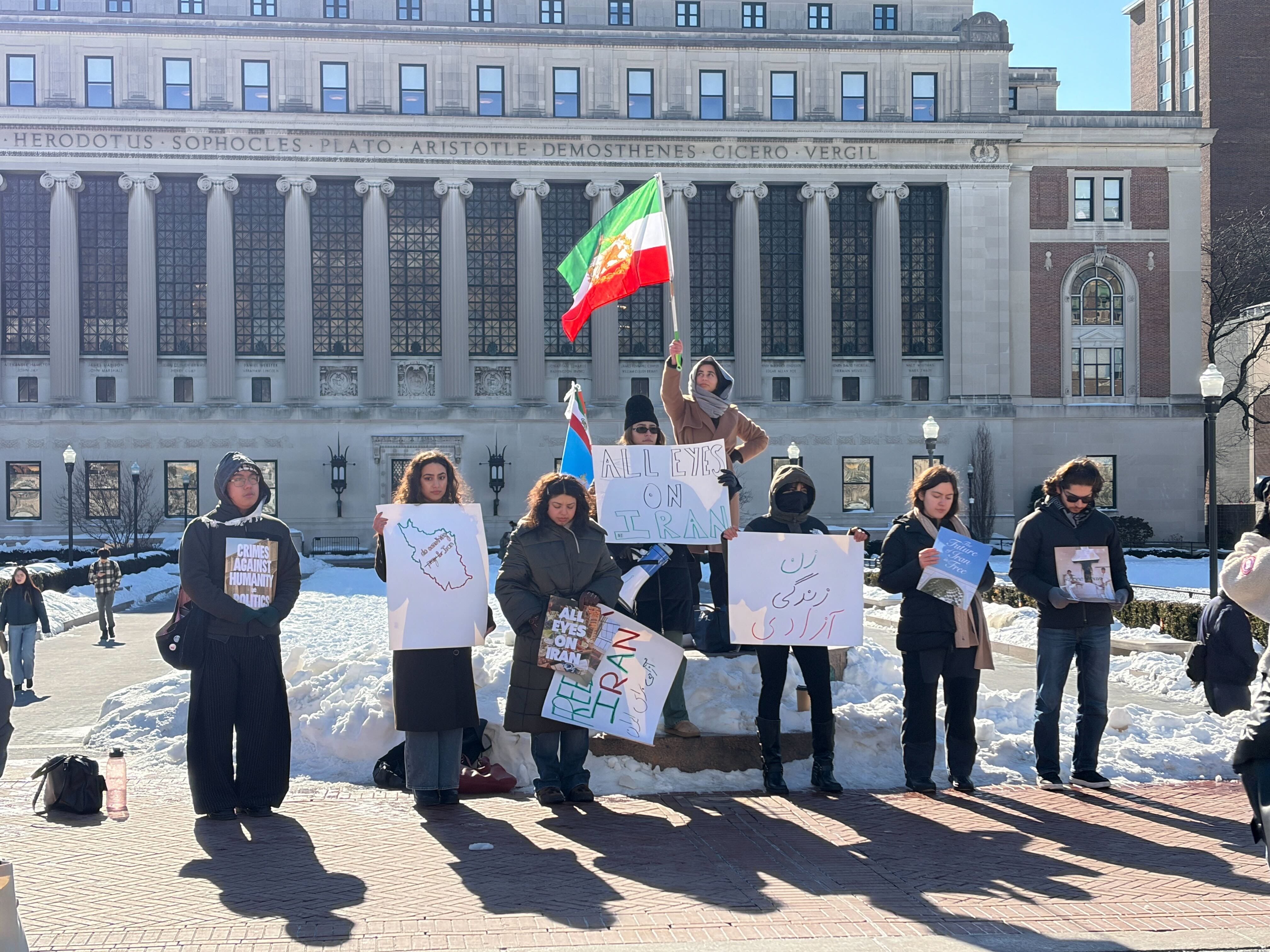
A day without a reply is inconvenient. A week is unsettling. But then silence stops feeling temporary and starts feeling terminal: You stop checking your phone for messages and start checking the news for names.
As the daughter of the single diasporic branch of my Tabrizi family, my phone buzzes with alerts and updates. Death counts, multilateral responses, and diplomatic objectives all blur together in Iran and its international lattice. All we can trust are the rallies taking place beyond Iran’s borders, including the largest Iranian rally in Europe’s history with over 250,000 participants. All we can hope is that our grassroots work counters the foreign militarization of minoritized groups, rejected House bills, the threat of boots on the ground, and Lindey Graham’s confessed lack of a US plan in Iran.
My country is an ethnography answering a single research question: How many years does it take for turmoil-induced action to finally breed development? It is a tragedy that research ethics is more heavily regulated than human rights law. For those of us tied to Iran, the consequences are not theoretical. They are lived, and they are ongoing.
Columbia’s June 2025 Presidential Committee on Institutional Voice claims that though “events in the world may prompt demands for statements of moral leadership, condemnation, support, or sympathy,” the administration has no obligation to publicly respond unless the University’s “paramount values and fundamental commitments” are threatened. This is often used to justify institutional silence during times of political turmoil.
But the current suppression of basic human rights is a direct threat to Columbia’s “paramount values.” The University need not choose nor make a statement on Iran’s political future, but it must defend the conditions that make scholarship possible. When Columbia remains silent while those conditions are violently denied to students, teachers, and researchers abroad, it is not preserving neutrality; it is narrowing the meaning of its own values.
Demonstrations in recent years have not been limited to abstract political slogans; they have emerged from wage disputes, unpaid pensions, rising prices, and workplace grievances. Teachers, students, and labor organizers internationally have repeatedly gathered to demand accountability, and have been detained not for proposing a new regime, but solely for organizing and speaking publicly.
This matters for a university because these are not merely economic complaints. They become human-rights violations at the moment expression is punished: when workers cannot organize, when teachers are arrested for petitioning, and when students are disciplined for public speech. The issue is no longer inflation or sanctions policy. It is whether people may speak collectively about the conditions under which they live.
Student activism has never been foreign to Columbia University. Columbia students have protested war, apartheid, segregation, authoritarianism, and mass human rights abuses for over a century, often shaping national discourse long before governments followed. From Vietnam to South Africa, from ethnic studies to divestment movements, student pressure here has historically forced the University to confront the moral implications of global power. Columbia’s conflict is not with protest itself but with timing and risk. The University has repeatedly articulated moral positions, including issuing public statements after Russia’s invasion of Ukraine, yet it tends to do so only once a broad political consensus has already formed. When a crisis is actively unfolding and public opinion remains contested, the administration shifts from moral language to procedural language, emphasizing neutrality, safety, and policy compliance. The result is a pattern: the University recognizes injustice most clearly in retrospect, but hesitates when recognition carries immediate political consequences. But, Columbia forgets, it does not merely observe foreign affairs; it helps define how they are debated. How can Columbia claim a headlining “commitment to attract and engage the best minds in pursuit of greater human understanding, pioneering new discoveries, and service to society” if it does not defend the conditions that make inquiry possible: the freedom to speak, to assemble, and to challenge authority without fear?
Administrators keep up this tradition because they know it is good in theory but less for their market of donors. Columbia must make its stance consistent and transparent: you either enforce free speech and the right to assembly; or you don’t. Columbia claims the former but acts on the latter. That is why Iran matters to Columbia. What the world casually calls ‘the Iranian protests’ is, in fact, a live test of the very rights this University claims to champion: the right to assemble, to speak without fear, and to dissent against state power.
The language of “unrest” no longer captures what many Iranians experience daily: mass arrests; lethal force; enforced silencing and erasure; and the systematic violation of rights that Iran’s own constitution (which is inaccessible to us outside the country due to the weeks-long internet blackout) claims to protect—freedom of assembly, due process, labor protections—alongside universally recognized human rights. In today’s Iran, these freedoms exist largely on paper. Peaceful protests are suppressed, detainees are denied fair legal process, and workers are punished for organizing. Yet, even as images and testimonies pierce the blackout, a deeper problem remains—one that has haunted Iranian resistance for decades, and now paralyzes a meaningful international response.
As a university, Columbia holds a unique position within the Iranian struggle.
From inside and across the diaspora, there are competing camps: those who demand immediate regime collapse with no compromise; those who argue for constitutional transition and legal reform; those who fixate on dynastic restoration, including Reza Pahlavi, whose symbolic appeal to some in exile is matched by deep skepticism among others who view monarchy—however modernized—as a return to centralized authority rather than accountability. These disagreements are real and unresolved.
Yet this fragmentation has consequences. When no unified political program exists, any government that intervenes risks being understood as choosing a side. And once states choose sides, authorities in Tehran easily portray all dissent as foreign manipulation. The movement is then recast not as citizens demanding rights, but as a geopolitical project.
This is precisely why institutions like Columbia matter. A university is not a government, a party, or a foreign ministry.
As a nonprofit and nonpartisan institution, Columbia does not have to endorse a faction, a leader, or a political outcome. It can do something far narrower and far more appropriate: defend the principles it claims to stand for—freedom of expression, the right to assemble, and the protection of scholars and students from punishment for speech.
The reality is that neutrality is harder to achieve than partiality. Columbia’s post-institutional neutrality investments, divestment debates, disciplinary decisions, and public statements have always communicated values. Additionally, if Columbia declines to defend these principles when they are under active assault, it is not remaining neutral. It is quietly redefining what its values mean in practice. When the University rigorously evaluates human rights claims in some contexts but hesitates in others, it teaches students a dangerous lesson: that human rights are conditional, selective, and subordinate to convenience.
Attempted neutrality toward competing political programs is appropriate. Neutrality toward the suppression of speech is not.
The University has hosted foreign heads of state, advised governments, trained diplomats, shaped sanctions discourse, and incubated policy frameworks that travel far beyond campus. Columbia professors have advised on West Asian policy, sanctions design, international law, development economics, and democratic transitions, sometimes with measurable impact, sometimes with blind spots. Iran has not been absent from this history. But too often, Columbia’s engagement with Iran has been episodic or personality-driven rather than sustained and accountable.
The 2007 Bollinger-Ahmadinejad confrontation is a prime example. While a valuable opportunity for open discourse, the event ultimately reduced Iran to a spectacle of moral theater, one night of clarity without long-term institutional follow-through. Engagement ended where discomfort began. No durable infrastructure remained for Iranian scholars, students, or civil society.
That framework is insufficient.
So what should Columbia do?
Iran’s tragedy is not only that the state kills its people. It is that spreading ideological absolutism has convinced the world to wait for perfect agreement before acting at all. The University must act before this faulty thinking infects their response to Iran.
In the short term, the administration must protect Iranian and Iranian-heritage students academically, psychologically, and legally. Trauma does not pause for finals. Speech protections cannot be selectively enforced. Emergency funding, counseling access, and clear protest guidance are not political acts; they are institutional obligations.
In the medium term, Columbia should convene without coercion. It should formalize spaces, building on student initiatives like Listening Tables, where Iranians across ideologies articulate minimum demands that do not require consensus on regime change to protect human life: internet access, medical neutrality, release of detainees, independent monitoring.
Administrators must only endorse the institutionalization of Iran not as a crisis spectacle, but as a sustained academic and moral commitment. Fellowships for at-risk scholars. Research on authoritarian resilience and digital repression. Archives that preserve testimony before it is erased. And, critically, a standing standard for how the University responds to mass human-rights violations—regardless of which country dominates headlines.
Students, too, carry responsibility. What is normalized now (i.e., disinformation, selective outrage, performative activism) will become governance later. Taking up space on campus with any and all causes is valuable and necessary. Iran is a blank canvas held up by a ghost regime. Students, pick up your tools (discipline, verification, coalition-building) and get to painting! Make history so powerful that Columbia administrators rewrite it as if they were on your side the entire time.
A university that claims to “advance knowledge and learning at the highest level and to convey the products of its efforts to the world” must act when certainty is impossible. Waiting for consensus in the face of mass repression is not neutrality.
And if Columbia truly believes its own motto, In lumine Tuo Videbimus Lumen, then it must recognize that the light it claims to offer obligates action when darkness is imposed elsewhere. Iran is only one such place. But a massacre is unfolding there now.
Giselle Sami Dalili is a Master of International Affairs candidate at the School of International and Public Affairs concentrating in development and governance. They are a staff writer for Sundial, and a first-generation American of Azeri-Iranian descent.
The opinions expressed in this article are solely those of the author and do not necessarily reflect the views of the Sundial editorial board as a whole or any other members of the staff.
Why do Ivy League care about a country in Middle East (like Israel)?
Giselle, You might also remind the Columbia community of the unfortunate too welcoming invitation to an Iranian despot some years back https://magazine.columbia.edu/article/ahmadinejad-columbia-campus-view. I share your hope for a better future for the Iranian people and freedom from the authoritarian regime that hijacked the "revolution" from the diverse groups that supported the overthrow of the Shah, tragically too often imprisoning or worse, its former coalition allies. Sincerely, Eric SIPA 84