


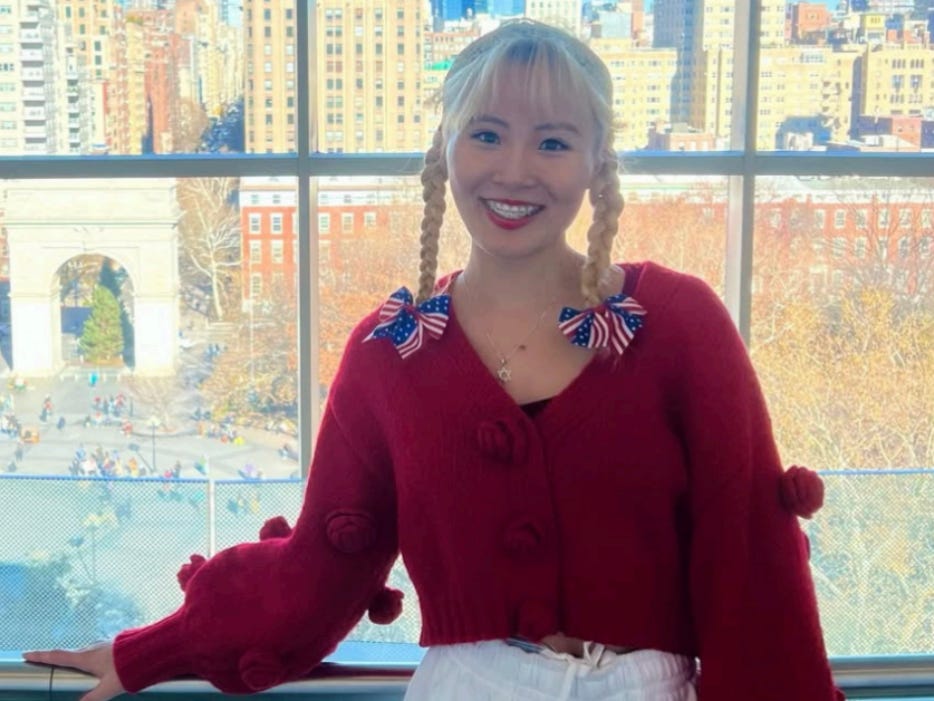
Xinlin Sherry Chen, GS ’26, was already waiting outside the Butler Library lounge when I arrived. We locked eyes. She was easy to spot—a real-life cutout of her online self—a neat blonde braid tied with an American-flag bow, a Columbia-blue hoodie, and, for the December chill, beige trousers instead of her usual Columbia-Lululemon miniskirt. This was Sherry—the self-styled “MAGA Chinese girl,” a Columbia-Sciences Po dual-degree student majoring in economics and political science who has built a high-profile online presence through opinionated social media posts in the U.S. and China, fueled by her outspoken Republican views and her bold ambition to become the U.S. Secretary of Defense. Online, her posts have attracted fascination and disbelief, leaving readers to wonder whether she is sincerely ‘crazy’ or intentionally provocative.
In person, she was as outspoken as her writing: unafraid, unembarrassed, and unbothered by who might overhear her bold remarks. Yet, she also came across as the sort of classmate I could imagine venting with after class or grabbing boba with on Broadway. Her persona is summed up in her LinkedIn “About” section: “when I grow up, I will become a Mother of American Children and the Guardian of America‘s National Defense.”
In a campus culture that often leans predictably liberal, Sherry’s politics—loudly pro-Trump, defiantly conservative, and shaped by her experience of growing up in China—make her a symbol to some, a provocation to others, and a mystery to almost everyone watching from a distance. I wanted to peel back the performance and uncover the person underneath.
Where did it all begin?
“When I was in kindergarten I said I wanted to be the president. Everyone was applauding. And my dad was so happy. He asked me where: in China or America or somewhere else? At that moment, I didn’t even know what America was. My dad was probably joking with me, but he liked the idea that I’m ambitious and big. Nobody ever told me you cannot think like that.”
Sherry described her upbringing as shaped by two worlds: “I stayed in Pennsylvania for about the same amount of time as I’ve lived in Shanghai, and I traveled a lot in between.” She attended a private school in Shanghai and later The Baldwin School in Pennsylvania before entering the dual-degree program at Sciences Po and Columbia University.
When pressed for a more concrete timeline, suggesting she might have spent roughly half of her life in each place, she rejected my inquiry. “There isn’t really a clear line,” she said. “I see both as my hometown. Both define my culture and upbringing.”
Sherry says each system taught her something different. “In China, there’s a strong emphasis on discipline, community, and rules. Those early experiences built my resilience and persistence,” she said. “When I came to the United States, I went to an all-girls private school in a wealthy suburb, where I was exposed to literature, philosophy, and political writing.”
She recalls reading works ranging from The Great Gatsby to 1984, as well as the U.S. Constitution. “At the time, I didn’t fully realize its influence. But the more I studied, the more I came back to it. It defines America as a nation and shapes Western liberal democracy. I think that’s amazing.”
“The First Amendment is my backbone”
When the conversation turned to the public criticism she’s faced, Sherry was candid. “Sometimes there are anonymous attacks,” she said, “but overall, I believe I should have courage and confidence in the First Amendment.”
Throughout our conversation, Sherry returned repeatedly to the First Amendment as a source of reassurance. “It empowers people to share ideas, whether serious, academic, imaginative, or even quirky,” she added. “I think the Constitution is a backbone that empowers me to have the courage to share my ideas to the people.” To her, the First Amendment is not simply a safeguard against government censorship and punishments as it was established to be. Sherry phrased it as the “backbone” that gives her both the right and the confidence to say whatever she wants, despite her detractors portraying her as irrational or, in more extreme cases, a spy penetrating U.S. politics.
In her online articles, too, she repeatedly mentions the First Amendment. In a November Linkedin post, she wrote: “I receive plenty of negative comments online. But I don’t mind. I have my free speech, and so do my readers. There are a thousand Hamlets in a thousand readers’ eyes, and I welcome every interpretation. Plus, their doubt and criticism are understandable. After all, they’ve never seen someone like me.” While the rest of us shy away from online controversies, fearful of being torn apart and devoured by the internet, Sherry vigorously throws herself into the spotlight.
“Like Ailing Gu”
Sherry declined to elaborate on her citizenship status. “I don’t want to talk about it,” she said.
The conversation eventually turned to the Trump administration’s ICE raids. “For me personally, it didn’t bother me,” she said. “Because I had already gone through all of those immigration processes.” As for whether she felt concern for undocumented individuals, legal visa holders, and the countless immigrant families affected by the current administration, Sherry again maintained her refusal to comment.
“I don’t want to talk about that because I don’t know much about the details,” she said. “And I don’t want to comment on something without a full understanding in a formal article. I’m afraid of being misquoted.”
When asked whether publicly embracing both of her national identities had ever caused her trouble, particularly given rising tensions between China and the United States, Sherry responded confidently. “Think of Ailing Gu,” she said, referring to the 22-year-old Chinese-American skier. “She has a lot of controversy around her nationality and citizenship, and I do as well. But I think that’s something a global citizen should train for.”
Eileen Gu, who is known as Gu Ailing in China, won gold medals in big air and halfpipe and a silver medal in slopestyle representing China at the 2022 Beijing Olympics. Born and raised in San Francisco to an American father and Chinese mother, Gu’s national identity has been the subject of debate. She has often navigated that complexity by identifying as American while in the U.S. and Chinese while in China.
Just as Eileen Gu frames herself as a bridge between China and the U.S. through athletics, Sherry hopes to “[translate] across East and West civilizations.” She envisions doing so from an entirely different position: U.S. Secretary of Defense.
“I want to protect”
“I’ve always wanted to go into politics,” Sherry told me. “I specifically want to work in national defense because it aligns with my vision to protect people.” However, despite being a vocal Trumpist, Sherry disagrees with Trump’s rebranding of the Department of Defense as the Department of War. “A lot of people try to correct me and say the position is called ‘Secretary of War.’ But I don’t like that term, because the purpose of national defense isn’t to initiate war—it’s to protect people’s lives. War can sometimes be a necessary method, but that’s not the purpose. I don’t like to call it war.”
She again emphasized the theme of protection when explaining what first drew her to conservatism and Trumpism. “I’d say Charlie Kirk’s argument that men should protect and provide for women was what first attracted me.”
“Men and women are not the same,” she elaborated. “I think we are equally important, but we’re not the same kind of creature because we’re not biologically similar. [Charlie Kirk] always talked about how men should protect and provide. Women have their values. They are so precious. I think that’s empowering. I don’t regard it as belittling.”
“I don’t think saying ‘protect’ means women are less important. We are equally important. And I do want to be protected by men, and I am. If my dad didn’t take care of me financially and spiritually, I wouldn’t be who I am now. So I cannot live without men, nor do I think any woman should.”
She added that what she finds most empowering is women’s biological capacity to create life. “I have the power to create human lives with my body,” she said. “I can choose not to, but the point is that I can—and men cannot. Isn’t that amazing?”
Her belief in biologically determined gender roles raises an unresolved question: Where, in that framework, does a woman in command of national defense belong? Sherry’s reasoning suggests that she embraces traditional gender ideology selectively, supporting the elements she believes empower women while rejecting those that constrain them.
“If women want to pursue politics, law, or careers, we should have the right to do so. But I don’t think biological differences are harmful to mention. For me it’s empowering. And it explains why men and women need to collaborate.”
When it is pointed out that many advocates of traditional gender roles also argue that women are unsuited to professional environments and should be restricted to the domestic sphere, Sherry dismisses that idea without hesitation. “That’s wrong,” she said, “but if a woman wants to do that, it is her choice.” She added that she does not believe Charlie Kirk advocated for traditional gender roles to undermine women in contexts where gender inequality is already severe. “We shouldn’t take people’s words out of context,” she said.
Why not China?
“I [chose to] do politics in America because it suits my personality more,” she said. At the same time, Sherry strongly supports the PRC, People’s Republic of China. “The political system in China is designed for the people [of China], it’s suitable for the Chinese society. The same political system would not be suitable for America.”
Sherry said she loves China and does not criticize its political system, but does not see it as the right environment for her political ambitions. This is why she openly affirms her Chinese identity while simultaneously building a career in American politics. In an article originally published on WeChat that she has since taken down, Sherry openly expressed her determination to advance what she calls the CCP’s “soft influence”—shaping positive perceptions of China through culture, education, media, and public diplomacy.
Sherry doesn’t back down from displaying her background or her admiration for the CCP, even though she knows this can be a liability in American politics. “I think it’s more important to be authentic and truthful,” she said. “I don’t want to lie to myself, and I don’t want to lie to my supporters or my haters—no matter if you like me or not. I am who I am.”
Afterthoughts
After talking with Sherry, I still found myself startled by much of what she had to say. In conversation, she didn’t come across as performative; instead, she was unapologetically herself and unshakeably confident with a touch of naivety. When she explains her views in depth, they begin to make sense within her own worldview—yet only within it.
In her worldview, free speech functions less as a civic principle than as a shield against the criticism she receives from Americans across the political spectrum in addition to Chinese people. Her particular understanding of the First Amendment leads to her seeing controversial statements as not only defensible, but as a strategic way to build visibility while claiming to serve the public.
The same dissonance surfaces in her embrace of traditional gender roles. As she praised Charlie Kirk’s vision of male protection, a question kept circling in my mind: Protection from what? From other men? From our drinks being spiked? Being followed home? Catcalling?
What Sherry calls “empowerment” reads instead as a narrow reverence for biology—women are sanctified only because we can reproduce. Fertility is elevated into the highest purpose, cloaked in the language of honor, while women themselves are reduced to mere vessels.
Biological determinism has long been used to exclude women from leadership, warfare, and governance—the very arenas Sherry hopes to enter—and continues to justify harm towards the transgender community. Her position rests on a selective reading of gender ideology: She embraces biological difference when it flatters women’s dignity, yet appears unmoved by its political consequences when those same ideas are used to deny equity.
In Sherry’s worldview, her ambition to become U.S. Secretary of Defense and her admiration for the CCP is a form of cultural bridge-building and strategic self-branding. The obvious tension in this political alignment did not dissuade her in the slightest—she chases her dreams like a pulp-fiction American hero, invincible to fear or embarrassment.
Sherry’s courage and audacity, confidence and narcissism, positivity and naivety tread a fine line. To some, she is a free speech heroine; to many others, she is a bewildering campus punchline.
Whether heroine or punchline, Sherry occupies an unsettling space where sincerity and spectacle become indistinguishable.
Ms. Zhang is a junior at Barnard College studying anthropology. She is a staff writer for Sundial.
The opinions expressed in this article are solely those of the author and do not necessarily reflect the views of the Sundial editorial board as a whole or any other members of the staff.

You only attended high school in Pennsylvania for four years. Before that, you grew up in Shanghai. How can you say you’ve spent the same amount of time in both places? Liar!
No questions about encampments?.. Shutting down the Campus?.. Cops arresting students?.. Admin expelling students?.. Gaza!?!
Some journalism!