

Editor’s note:
In accordance with Sundial’s byline policy, anonymity is granted only in exceptional cases in which the writer could be seriously harmed by attaching their name to a piece. As such, the writer of this article has met this criterion and has been granted permission to publish under a pseudonym, Colloquious.
— Alex Nagin, Editor Emeritus
Earlier today, The Columbia Daily Spectator reported on a student who Columbia threatened with discipline for passing out flyers critical of the trustees at a University Senate forum. I am that student.
My case proves that Columbia’s promises to protect free expression mean very little when criticism touches the powerful. I distributed a flyer with publicly available information about the people who govern Columbia and participated in the Senate Forum without causing disruption. My criticism of our leaders was entirely factual, without any contested rhetoric. For that, the University publicly smeared my exercise of free speech as harassment and threatened me with disciplinary proceedings.
I am not the first to experience this repression. Since Israel’s genocide in Gaza has intensified, the Columbia Board of Trustees has worked with administrators to arrest, suspend, and expel students for protesting in support of Palestinian liberation and against genocide. The University locked the gates to the Harlem community and collaborated with the Department of Homeland Security (DHS) to attempt to deport Mahmoud Khalil. Furthermore, by signing the capitulation deal (negotiated by Columbia professor Jay Lefkowitz, who also negotiated Epstein’s 2008 sweetheart deal), Columbia made any criticism of Israel’s racist and colonial project disciplinable.
It was with this context that I arrived at a University Senate town hall on shared governance on March 26. During the Q&A portion, I raised my hand to ask why the Senate had not yet taken a vote of no confidence in the Board. I further noted that last semester my friend had received a disciplinary warning for putting up a flyer with the words “The Trustees crushed freedom of speech” and stated that I brought a flyer to pass out containing details about Columbia’s leadership. Days later, I received a notice from the Office of Institutional Equity (OIE) stating that I was being summoned to a mandatory hearing about a report filed about me, but was left completely in the dark as to why.
On April 8, the University released a public statement condemning the incident, alleging that I was harassing and doxxing the trustees. I found the University’s weaponization of their anti-doxxing policy against free expression laughable: It is absurd for this powerful institution to claim that handing out flyers with easily searchable information constitutes targeting and harassment.
At an April 10 Senate Plenary on Zoom, President Shipman all but admitted the contradiction at the heart of Columbia’s response to my flyers. She conceded that the flyer “may well be free speech” and suggested that criticism of leadership may be “legitimate.” However, instead of defending that right, Shipman pivoted to saying she would prefer “other avenues” and more “constructive discussion,” because the flyer “felt targeted.”
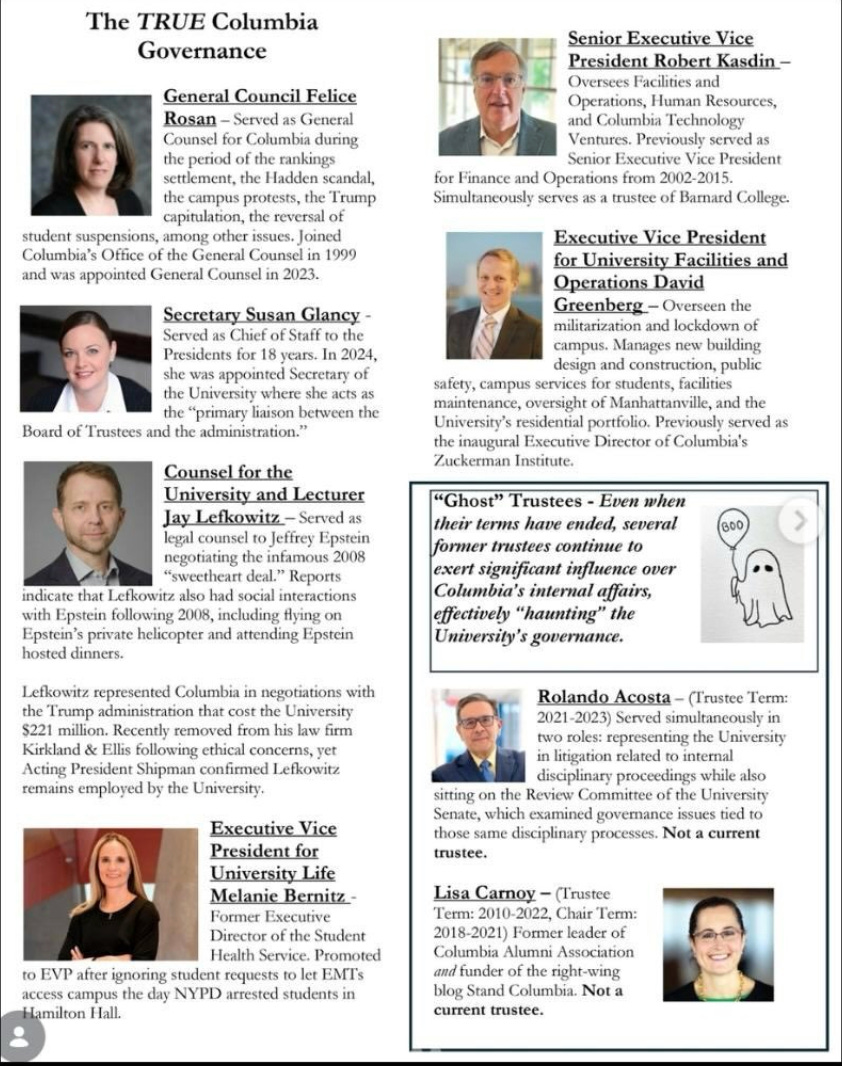
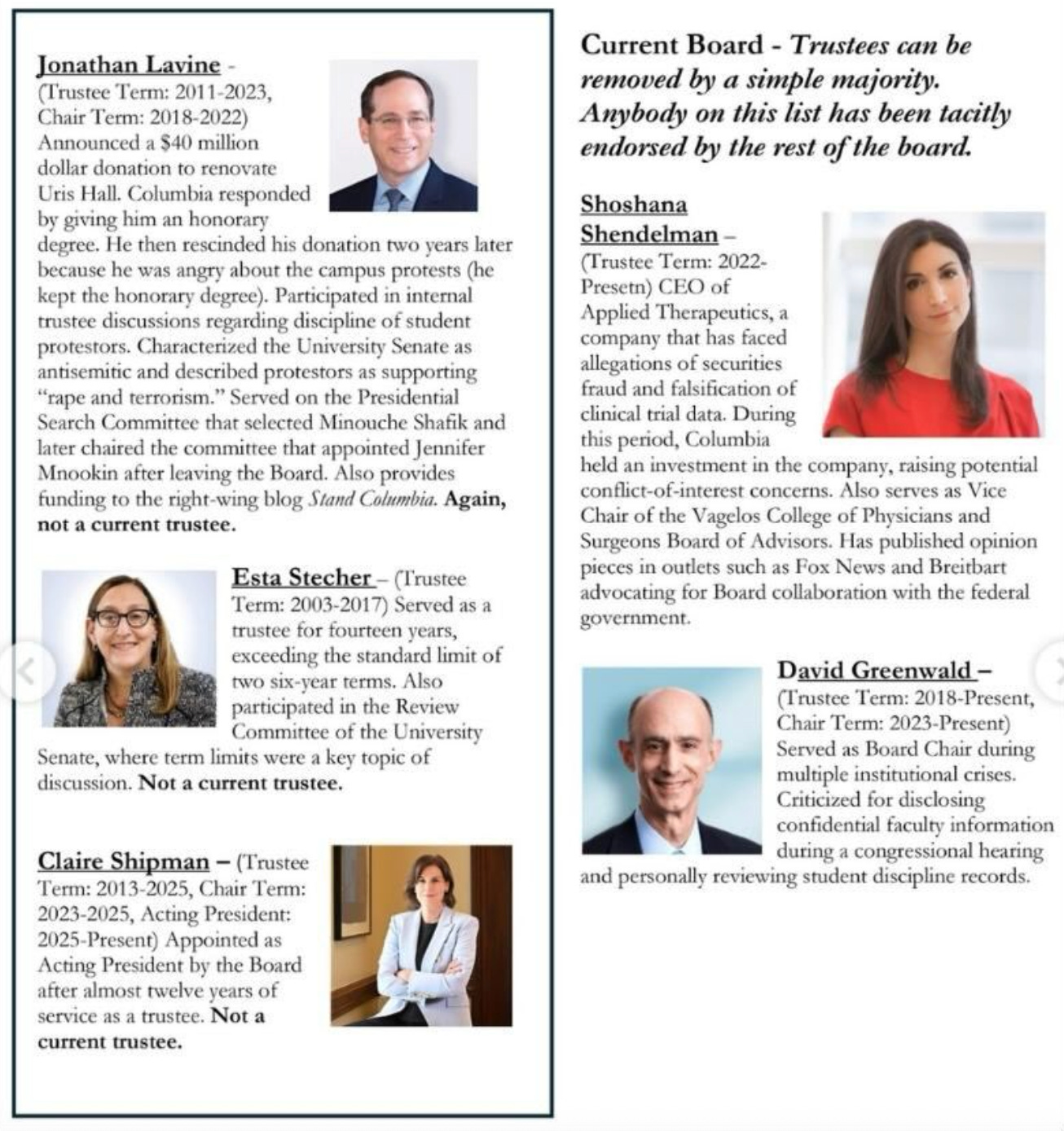
This logic is absurd. Senior leadership at Columbia is notoriously elusive despite their unilateral power over discipline and University governance, and students are now being told that even though criticism is protected speech, they should not express themselves too directly, too publicly, or too forcefully. In other words: yes, you may have the right to criticize the trustees—but if that criticism makes them even mildly uncomfortable, no matter the veracity of the facts or your supposed freedom of expression, Columbia may still drag you through a fraught disciplinary process. No wonder Columbia is nationally recognized as one of the worst college free speech environments.
Ultimately, after mounting public pressure, my case was dropped. But this is beside the point. If a student handing out a flyer (the most basic case of free speech) is harassment, then is there any acceptable way to criticize our leadership?
My experience also shows the arbitrary nature of the University’s disciplinary process. Even though Columbia’s Rules of Conduct (§440) affirm students’ right to free speech, the Board of Trustees can enforce or remove sanctions on a whim. This is not surprising—David Greenwald is known to personally review student disciplinary records—but it means that the idea of equity and inclusivity has been weaponized and co-opted to silence activists.
Let me be clear—our leadership is corrupt and rotten to the core. Shoshana Shendelman lied to the FDA about her pediatric drug; Jonathan Lavine, a vulture capitalist who ran Bain Capital, described protesters as supporting “rape and terrorism”; Jeh Johnson was architect of the US drone strike policy that killed hundreds of civilians, was on the board of Lockheed Martin, and claimed during his tenure as DHS head that it would be necessary to “send a message” by locking up mothers and children fleeing violence; Abigail Elbaum—a nepo baby and the Milstein Family’s current representative on the Board—was sued for refusing to refund tenants after Superstorm Sandy; Victor Mendelson is CEO of the war profiteer HEICO Corporation.
After all the Board’s actions over the past two years, nobody has faced meaningful accountability. Our rotating cast of Presidents are mere figureheads—the same Board has run our school with impunity at the behest of Stephen Miller, and influential Zionist donors. The University has consistently privileged pro-Israel perspectives and affiliates over everyone else.
The trustees capitulated to Donald Trump’s authoritarian federal government. Now, they are uncomfortable when students criticize them. It’s high time for the trustees to realize that actions have consequences.
I have a message for David Greenwald, Claire Shipman, the “ghost trustees” like Jonathan Lavine and Lisa Carnoy, and the rest of the Board: You will not get away with using Columbia to protect sex criminals, to gentrify Harlem, and to manufacture consent for genocide.
You tried to silence me, but I will not be silenced. The student movement will not be silenced. We will keep fighting until there is real accountability.
— Colloquious
The opinions expressed in this article are solely those of the author and do not necessarily reflect the views of the Sundial editorial board as a whole or any other members of the staff.
SIPA Alum here, from back in the 20th century. I'm sympathetic to Stephen's comment below. The writer is out making information about the Trustees readily available, that tolooks like an invitation to harass these individuals for their alleged transgressions. So Colloquious is fine inviting harassment of others but hides behind anonymity. I don't see much integrity there. I also concur with Stephen that his hateful rhetoric about Israel. This gives me strong reason to believe he knows little about the situation there aside from the propaganda he's been brainwashed with. (Tragically this may include courses he's taken at Columbia that promote simplistic one sided versions of history. That students pay high tuitions and spend important years of their education to learn garbage makes it doubly tragic.) Does Colloquious have any idea how many people have been tortured in prisons or killed in Syria, Lebanon, Yemen, Iran, and Gaza (where Hamas is the perpetrator)? This is not to mention the unfolding tragedy in Sudan among others conflicts. Why is Israel singled out? Why is Iran, that has funded instability, tragedy and death throughout the region, not mentioned? Not to mention that Iran has stolen wealth that should have been used for the betterment of the Iranian people, just as Hamas has stolen funds that should have been for the betterment of the people in Gaza. Hamas built what could have been the world's largest bomb shelter under residential and civilian infrastructure, yet no civilians were allowed in. I would say about Colloquious what I'd say for most of the student and non-student activists on the Columbia campus, the self-righteous self importance is only exceeded by the enormity of the ignorance
I’ve been a fan of Sundial, but I think they dropped the ball on this one. Not because they published the article—free speech includes the publication, within the bounds of the law, of even abhorrent views, and falsehoods and misrepresentations, in this case, in relation to Israel. They erred, I believe, in allowing the author—whoever he or she was—to be anonymous. It is unfortunate that the author does not have the courage of his or her expressed convictions. As for Sundial’s determination that the author meets its test for anonymity—that the author “could be seriously harmed by attaching [sic.] their [i.e.,his or her] name to a piece”—there is a cruel irony here. In the current environment at Columbia, the expression of anti-Israel views and lies is far more likely to be rewarded; it’s the expression if pro-Israel views that is likely to expose the speaker to harm.