


When I attended Columbia from fall 2023 to spring 2025, I noticed the same problem that many others did: There was a severe lack of productive dialogue between individuals and groups who disagreed on important issues. Instead, we had protests, encampments, and a lot of yelling. I wanted to do my part to improve the culture on campus, so in the last semester of my senior year I founded the Columbia Open Discourse Alliance (CODA).
There were already several groups at Columbia concerned with fostering dialogue and defending free expression, namely the Columbia chapter of Heterodox Academy (HxA), BridgeColumbia, Sundial, and Platypus (Columbia’s Marxist reading group), but I felt as though we (I say “we” because I was a part of both HxA and Sundial) weren’t coordinating our efforts as effectively as we could have been.
Attendance at events was rarely stellar, despite our collective memberships numbering well into the hundreds. We weren’t making a united effort to pressure the administration to cooperate. Garnering enough media attention was also a constant challenge.
We needed a central node for sharing ideas, resources, manpower, and connections. Such an organization would make it easier to market events, deal with administrative red tape, and get more attention on campus and off.
We also needed this organization to act as an alliance. If one member came under fire for hosting a heterodox speaker or voicing an unpopular opinion, we could all come to their defense. Anyone who decided to stand up to the mob would not do so alone.
That was CODA’s raison d’être.
Recruiting My A-Team
I was optimistic about what I was building. I had representatives from HxA, Bridge, Sundial, and Platypus on board, and was reaching out to the College Republicans and College Democrats. I believed that if CODA could amass a large, ideologically diverse membership, it would be capable of radically changing campus culture. In the wake of national controversy, Columbia could become a paradigm of productive disagreement and civil discourse.
The only thing left to do was to find a group of students to carry the torch after I graduated; an open-discourse A-Team, so to speak.
I ended up recruiting three people for the job: Nikos Mohammadi CC ’28, Chloe Hoyle BC ’26, and Aum Desai CC ’28.
I already knew Mohammadi, with whom I overlapped at Sundial, and Hoyle. I was confident they were up to the task. Desai and I only met after he expressed a strong interest in leading CODA. After a long discussion over coffee at Joe’s, I felt just as good about him. He seemed very sharp and incredibly driven. He conveyed a real passion for CODA’s founding ideals, and I believed his ambition would serve the fledgling organization well.
I didn’t keep close tabs on CODA after graduating that May, but from what I could tell, it was making great progress. The website looked nice, and several impressive faculty members had joined the advisory board.
Later that year I hosted Mohammadi and Desai on my podcast The Discourse Lab (along with Anthony Rispo, who has since resigned as co-host), where we discussed the state of free expression at Columbia and the importance of civil discourse. Both guests expressed how optimistic they were about CODA’s future and the impact it was having on campus.
I thought Mohammadi, Desai, and Hoyle were clearly right for the job, and I was proud to have played a part in the organization’s formation.
The Betrayal
You can imagine my surprise when, while scrolling Instagram last week, I saw the following post from CODA’s account:
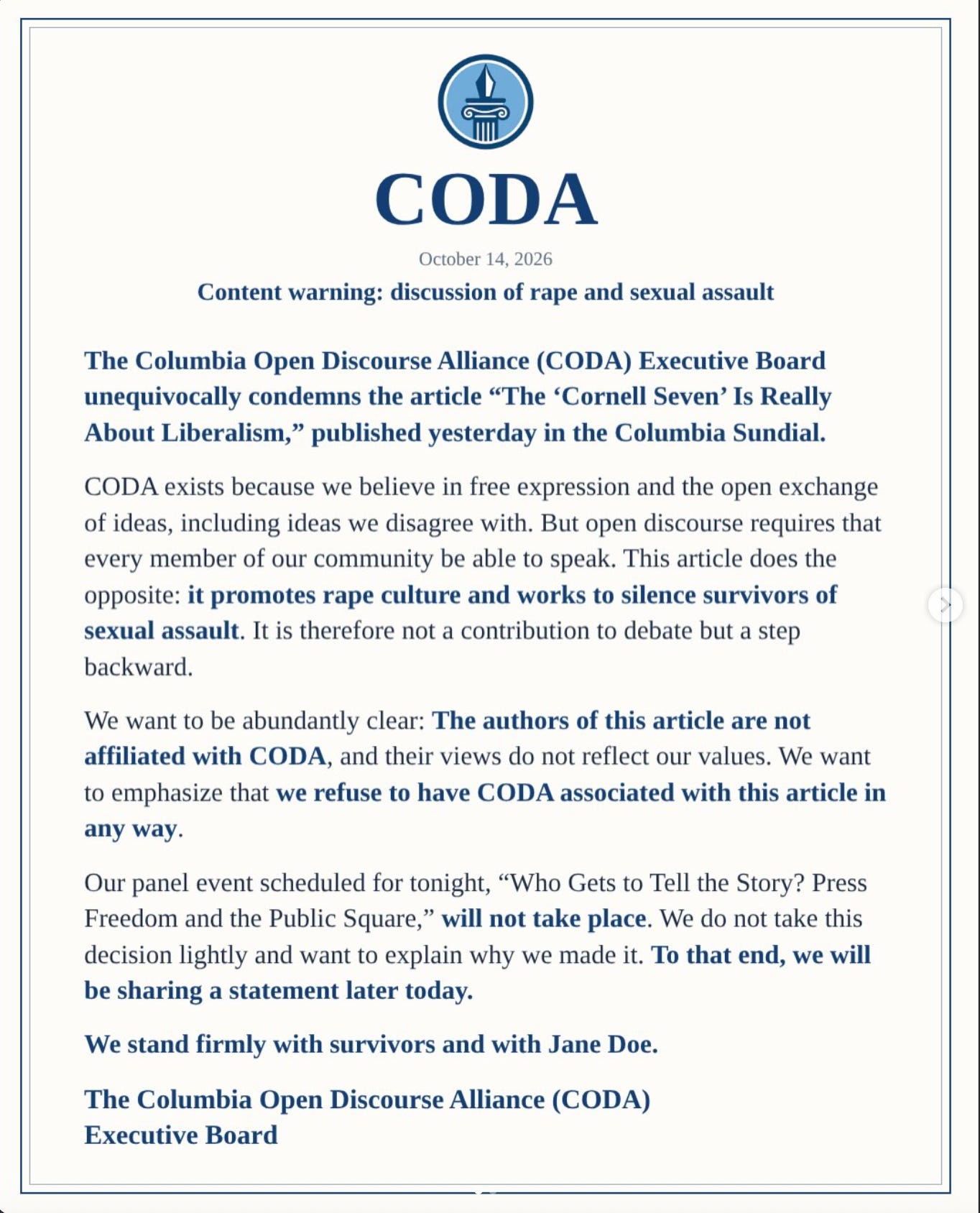
“Open discourse requires that every member of our community be able to speak. This article does the opposite: it promotes rape culture and works to silence survivors of sexual assault. It is therefore not a contribution to debate but a step backward,” the statement read.
The open discourse organization I had founded was attempting to stifle civil discourse? I could barely endure the irony long enough to finish reading it.
I had read The “Cornell Seven” Is Really About Liberalism just days before, and had no idea how the CODA executive board could have interpreted it the way they did. The piece was written by a member of my A-Team, Nikos Mohammadi, a deputy editor for Sundial, and his co-author, Christina Ma, a staff writer for Sundial. In it, they articulate a viewpoint on the “Cornell Seven” story that is undeniably provocative. Part of their argument is that liberal sexual norms often facilitate traumatic sexual encounters that are nonetheless consensual. They also argue that much of the outrage surrounding the Cornell scandal constitutes a “collective frenzy” that ultimately infantilizes women.
I can entirely understand why many people would vehemently disagree with their article, and was not at all surprised that it garnered significant backlash. The piece triggered a pile-on which included messages telling Mohammadi to kill himself and condemnations from several student groups.
However, it was also well written, well reasoned, and well within the Overton window. CODA should have come to their defense and started brainstorming a way to put them in civil, public dialogue with their critics. Instead, it joined the pile-on.
The claim that Mohammadi and Ma’s article prevents other students from speaking because it “promotes rape culture and works to silence survivors of sexual assault” is so absurd it’s almost laughable. Although they cast doubt on the veracity of Jane Doe’s narrative, they never argue that she, or anyone else, should ever be denied the right to take legal action against their alleged transgressors.
As for the charge of supporting “rape culture,” I would simply ask them to explain exactly how they do so, and what that term even means.
Hitchens’ razor is best employed in a situation like this. The accusations the CODA executive board levels against Mohammadi and Ma’s piece are not only extremely serious, but entirely unfounded. What is asserted without evidence can be dismissed without evidence.
In actuality, the board’s invocation of “rape culture” is just a lazy excuse for them to justify something they likely all understand is inexcusable, leveraging their position at an open discourse organization to try and silence opinions they don’t like.
Later that day, the CODA executive board came out with another, equally troubling statement.
CODA was in part founded to ensure emotional mob reactions would not stop events like this from taking place. For the executive board to erroneously allege that Mohammadi and Ma’s article constitutes an attack on survivors, threatens the safety of survivors, or that their argument “fails” as a justification for canceling an event on press freedom is a perversion of its mission.
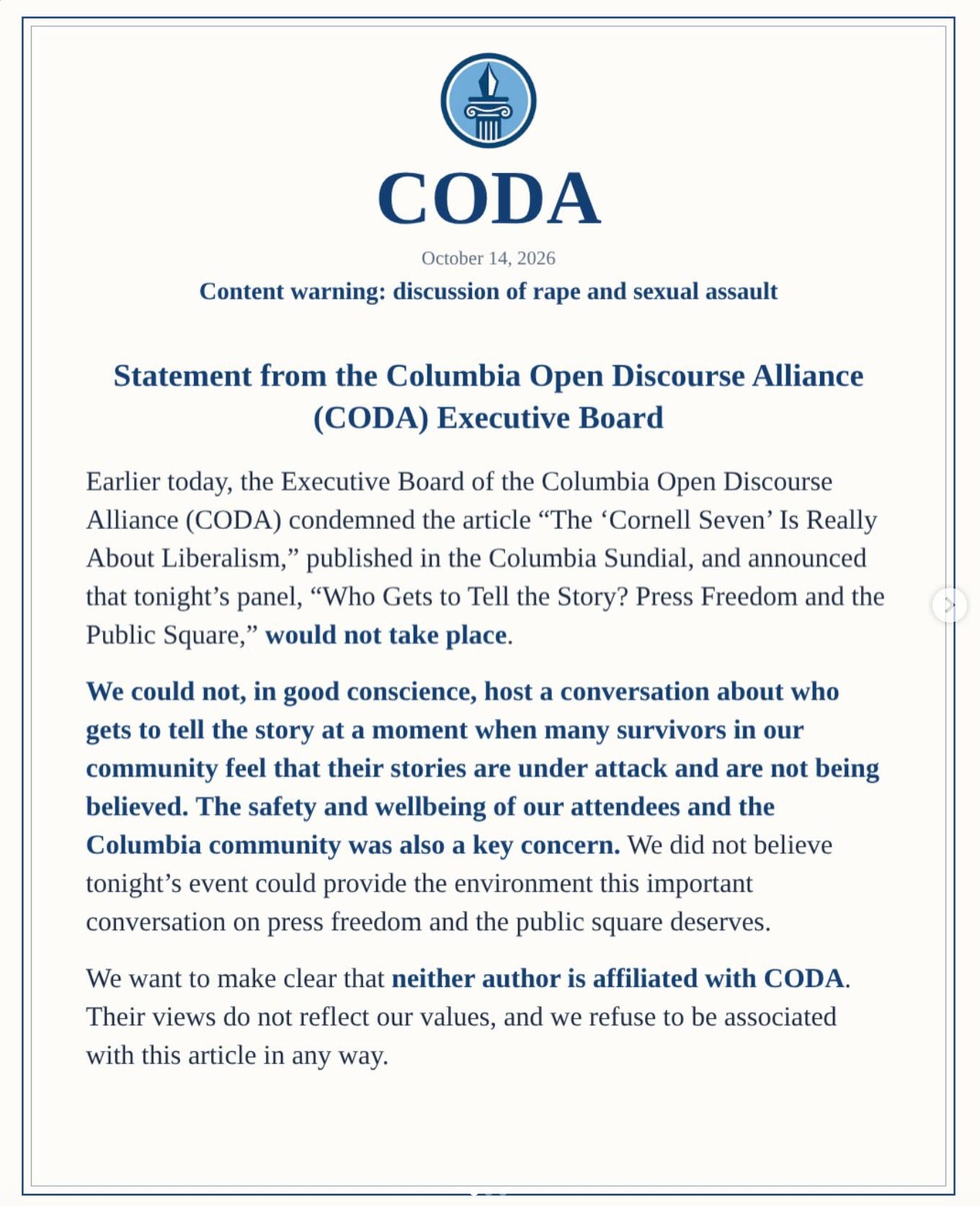
They threw two of their classmates under the bus to appease a mob. They doubled down on lazy, baseless accusations to justify taking actions which are anathema to the stated values of their organization. They did all of this while hiding behind hollow commitments to free expression.
I soon came to discover that, as I immediately suspected, both Mohammadi and Hoyle had nothing to do with this fiasco. In fact, they had both left CODA long before the statement was published, and Hoyle has also since graduated.
Desai, however, is still the president.
According to Mohammadi, he and Hoyle began to lose faith in the direction in which CODA was heading. Mohammadi told me recently that it often appeared as if the executive board seemed more concerned with securing official university recognition and cultivating the “right” connections than actually fostering productive discourse about divisive topics.
Perhaps this explains how CODA ended up with a board that was comfortable denouncing unpopular opinions and canceling events. All the true believers quit, leaving only those who were more concerned with status than sticking to principle.
It’s also possible that they were simply lacking in courage. They may not have been able to stomach the criticism and the controversy, so they caved to the mob to save face.
It’s tough to say for sure, but whether it was a failure of values or a failure of nerve, one thing is certain: They have blatantly betrayed CODA’s mission.
What Should Happen Now?
In my humble opinion, all of the board members who supported CODA’s statements should resign. Those who dissented (if there were any) should stay on. The remaining seats should be filled by people with a genuine commitment to CODA’s founding principles and the spinal fortitude to stick up for them when doing so is unpleasant.
I could think of a few young writers at Sundial who might make a good fit.
To be clear, this is just a recommendation. I’m under no illusion that it will be heeded, and I’m certainly not trying to force anyone out. I would give the same advice to a movie director who didn’t understand the appeal of cinema or a priest who didn’t believe in God. If you don’t understand the value of civil, productive discourse around contentious topics, even ones as sensitive and serious as the “Cornell Seven,” or if you lack the courage of your convictions, then you simply shouldn’t be leading an open discourse organization.
Until there is a major change in leadership, I fear CODA will continue on as the bastion of irony and hypocrisy it has mutilated itself into. New students may well look to it as an example and come away believing that free expression only applies to speech that the majority finds acceptable, or that open discourse means only discussing viewpoints that don’t offend anyone.
I can’t help but think of that famous quote from The Godfather:
“Look how they massacred my boy!”
Mr. Smith is a former Sundial staff editor, and hosts the podcast The Discourse Lab.
The opinions expressed in this article are solely those of the author and do not necessarily reflect the views of the Sundial editorial board as a whole or any other members of the staff.

Clayton, thank you for your excellent article. CODA's explanation of its betrayal of its founding principles was so egregious it could have been written by the Babylon Bee, as an absurd satirical example of organizational hypocrisy.