


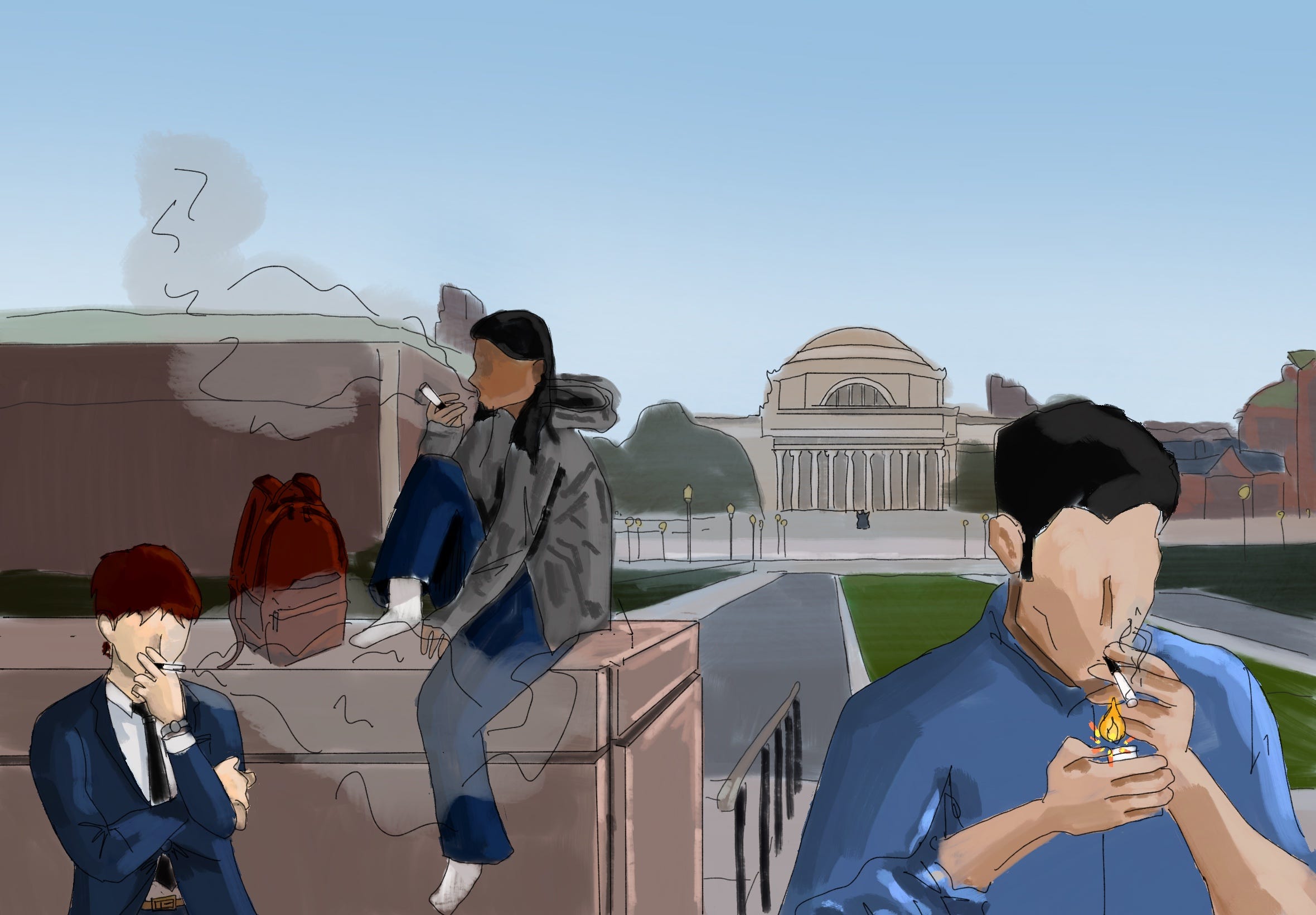
I was smoking an American Spirit on the bench by the doors of Butler Library on a Wednesday night, taking a break from my macroeconomics homework and looking up at the lack of stars. A friend from Sundial and two others came up to me, and one of them offered me a dollar for a cigarette. A profitable transaction increasing my net value, I thought to myself, and eagerly accepted. Soon, a thought crossed my friend’s mind. “Hey, you just pitched that article about weed, right? Dude, that’s sick.”
“Yeah, bruh, it’s gonna be gnarly,” I replied, in the mindless slang of my Southern California upbringing.
“Actually, we’re about to go smoke a couple joints, you wanna come along? Get some investigative journalism in,” he suggested.
“Dude, I’m so down, lemme just run in and grab my stuff,” I said—solely for investigative journalism purposes, of course.
The situation at hand hit me as I made the Sisyphean trek up the Butler stairs to the third-floor reading room to get my backpack. For one thing, it was visually incoherent—I was still wearing my chinos and button-down shirt from my umpteenth finance networking event earlier that day, in sharp contrast to the ripped jeans, hoodie, long hair, and beard motif adopted by this group. Moreover, it was shameful—after all, what would Mommy think of her darling boy cavorting with these hoodlums of Morningside Heights, smoking Mary Jane, instead of doing his homework and getting his eight hours of beauty sleep?
Wrapped in my protective blanket of self-absorbed anxieties, I rejoined the group outside Butler as we started the walk to the first destination of the night: the ledge outside Schermerhorn Hall overlooking Amsterdam Avenue, that idyllic place where the eye can see 80 blocks down to Hudson Yards. I’m being stupid, I thought to myself. They’re just inviting me out of some perceived obligation; they don’t want me around. I did not speak for the entirety of the walk to the ledge, locking my jaw and gazing at my loafers as I debated exactly how I would get out of this and go back to the library to prepare for the next day’s very important lectures and coffee chats.
As we got to the ledge, my friend pulled a preroll out of his pocket, lit it, and offered it to me. Not wanting to commit an unwitting faux pas in this new social ecosystem, I lifted it to my mouth—after all, one hit couldn’t hurt. In the words of Bill Clinton, however, “I didn’t like it. I didn’t inhale it.”
As I passed the joint, continuing the clockwise pattern they had started, a novel feeling overtook me, what frequent connoisseurs reportedly refer to as “chillaxed.” The rotation continued in a lazy fashion, and as I found myself laughing at their slurred jokes, I couldn’t remember what I had been so concerned about.
After a bit, we—a Weezer-esque line of nerdy newfound pals—migrated to a bench outside Riverside Park for the second joint of the night. An elderly gentleman walking his Pomeranian came by, and I politely waved, but this was greeted with a scornful look and shouted: “What is this, the neighborhood GANG?”
“YES!!” I yelled back, in what I thought was a biting retort. It only drew a dismissive shake from the gentleman and a decisive removal of the joint from my hand by my new friend.
As the night continued, the conversation turned to the topic of the morality of free speech. Talking at length about one’s nuanced thoughts on free speech is a favorite pastime of Sundial writers (you have to be able to deliver a 15-minute monologue on the subject with no preparation at any time, or else you’re kicked out). My friend and I passionately rehashed our favorite talking points on the subject again as his friends looked at their watches. Eventually, my friend came up with an idea: an organization dedicated to founding and supporting free-speech journals across university campuses. I loved this idea, and as he voice-recorded what we had just said, I reflected on the fact that these aren’t just stoners—these are Columbia stoners, meaning delusional ambition and philosophical musings fill as much of the stoned conversation as crude jokes do. These are stoners of an Ivy League variety!
As I’ve been reflecting on this dabble in degeneracy, a few thoughts come to mind. First, stoners (at least as judged by this group) appear to be uniquely welcoming. The social environment at Columbia can feel hierarchical and cutthroat—ask any freshman on their eighth club coffee chat of the week—but the only requirement to hang out with stoners is to want to smoke weed and not be a narc. Even after knowing these people for a couple of hours, I felt more accepted by them and closer emotionally to them than I have with some acquaintances that I’ve known for years.
Second, there’s an unfortunate cultural stereotype that suggests that marijuana users are lazy, stupid, and more interested in the next high than any other development in their life. This sentiment is to an extent based in truth, as there is evidence that chronic marijuana use impairs attention, memory, and motivation. At Columbia, however, this stereotype ought to be taken with a grain of salt, as the student body here is self-selected to have high cognitive ability, meaning above-average attention and memory, as well as high levels of motivation and ambition. Aristotle’s “theory of the mean” tells us that flourishing happens in the middle ground between excess and deficiency, and in a school where large portions of the student body have such an excess of motivation to achieve their goals that it begins to harm their physical and mental health, perhaps self-medication with marijuana doesn’t leave them deficient in motivation so much as it helps them return to a virtuous middle ground.
A few days later, I was again at my spawn-ground (the bench outside Butler) and was approached by a group of friends. “Hey, we’re going to the ADP (Alpha Delta Phi) party,” one of them said. “Wanna come along?”
“What’s ADP?” I replied.
“Oh, it’s like a hipster frat, it’s the house on 114th with the big Palestinian flag, there’s some bands playing but we’re mostly just going to smoke weed.”
The me of a few days ago would have heard this collection of words—weed, hipster, Palestine—and immediately said, “No. That sounds like the WRONG crowd of people, I will return to my studies at Butler, unless of course your crowd of degenerates wants to DISRUPT the PEACE at Butler like you did a couple of years ago.” My previous experience, however, was making me rethink all my firmly held and loudly shared convictions. Were hipsters not hoodlums? Do Palestinians deserve basic respect for their human rights? Is smoking weed, perhaps, fun?
With a little more pep in my step, I followed my friends to the ADP house. A band was playing in the main living room, but we went directly to what one could call the “reading room,” full of leather couches, bookshelves, and ash stains on the floor. We sat on the couch, and a friend pulled a joint from his pocket and lit it. “Whoa, can we do that inside?” I announced to the void. “Pretty sure that’s against the New York City municipal fire code.” As I looked around, however, not a soul in sight was lacking in the devil’s lettuce. “True strength comes from blending in,” I whispered to myself as I lifted the joint, again, to my mouth and inhaled. What was I becoming?
Having been to a fair number of fraternity parties in my day (read: exactly one), I knew roughly what to expect—people would dance, get drunk and play drinking games, make out with each other, etc. As I looked around, however, while I did see people calmly dancing to the live jazz, the “energy” of this place appeared remarkably different, with nary a beer pong game or public displays of affection in sight.
Across the United States, the share of college students who use marijuana regularly is increasing, while the share of college students who drink regularly is decreasing. Thus, the societal image of what constitutes a “frat party” may be an outdated one—as more people shift toward a new “poison of choice” at these parties, what is considered “normal behavior” there shifts as well. Perhaps the environment of ADP is not as unusual as it seemed at first to me: The relaxed, low-key atmosphere of ADP parties may simply be what college parties are evolving to look like in the 21st century.
As the night went on, we found ourselves back outside Butler and ran into a different friend. “Ugh, you all reek of weed!” she said, a flask of whiskey in her hand. “Weed is a chud drug, it’s killing your brain cells and making you dumb. Plus only losers smoke it anyway.”
I’d heard variations of this anti-weed tirade dozens of times, and as the night’s conversation turned into the classic “drunk versus stoned” argument yet again, I pondered why this vitriolic dislike of weed has become such a common sentiment. Fearmongering on this subject is not a new phenomenon: In fact, stoking fear on the subject was a deliberate political strategy employed by the Richard Nixon administration. Even so, it’s strange to hear these talking points reiterated by young left-wing college students who disagree with almost everything else Nixon said and did in his presidency.
One possible explanation for this comes to mind. Weed, particularly when its consumption was fully illegal, has long been associated with counterculturalism and deviation from accepted societal norms. As weed has become legal and normalized, however, it has become more entrenched in mainstream culture and perhaps lost its “rebellious edge” that drew some people to marijuana in the past. Thus, as weed use has become “the culture,” the same countercultural instinct that drove people to smoke weed in the past is now driving people to push back against it. The societal order has effectively flipped: Weed used to be a useful symbol that you were someone who wouldn’t let The Man tell you what to do; now, The Man is telling you to smoke weed, fostering hesitation about whether weed use is the best thing for you to do. This passionate resistance from peers, while a little annoying, is perhaps an inevitable part of weed becoming entrenched in popular culture.
Weed tends to attract grand narratives about it, both positive and negative: it cures all your ills, it makes you an idiot, you can’t get addicted to it, it turns you insane, etc. It’s easy to forget the deceptively-simple truth: Weed is just a substance you can choose, or choose not, to consume. It can be a means to form a closer bond with friends or a means to self-medicate to relieve anxiety, but it deserves caution as it can lead to dependency or pose health risks for some individuals. College is a time for experimentation: There is ample opportunity for curious people to meet up with some friends, spark up a joint, and experience for oneself the benefits and drawbacks of being high on Low.
Mr. Stuart-Alban is a sophomore at Columbia College studying economics and political science. He is a former staff writer for Sundial.
The opinions expressed in this article are solely those of the author and do not necessarily reflect the views of the Sundial editorial board as a whole or any other members of the staff.

I really enjoyed this piece—particularly your willingness to make yourself, and your assumptions, the subject of the humor. The contrast between finance networking and an evening with your newfound friends captures something recognizable: how much energy we spend presenting ourselves a certain way, and how refreshing it can be to feel accepted without having to prove anything.
What stayed with me was your willingness to reconsider people you had already categorized. That takes some humility, and the self-deprecating tone you use makes the discovery engaging rather than preachy. The free-speech conversation, complete with friends checking their watches, was especially funny.
You captured the pleasure of letting your guard down and discovering unexpected company. That openness to being surprised by people is something worth carrying well beyond college.