


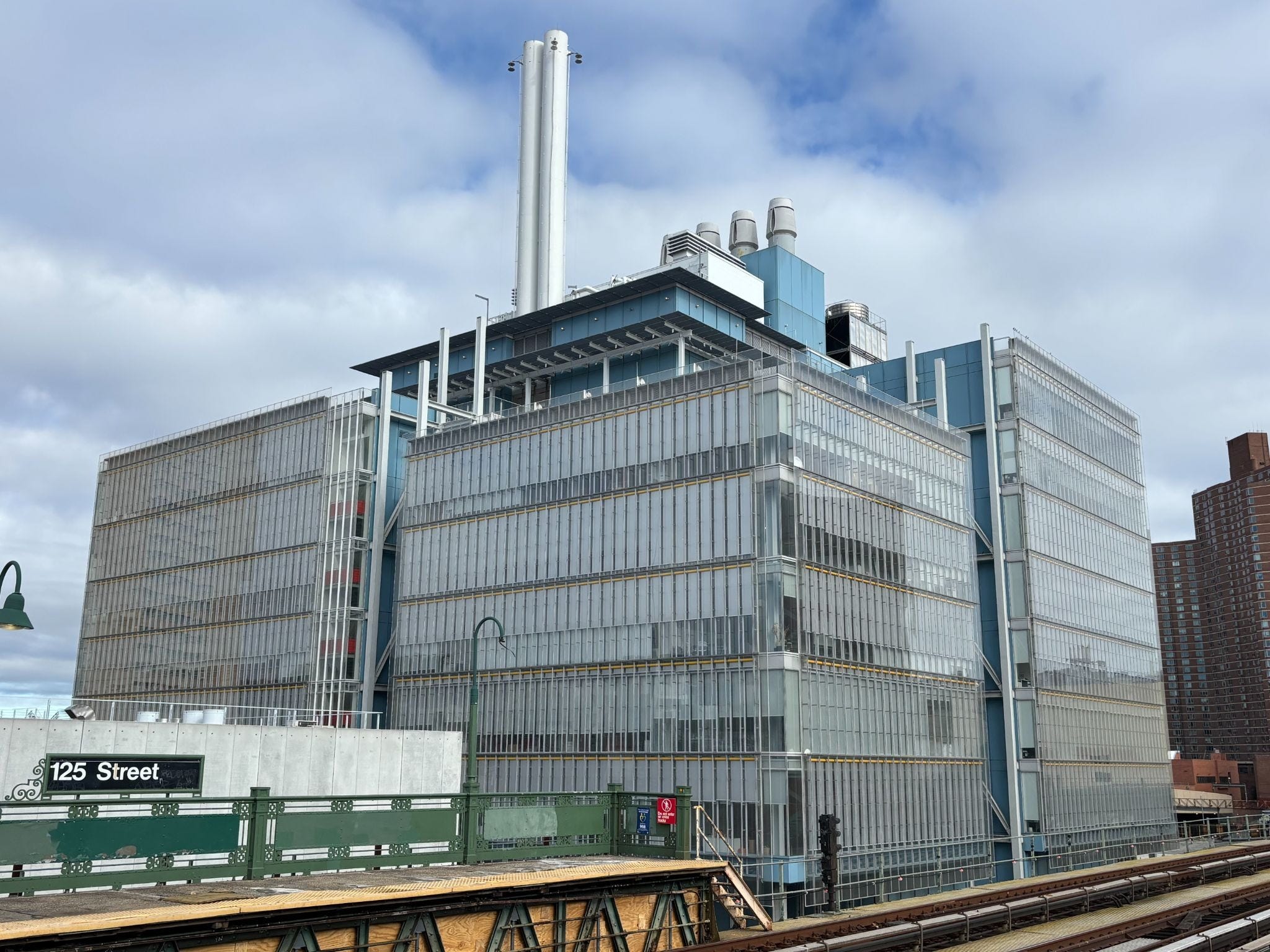
It’s October 2016, and Columbia President Lee Bollinger and the Trustees find themselves in a foreign, distant land: the area north of 125th Street. Construction has neared completion for the first two of seven buildings in what would become Columbia’s modernist Manhattanville campus. Speaking at its dedication ceremony, Bollinger paraded Manhattanville as the culmination of Columbia’s century-long envelopment of Upper Manhattan, deeming it the “spiritual plank” that binds the school’s other campuses in Washington Heights and Inwood “into one seaworthy vessel.” Left in this vessel’s wake, however, is a series of unanswered questions and betrayed expectations from Columbia’s new neighbors.
Building the 17-acre campus involved demolishing five apartment buildings housing up to 140 low-income households; one such building was designated to house formerly homeless families and had just undergone a taxpayer-funded renovation. It would also involve the relocation of small businesses staffing an estimated 1,200 employees. Of course, this didn’t stop Bollinger from deeming the Manhattanville campus “the best thing that could happen” to Upper Manhattan. Yet to convince actual Upper Manhattan residents and officials of this, in 2009, Columbia signed a widely anticipated Community Benefits Agreement with the group that would become the West Harlem Development Corporation (WHDC).
Among other items, the agreement pledged $76 million “to fund community benefits for the West Harlem community,” $20 million for affordable housing, and $4 million in housing legal assistance for local residents. In return, the community would agree not to litigate or bring a lawsuit against the campus expansion. However, the WHDC would also not have the right to “litigate, mediate, arbitrate, or otherwise enforce” any of the promises Columbia actually mentioned in the agreement.
Put another way: Columbia could absolutely renege on these “promises.” And, as it turns out, that’s exactly what happened with the over $150 million in total that the University pledged in the agreement.
While the $76 million benefits fund was intended to be entirely paid out between 2009 and 2025, Barnard Bulletin reported last year that Columbia only fulfilled six of the 39 promises that it was intended to support. A decade after the dedication of the Manhattanville campus, local officials have been taking note.
“Most people aren’t happy with how Columbia has handled this,” explains Victor Edwards, chair of Manhattan Community Board 9, which covers both Morningside Heights and West Harlem. “After moving housing, businesses, and a church to build the campus, what came after were little shops and cafes that didn’t really cater to the people of the neighborhood.”
One casualty is Watkins Products, a local grocery store that had been continuously operating since 1965, when Manhattanville construction forced its relocation. While Columbia helped fund its move to a new storefront, the store’s new location five blocks east on 125th Street has seen skyrocketing rents—and has a smaller square footage.
In fact, Watkins Products may have been one of the lucky ones. Not all relocated businesses managed to stay open. Floridita, a popular Cuban restaurant, sat on the busy corner of 125th Street and Broadway for 38 years. In 2010, Columbia struck a deal with the business to close its existing location and reopen it farther west in a discreet location tucked under the Riverside Drive Viaduct. While a University spokeswoman paraded the spot as “an attractive relocation space,” the building’s very first inspection after the relocation found significant amounts of asbestos. Yet Columbia refused to help fund the removal of the asbestos.
The contamination forced the restaurant to remain closed until fall 2012; after a few years of reopened business, it shut its doors for good, a decision that Edwards attributes to its tucked-away location. “These new businesses are more expensive, and their menus don’t cater to the locals like Floridita did,” he lamented.
As jobs relocated elsewhere, Bollinger pledged that “thousands of new employment opportunities will become available” from the construction process. These opportunities, however, were open exclusively to union workers.
“When local workers would arrive at the site for a job, they’d be quickly turned away because they weren’t part of the union, nor were they provided a stream to becoming a union member,” Edwards told Sundial. “When I went to the construction site and asked the workers where they’re from, many of them came from other neighborhoods as far away as Brooklyn, Queens, and New Jersey. Few were from our community.”
Moreover, other pledges made under the agreement have come with serious caveats. In one instance, according to Edwards, the school agreed to extend 20 undergraduate scholarships per year to students with addresses in the West Harlem area. Yet upon further investigation, Edwards found that eligibility was drastically expanded to students whose addresses were anywhere in “Upper Manhattan,” encompassing large sections of the Bronx and even the Upper West Side. The result, he says, was that “the vast majority of scholarships were going to students who attended elite city high schools, whose addresses just so happened to be in this incredibly broad, socioeconomically diverse area.”
Speaking with Sundial following this piece’s print publication, a University official disputed several of these claims made by Edwards, arguing that Columbia did provide pathways for acquiring union membership, and that while the eligibility of “local” scholarships spans 17 different zip codes across Upper Manhattan and the South Bronx, the agreement actually provides 40 scholarships per year to aid-qualifying students.
Meanwhile, of the $20 million offered under the agreement for affordable housing, only half has been granted to the WHDC. On the one hand, the University official informs that the remaining $10 million is tied to specific development milestones which have not been reached. Yet the existing sum, as Edwards tells us, provides nowhere near enough to support housing affordability in an increasingly rent-burdened community. A possible alternative to help the community might have been to assist local officials in finding housing partners to construct affordable homes. Columbia didn’t do so, though, all while more luxury developments have sprung up in the area. In these new buildings, rent for a one-bedroom apartment alone is over $4,300 a month, more than 50 percent higher than Harlem’s average.
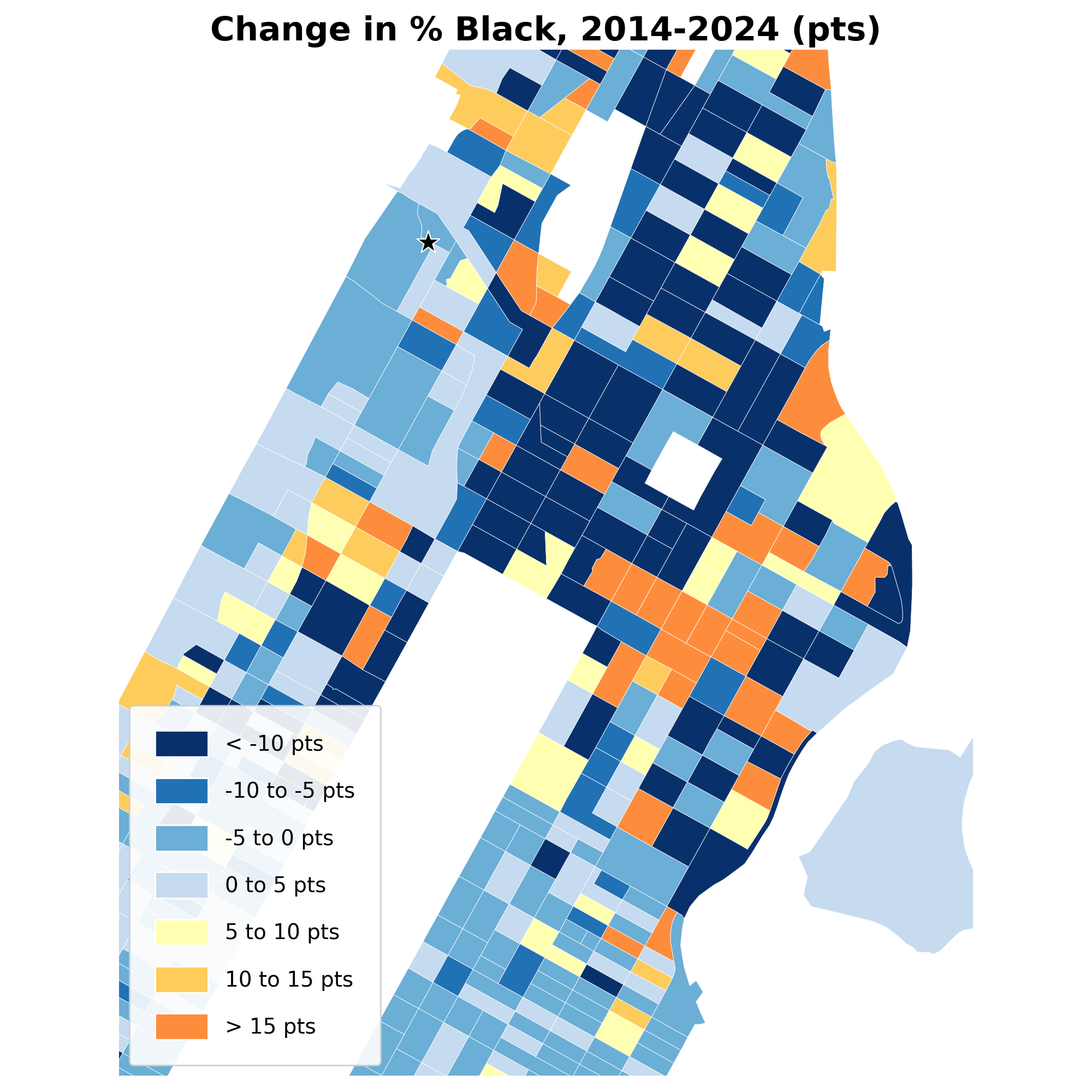
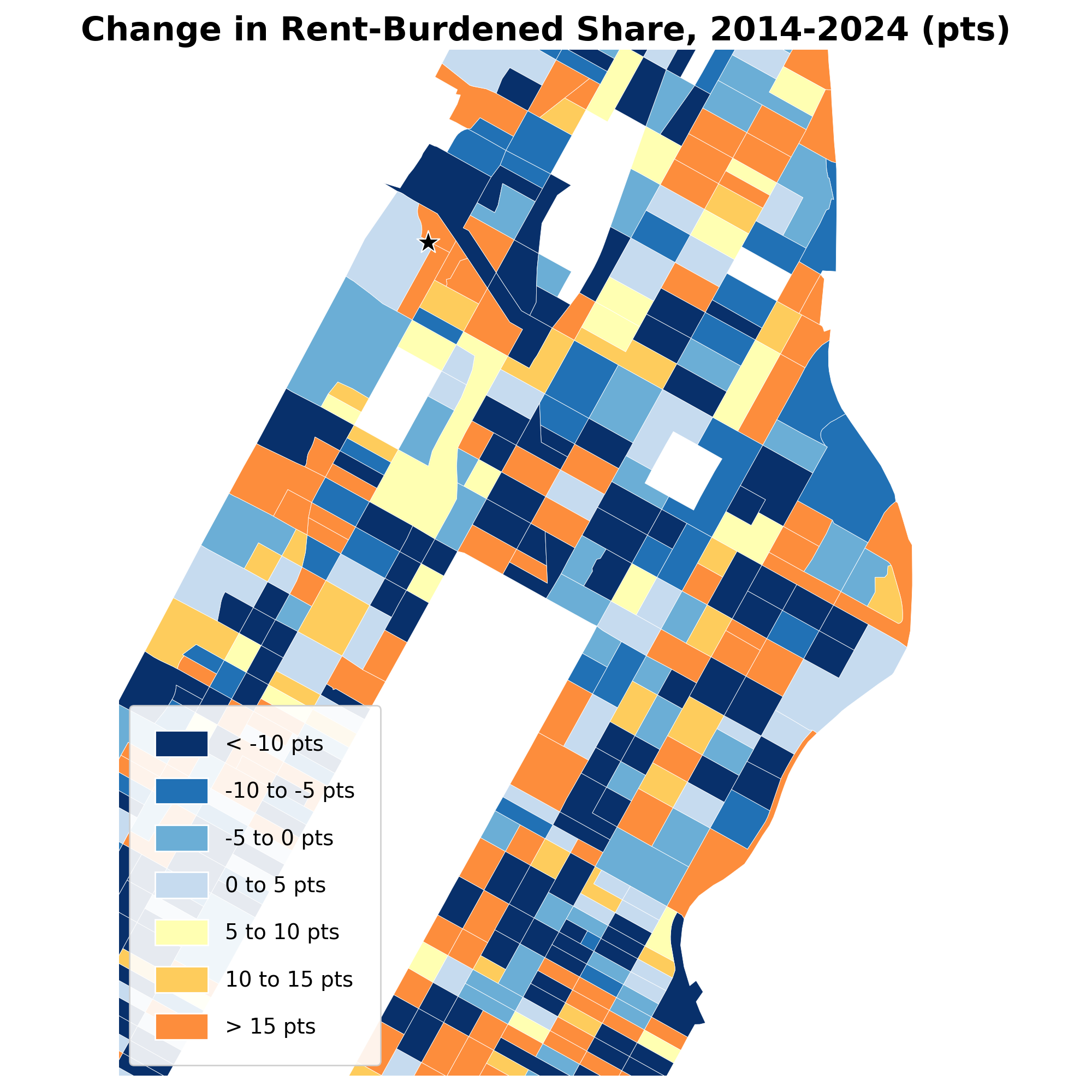
The school’s shortcomings in executing the agreement come as West Harlem, and Upper Manhattan in general, struggle with the intensifying effects of gentrification. As visualized above, data from the American Community Survey reveals drastic changes in Manhattanville’s surroundings before and after its construction.
The map on the left shows that many black residents appear to have been pushed out of West and Central Harlem, where rent increases are highest, opting to move east, where housing prices remain slightly lower. The map on the right shows the percentage of rent-burdened households (defined as a household spending 30 percent or more of their income on rent) has drastically increased immediately around the Manhattanville campus, even while the surrounding area has shown more mixed signs.
It’s worth mentioning that West Harlem locals’ relations with the new campus have by no means been entirely negative. Edwards credits the housing legal assistance funds, open community spaces like the Bollinger Forum, and an online portal allowing locals to rent space on the campus, all noteworthy accomplishments. To him, they represent Columbia’s capacity to execute its pledges and the possibility of converting the new campus into a net positive for the community.
In a statement to Sundial, a University spokesperson said, “Many of the commitments connected to Manhattanville were designed to continue over decades or are tied to future development, and Columbia remains committed to ensuring that continued growth creates meaningful benefits for the community, the University and the city.”
Notwithstanding, as the University appears to have failed thus far to deliver on many of the promises it agreed to in the Community Benefits Agreement, the idea of the school being a force for good in the neighborhood might sound rather bizarre, especially on a campus where students refer to Columbia’s uptown expansions as an “occupation.”
As New York’s largest private landowner, Columbia unquestionably has a responsibility to be a good neighbor. Surface-level promises do nothing for the good of the community, nor do they accomplish any long-term public relations goals, which are contingent upon establishing real trust. For Columbia and the “seaworthy vessel” it’s amassed, the first step to keeping its public image afloat is delivering on its promises.
Mr. Baum is a senior in the joint degree program between the Jewish Theological Seminary and the School of General Studies. He is the editor-in-chief of Sundial.
Mr. Hong is a freshman at Columbia College, studying cognitive science and statistics. He is a staff writer and an illustrator for Sundial.
The opinions expressed in this article are solely those of the authors and do not necessarily reflect the views of the Sundial editorial board as a whole or any other members of the staff.