


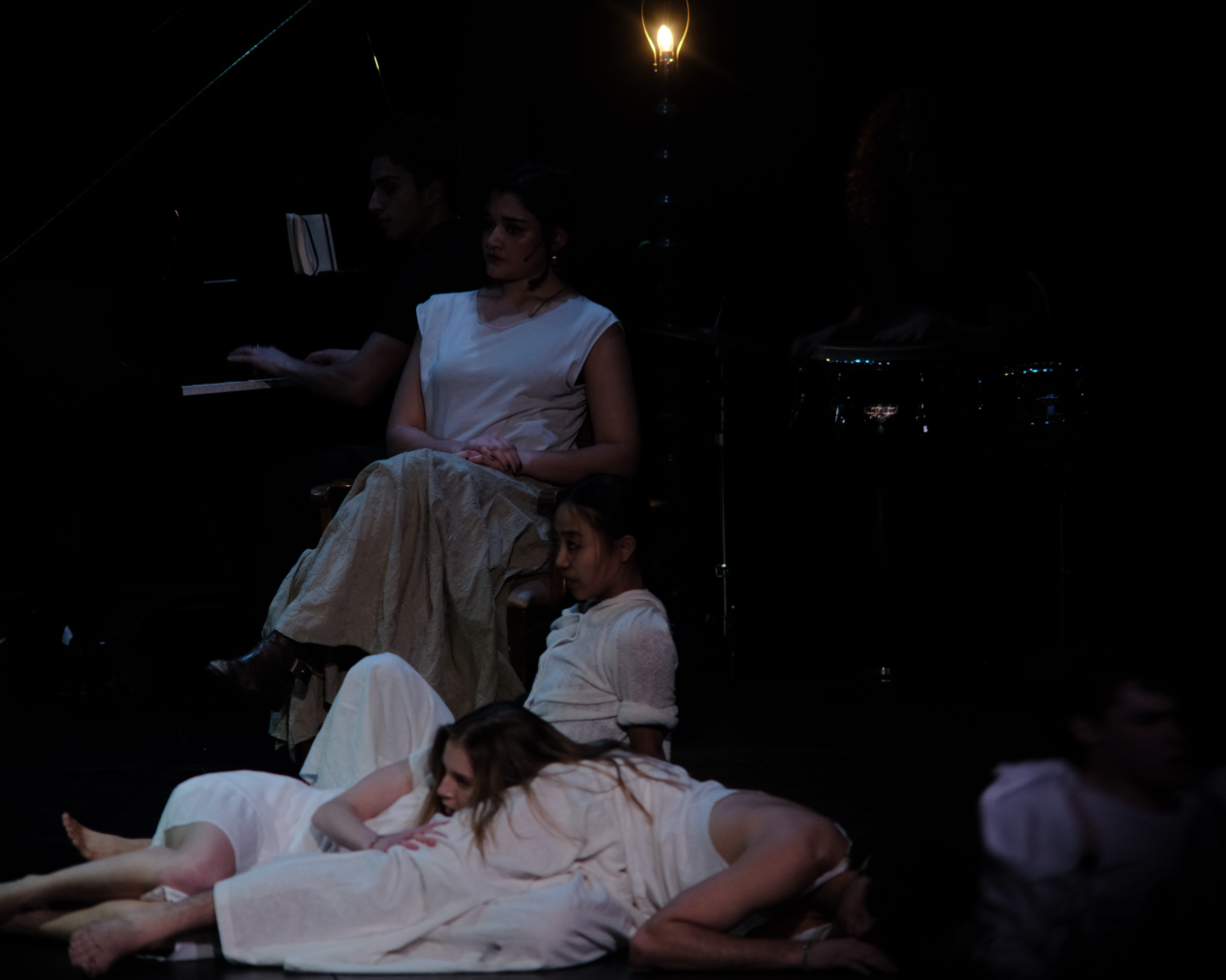
“The day he left me was the day that he died, and then he was reborn as a whale.” This line, appropriated from TikTok, isn’t that far from describing The Whale—a play mired in surrealist literature, religious iconography, and dance.
Written and directed by Yusuf Luqman GS ‘26, the play, first staged and reviewed by Sundial at the Riverside Theater on March 28 and restaged at the Lerner Black Box on April 14 and 15, takes audience members into the trenches of tortured passion.
Considering the premise of the play—“the whale”—I was initially a bit disappointed by the lack of direct whale-on-stage action. Although the titular whale is central to the plot, it is largely perceived by the audience through dialogue. Having said this, the human plot was intriguing in its own right, concerning a grieving widow, Aila (Violeta Reyes CC ‘28), who believes her dead trucker husband (Calidore Robinson CC ‘26) has returned to her in the guise of an oceanic mammal—as one does. This is explained in a flashback in which said husband playfully remarks that, should he pass, he will return as “a nice, thick, and horny, chunky whale.” Some like it hot—others prefer cold, wet whales, apparently.
As Aila comes to believe his jest, the play calls our initial perceptions into doubt. Is Aila truly delusional, as the hot priest, Father Walter (Rayan Ali CC ‘27), would insinuate? Is she merely a fantastical storyteller, as the town inn-keeper and writer Aisha (Kmar El-Matri GS ‘27) believes? So many questions, but The Whale is a play in which answers are hardly the point. One is instead struck into hazy admiration of the performance itself.
It opens with a shriek, a ghost, and a flashback; the action is relentless from there, as actors probe philosophical questions with an intensity fueled by the evocative script. The play is reference-dense with nods to Shakespeare as well as to the writer, politician and founder of the négritude movement Aimé Césaire in its opening—“And that great black hole where a moon ago I / wanted to drown / It is there I will now fish.” The speed and unique visuals quicken the delivery and the pace, collapsing the barriers between literature and reality’s understated tragedies.
Standout performances come from Aila and Father Walter as each wrangles with their respective faith and tortured desires. The choreography (Luke Garbacz, CC ‘27) is remarkable, heightening the dramatic tension between our woman Aila, the whale, and Aisha as she whirls around, arm-in-arm with the dancers whilst she proclaims her desire for revenge, life, and godly status as a storyteller. The minimalistic, starkly lit set curated by (Zoë Holmes CC ‘28) feels like an appropriate representation of a declining town in early 1970s America, prior to the 1971 commercial whaling ban. The town’s hottest location is an isolated dock ideal for soulfully gazing off into the distance whilst contemplating unrequited passion. One might imagine dangling one‘s feet from here, pondering whether or not to pull a feat straight out of Guillermo Del Toro’s The Shape of Water and get one’s feet wet, so to speak.
In the show’s finest moments, any unclear plotlines are overshadowed by the grandeur of the premise itself—a creative, internal reality that supersedes the external world’s constraints. As when wallowing in the everlasting pervasiveness of lost love or the taste of a really great cheeseburger, time’s passage and the facts of the play cease to matter: They are insignificant compared to the gravity of the story’s emotional truth. There’s no denying that the headiness of the material exceeds the modest aspirations one might typically associate with a student production.
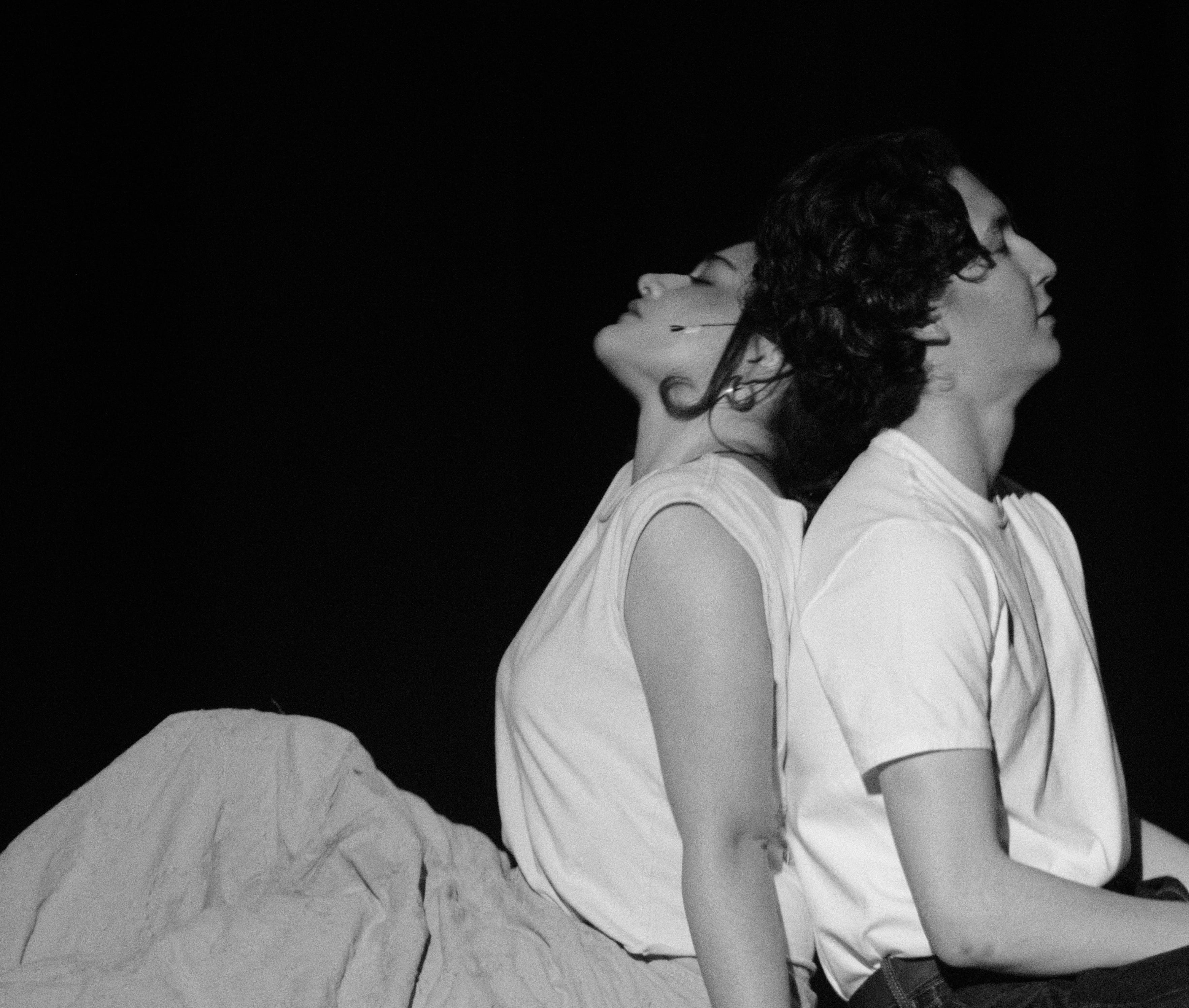
The Whale was literally borne from the dreams of the director, who was kind enough to agree to an exclusive interview with Sundial following the show’s first run. I met Yusuf at the Pulitzer Joe’s Coffee, and, after the obligatory exchange of weather-related grievances, I asked him about the source of The Whale’s premise. He told me that it came to him in a dream he had of a woman and a joke two years ago that entailed the words “whale song.” After frantically scribbling the beginning and ending in his Notes app, he reworked the premise and planned to stage it during his last semester at Columbia. Yusuf described his creation as “a modern-day prophecy.”
Dreams fascinated Yusuf by virtue of their duality: at once having a lineage of “being treated very seriously from a theological standpoint” while at the same time encapsulating the highly nonsensical, easy-to-dismiss human subconscious.
“I think the audience gets to decide as to how much of it is true and how much isn’t,” he said, referring to the play’s ambiguous, dream-like plot. Drawing on layered literary and personal experiences proved fruitful. He referenced T.S. Eliot’s essay, Tradition and the Individual Talent. Eliot “makes this point that it’s quite important to at once be like you’re subservient to a tradition that comes before you. And in one sense, you’re positioning yourself within the tradition,” he explained, “but, at the same time, you have to also be able to stand at a remove from it.” He said that there were “certain elements” he’d drawn from “growing up and [his] background,” mixed with “elements of complete fiction.” Though the historical references to the last whaling company and the collapse of the industry were factual, Yusuf emphasized his desire to make a story that would resonate beyond its immediate concerns.
He said that, often, prospective audience members assumed The Whale “would just be about a woman and whale.” He added, “It’s really not about that at all... you have people who are really dislocated in terms of culture, in terms of society and who are trying to make their own sense of identity.” He told me that the play could be encapsulated in three words: “belief, death, desire.”
Admittedly, I didn’t comprehend all the nuances of the plot, or catch all the words in the cascading, oblique exchange about Aila’s son, but the play proved a welcome reprieve from a world full of facts certain to depress. Sometimes you want to lose yourself in a derangement of the senses so profound you forget all the doubts—to indulge in the play within the lifeless, connivingly stilted play called “real life.” The Whale provides just such a reprieve.
I would summarize The Whale as Fleabag meets The Shape of Water. Aila concludes the production by quoting from the Quran: “And call not those who are slain in the way of God “dead.” Nay, they are living, only ye perceive it not.” Leaving Riverside Theater, I felt that. I was a bit lost and dazed, but in the sense of feeling inspired rather than confused, like an erstwhile widow who has triumphed in her return to self. I certainly felt the rough, sea-salty skin of The Whale accompanying me home.
The charm ofthe play lies in how it undermines the expectations of the dominant culture that we are in a default race against time to prove ourselves successful or worthy. What is time against the nebulous nature of grief? In a time when stale campus discourse can feel impossible to challenge, it is riveting to witness Aila’s defiance in the face of social norms, veering from the surface and into the surreal. It is disturbing and gorgeous to hear her reminiscing and diving into the rapture of recalling her dead husband: “Yes, I live and remember. Down at the beaches, we—dewy-eyed—held hands and skipped, and there was nowhere else we could go.” Words to harpoon the cold hearts of any Columbia student exhausted from the constant demands society places on us, revelling in the memory of happier days.
Ms. Rohslau is a senior in the dual BA program with Trinity College Dublin and the School of General Studies. She is a guest contributor for Sundial.
The opinions expressed in this article are solely those of the author and do not necessarily reflect the views of the Sundial editorial board as a whole or any other members of the staff.

No byline?