


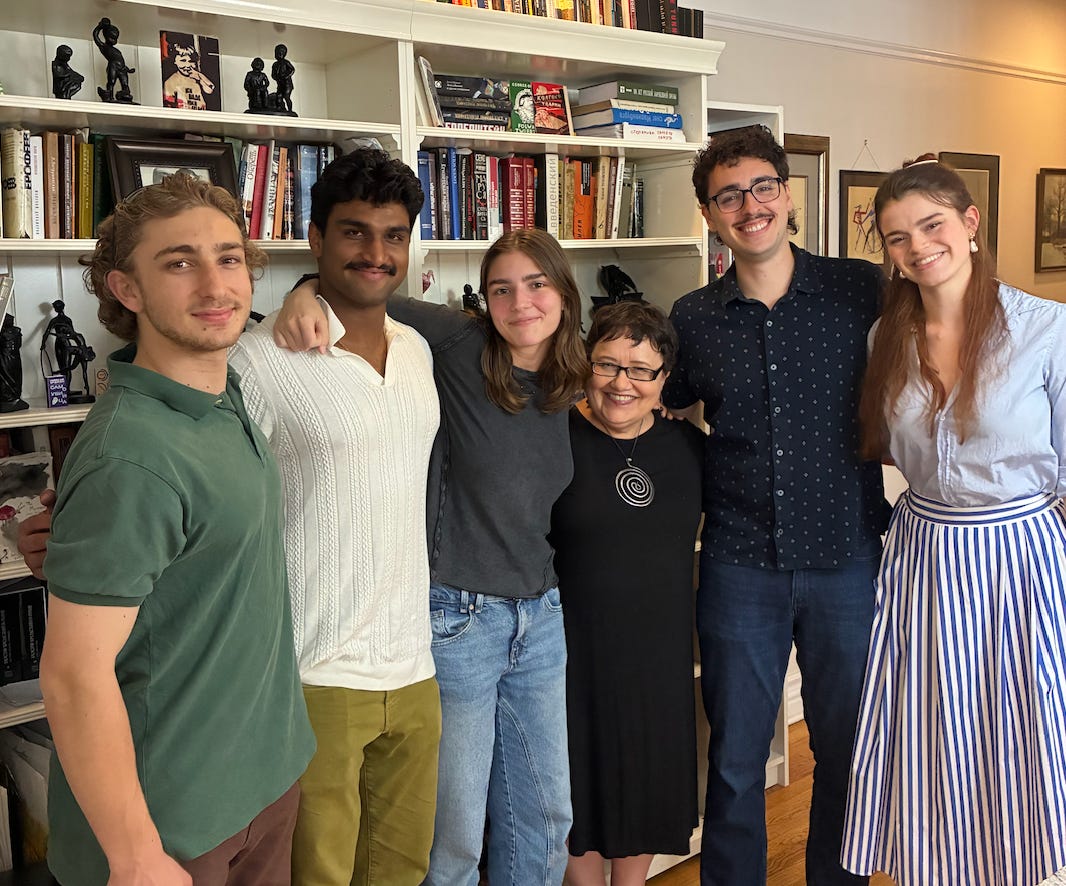
At the end of her classes, Tatiana Aleekseevna Mikhailova, Lecturer in Russian at Columbia University, requires her students to spiritedly recite the following in unison po russki: “Svoboda, ravenstvo, sestrinstvo, bratsvo!” (“Freedom, equality, sisterhood, brotherhood!”)—freedom because it can only be achieved through equality, sisterhood because it cannot exist without brotherhood.
It’s difficult to understand how Tatiana’s spirit fits into just five feet and one inch. During lessons with her students, she is a force to behold. Indeed, class typically begins with a motivating and upbeat launch off: “There’s little time. We have a big program today!” If students stroll in without a certain pep in their steps, she’ll cut to the chase: “Fast, fast, we’re running, we’re running!”
Tatiana frequently reminds latecomers in Russian: “Don’t be late! We are one body. Without a limb, we suffer.” It’s the sort of unconventional affection one must accept unreservedly if they are to excel in her class.
Tatiana’s classes are a deeply rewarding, challenging, and borderline cathartic experience that require you to surrender your ego, forget your accomplishments, and be willing—enthusiastic, even—to be wrong.
Tatiana’s smile, glowing against her usual all-black outfits, is disarming. When she does smile, you know she means it. As the Russian idiom I often joke about with her goes: “Smekh bez prichini, priznak durachini.” (“Laughter without reason is a sign of stupidity.”)
Raised in Soviet Sverdlovsk—which became Yekaterinburg after 1991—Tatiana constantly had books and papers lying around due to her “many projects” in her corner of the room she shared with her sister, Nadya. Since her youth, she had been fascinated by literature and chemistry. The idea that one substance could transmute into another, with some elements remaining from its prior makeup, is emblematic of the sort of resourcefulness Tatiana inherited from her family.
For the Mikhailovas, restaurants of any kind were “out of reach.” They mostly ate fish and cabbage pies, potatoes, and vegetables. Red meat was too expensive (and unavailable) to have on a consistent basis. It didn’t matter much, however, because Tatiana’s mother, Valentina, was an outstanding cook. While the Mikhailovas were not wealthy by any measure, a certain brand of no-nonsense Soviet resourcefulness bred fulfillment in their home: “You could make 40 dishes out of potato, if you are inventive enough,” she told me.
This sort of “anything is possible” mentality defines much of Tatiana’s approach to life. If the conditions are right, hydrogen and oxygen can become water, and the humble potato can transform into kartofel’niki or vareniki.
Tatiana had many best friends growing up, yet they parted ways once the late teenage years rolled around. She preferred to read and ponder, while her former circles grew more interested in vodka and the vibrant Soviet discotheques that illuminated dark weekend nights in Sverdlovsk. She doesn’t regret the social sacrifices that resulted from her pursuit of intellectual development: “It’s not very productive if you are spending your life on something like that,” as opposed to focusing on higher, academic pursuits.
As a young woman, Tatiana always wanted to play piano, though she could never afford it. The piano was expensive. The domra, on the other hand—a circular Russian string instrument akin to the American banjo—was cheap. And so, the domra it was. On top of regular school, she played the domra in a Russian folk orchestra at the music school she attended.
Tatiana, in wise fashion, seldom ruminates over the unideal, inconvenient, or unfortunate. These inevitabilities are simply worthless to spend any amount of energy on.
The circumstances of Tatiana’s Soviet childhood, whether positive or negative, were defined by a productive and judicious system of thought: acknowledge, accept, continue.
Once Tatiana enrolled at Ural State University in 1981, she entered a new milieu that didn’t attract her childhood friends. Soon enough, she met the man she would spend the rest of her life—and eventually land at Columbia—with. On the first day of her history of Russian literature class, Tatiana saw a handsome classmate, Mark Lipovetsky, now Chair of the Columbia Department of Slavic Languages, across the room. She was immediately captivated by him: “He caught my attention because he was really smart, and he outperformed everyone. He was a good writer back then, and he’s a good writer still.” Understanding her worth and intellect, Tatiana knew she would never settle for a man who wasn’t the top dog. Lipovetsky, too, meant business—he asked Tatiana to marry him when they were just 20.
Tatiana likes being married to another academic. “It’s perfect, actually,” she told me. “You can gossip, laugh, ridicule, question, analyze, and dissect everything.” Tatiana loves Mark the most for how he sees the world and how his intellect guides his values and principles. In an unspoken way, Tatiana’s students know this.
Last spring, Tatiana and Mark hosted an end-of-semester dinner party in their apartment for Russian language students. Against the backdrop of a colorful Russian feast and bookshelves galore in their snug and folksy Upper West Side apartment, we played charades. When I opened up my slip of paper to see which character I had to act out, I instantly chuckled: “Mark Lipovetsky.” Immediately, I walked over to Tatiana, wrapped my hand around her shoulder, and began pretending to have an intellectual discussion with her without actually saying any words. Everyone laughed, and within the blink of an eye, my peers blurted out the answer they didn’t need to think about for more than a second: “Ты - Марк! Марк Липоветский!”—“You’re Mark! Mark Lipovetsky!”
Once the answer was revealed, Tatiana let out her typical, succinct, Soviet chuckle. Imagine saying the cha in challah very loudly and in one concise burst: “Hah!”
The refrigerator of the Mikhailova-Lipovetsky residence is littered with magnets of all varieties, some in Russian, some in English: “Parmesan was here,” “Everything I enjoy is illegal, immoral, or fattening,” and “Like work like salary!”

Poetry and idioms are essential in Tatiana’s classes. Lessons in her Russian modules often begin with recitations. For weeks on end in both Fourth-Year Russian I and Russian Through Theater, we repeated Daniil Kharms’ 1931 poem, “A person is made of three parts…” in unison:
Man is made of three parts,
Of three parts,
Of three parts,
Hey la la
Drum drum tu tu
Man is made of three parts.
Beard and an eye and fifteen hands,
And fifteen hands,
And fifteen hands,
Hey la la
Drum drum tu tu
Fifteen hands and a rib
But actually, there are not fifteen hands,
fifteen hands,
fifteen hands,
Hey la la
Drum drum tu tu
Fifteen hands, but not hands.
In essentially every session where we recited this poem, Tatiana would first critique our readings, then guide us through extended philosophical discussions that began with students feeling lost. Tatiana also often asked us to recite the poem individually. My recurring critique from her was only two words: “Need drama!”
She frequently would begin our discussions about this poem with simple questions, referring to me in my Russian diminutive, such as: “Sasha, how many parts is a person made up of?” Panicking and referring instantly back to the poem, I answered in Russian: “Three.” Within less than a second, Tatiana served me a volley back: “Which three?” My answer wasn’t good enough. Almost telepathically, I could hear her voice coaching me: No sloppy answers. Actually think about it. Do not be lazy.
I improvised: “Soul, spirit, and mind,” I said. Tatiana critiqued my separation of “soul” and “spirit,” which, in Russian, have very similar meanings. However, she made it clear I was moving our conversation in the right direction. After finishing her remark about my answer, she moved on to my classmate at lightning speed: “And you? How many parts does a person have to them?”
Tatiana’s students understand well that validation must only ever come in small doses. To be drunk on your own intelligence or success is to disrespect yourself as a lifelong learner.
Tatiana’s favorite idiom, after decades of intellectual exploration in Russian art and literature, is not Russian. To my surprise, it is one popularized by Hillary Clinton: “Bloom where you’re planted.” Tatiana feels this reflects her “main position” in life: “If we are trying our best, that’s much more productive than just sitting and whining that we are not getting what we deserve.”
Tatiana’s remarkable character results from the confluence of her erudite spirit, hunger for excellence, and truly loving soul. Whenever I look at her—whether it be in class, office hours, or in the hallways of Hamilton—I can see she has a certain glow in her eyes for me and all of her beloved students. To be respected by someone I admire so deeply is one of the experiences I walk away from Columbia with most proudly.
After my grandmother died of ovarian cancer in March, it was impossible to focus. I spent breaks in between classes crying, and typing a sentence felt like lifting a 100-pound weight. The Wednesday after my grandmother passed, I had several memorized lines of our class play, Roachzilla (Tarakanishche), due. I informed Tatiana before the class that I would be unprepared. When it came time to recite the lines by heart with our partners, she pulled me aside: “Sasha will work with me.”
In a soft, warming voice—and with intense eye contact—she slowly asked me: “Sash, how are you?” It felt like she spent time on every letter in that little four-word sentence.
Removing one letter, that quiet little “a” at the end of my Russian name, Sasha, meant more to me than she could have ever known. Tatiana knew she was checking in on a version of me that felt incomplete, lost, and devastated. I wasn’t my fullest self at that moment; I wasn’t Sasha. And it told me everything about our student-teacher relationship that she knew she was talking to Sash without me having to tell her.
Tatiana is one of the few people I’ve met in my life who is truly difficult to explain. She is someone whom the most brilliant poet or storyteller could not do justice to. To understand the nooks and crannies of her teaching philosophy, worldview, and love for life and her people, you just have to meet her.
I used to believe that, despite attending Columbia, I would never be ”good enough.” That, no matter where I went in life, there would always be someone to outshine me, or insurmountable barriers to finding success and happiness. As I prepare to graduate from Columbia, I have abandoned these fears proudly, in no small part due to Tatiana’s mentorship and belief in my potential.
Learning Russian at Columbia with Tatiana has forced me to reevaluate my life and perception of myself completely. In order to bloom, I needed someone to “plant” me: to invest in my success without coddling me, to push me where I fell short, and, ultimately, to normalize struggle and perseverance as fundamental ingredients of a life defined by freedom, equality, sisterhood, and brotherhood.
Mr. Nagin is a senior in the Dual BA program with Trinity College Dublin, majoring in political science. He is the editor emeritus of Sundial.
The opinions expressed in this article are solely those of the author and do not necessarily reflect the views of the Sundial editorial board as a whole or any other members of the staff.
Such a wonderful, uplifting, positive, joyful, piece. You’ve painted a vivid picture of an extraordinary educator. Incidentally, your opening paragraphs reminded me of my high school biology teacher, who would call for haste with, “Hurry up, tempus is fugiting!”
🇺🇸❤️🇷🇺 MIR!