


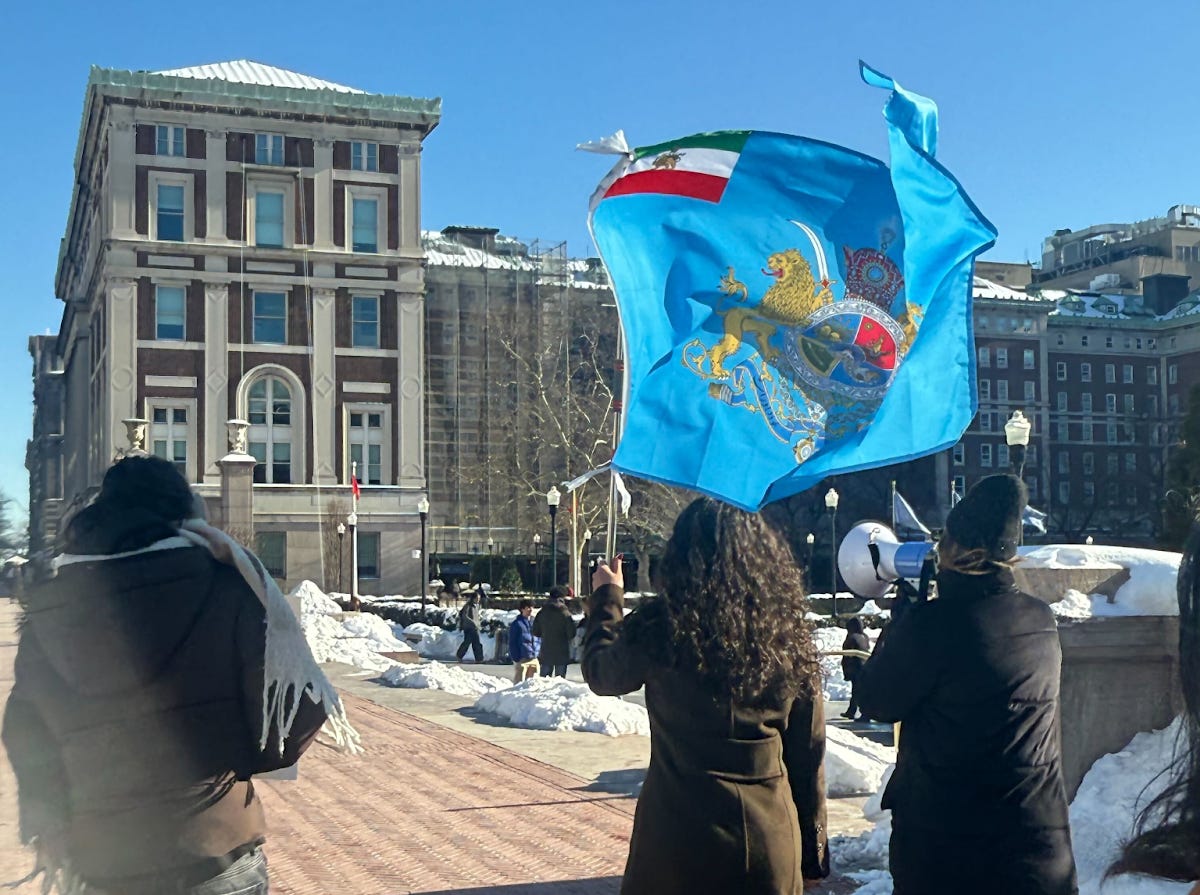
“I think these people are representing a small portion of the Iranian people,” a keffiyeh-clad student tells me of the Columbia Iranian Students Association’s (CISA) pro-Pahlavi messaging at their protest last month.
Here’s what I observed at this demonstration: An organization, like the broader diasporic Iranian “resistance,” caught up on ideological dogmatism, a hyper-aggressive posture, and the inability to let go of the past. CISA’s fundamentally bourgeois disposition, in Columbia’s current performative protest climate and CUAD-indoctrinated subculture, are preventing them from achieving any implicit message beyond “Ayatollah bad, West and Reza Pahlavi good.”
First, we must look back to history: Iran is a unique place with a long and oft-fraught history of achieving genuine self-determination, and it’s not as simple as being against the Ayatollah.
The year is 1953. Theodore Roosevelt’s grandson Kermit is in Tehran, where he is the head of Operation Ajax, a CIA effort to oust Iran’s democratically elected, nationalist-socialist prime minister, Mohammed Mossadegh. The supposedly “anti-Communist” coup—the first such U.S. foreign intervention—succeeds. The West maintains control of Iran’s oil industry, and the Shah is effectively reinstated as the absolute monarch.
For the following two decades, Mohammad Reza Pahlavi rules Iran with an iron fist. His SAVAK thugs—the secret police—barge into homes in the middle of the night, dragging teenagers away from their weeping mothers for merely owning a copy of The Communist Manifesto. The Shah organizes lavish parties for foreign dignitaries to which ordinary Iranians are not invited, running a bill in the hundreds of millions of dollars.
In 1979, profoundly disappointed with the pro-Western status quo that appears to subvert the national good, the Iranian people rebell—never mind Mossadegh’s more tame nationalist socialism—but, now, for a full-blown Marxist-Islamist Revolution. Despite the secular attitudes of many Iranians at the time, a whopping near-99 percent vote in favor of the Islamic Republic. And, as a quick glance at Iran’s political situation today will indicate, the Marxists didn’t fare too well following the Revolution: What Iranians got instead was a hard-Sharia, tyrannical, and kleptocratic theocracy. It’s impossible to talk about the protests happening within Iran, and those organized by the diaspora, without understanding this history.
Fast forward to 2026. Since the new year, an enormous number of Iranians have been killed for protesting on the streets. The Iranian government claims that over 3,000 have been killed, while the U.S.-based Iran advocacy group the Human Rights Activists News Agency reports that over 6,500 are dead, with some figures reaching almost 40,000.
Today, diasporic Iranians and their ideological allies will—admittedly, not without some reason—parrot the line, Oh, everyone protested about Gaza, why is nobody protesting about us? Republican Zionist personality Eyal Yakoby wrote a now-viral tweet on January 10, “BREAKING: Live look at Columbia University after they learned that over 2,000 unarmed Iranian civilians were massacred by the Islamic Republic,” showing a picture of an empty Butler Lawn.
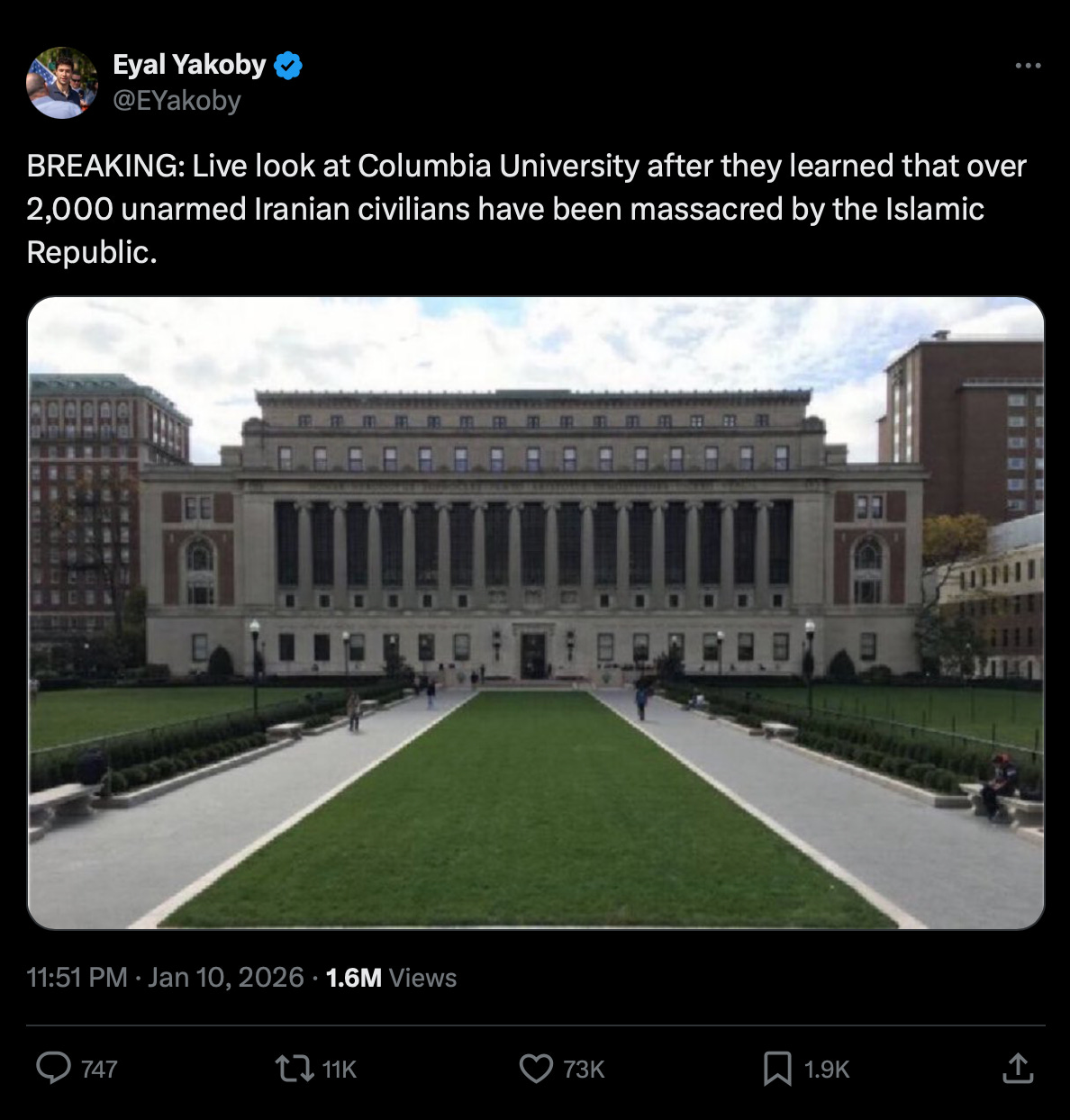
CISA posted a screenshot of Yakoby’s tweet on their Instagram page, saying that they would organize a protest once they got back, as classes were not in session for winter break. On Friday, January 30, they held a protest at the Sundial. Unfortunately for them, what ensued was not much better than Yakoby’s provocative meme.
I got there shortly after 1 p.m., already freezing. A dozen or so students were leading the protest, and another dozen were echoing their chants: “Free Free Iran,” “Freedom for Iran,” “Fight for Iran/Pray for Iran/Do Something for Iran.” Later, a moment of silence was held for the “40,000 innocents” who had perished at the hands of the regime. Surprisingly, they did not carry the simple lion and sun flag of pre-revolutionary Iran—which, by this point, is a universal symbol of resistance against the Islamic Republic. Instead, a version of the flag was flown that included the crown, as well as a blue flag with the coat of arms of the Pahlavi dynasty.
Reza Pahlavi, the son of the last Shah, has not condemned or even admitted to his father’s atrocities, a period far from the “democracy” he claims to champion today to a Western audience, and which Roya Hakakian, for example, conveniently whitewashes in the pages of The Free Press as “a lost and, in retrospect, cherished era.” Pahlavi tweeted on January 9 directly to Iranians in Farsi, “Those of you who were hesitant, join your fellow compatriots on Friday night (January 9 - 8 PM), and make the crowd even larger so that the regime’s repressive power becomes even weaker.”
He went on: “I know that despite the internet and communication cuts, you will not abandon the streets. Be assured that victory belongs to you!” The editorial board of The Wall Street Journal praised him, alleging that he took “a risk” in calling for the protests. What that “risk” precisely was is hard to imagine. The people who took the risk, in my mind, were clearly the Iranians who bravely protested the regime, many even before Pahlavi’s call, and far too many of whom perished—not Pahlavi, who simply put out a tweet, perhaps from the comfort of his $3.1 million estate in Potomac, Maryland.
Columbians assembled in the middle of campus with the politically-charged Pahlavi coat of arms. That’s why it didn’t make much sense when the CISA girl with the bullhorn proclaimed that the protest wasn’t political and was meant to unite everyone: “I turn now to the Iranian community, to the Iranian diaspora, both at Columbia and across the United States. We must put aside our differences. We must come together as one for a free Iran. I believe there is a space for us to come together, irrespective of political stances or religion, in order to support the Iranian people in their fight for freedom.”
The slogans continued: “All eyes on Iran,” “Zan Zendegi Azadi” (Woman, Life, Freedom), “Be the voice of Iran.” At some point, the girl chanting chuckled, “I’m running out of ideas…but.” And then the rhetoric escalated, not only to “Down with the Islamic Republic,” but to “Death to the dictator!” After a few tries, however, I think they realized how hostile their language was. The protesters quickly changed their chant to a more tame “down with the dictator.”
Speaking to organizers after the protest had finished, they told me that there was a “diversity of opinions” amongst the organizers, despite the explicit pro-Pahlavi messaging. On “death to the dictator,” and how it could turn many off from supporting them, I was told, “That’s okay,” and that, “One of the things that I think should be a key takeaway from today’s protest is that we are amplifying the voices of the people who’ve been suppressed in Iran, right? So when you chant ‘marg bar dictator’ in Iran, you die.” When I asked her, the girl who had chanted “death to the dictator” stuttered and didn’t know what to say.
Elisha Baker, CC ‘26, a prominent Zionist activist, told me that he was in attendance because, “as a Jew and as an American, and as someone who benefits from the privileges of this country, I think this is a cause worth standing up for. And it’s also worth noting that the Islamic regime in Iran has inflicted terror on Americans, on Jews, on Westerners across the world, and the struggle of the people of Iran is a struggle that extends outside of the boundaries of Iran as well.” Baker told me that pro-Israel groups were not involved in organizing the protest, but that he nonetheless felt an “obligation” to be there. On the flag of the Pahlavi dynasty, Baker didn’t have strong feelings, saying, “Look, I’m just here because I want to support the Iranian community on campus and stand with the people of Iran,” and that he didn’t know much more.
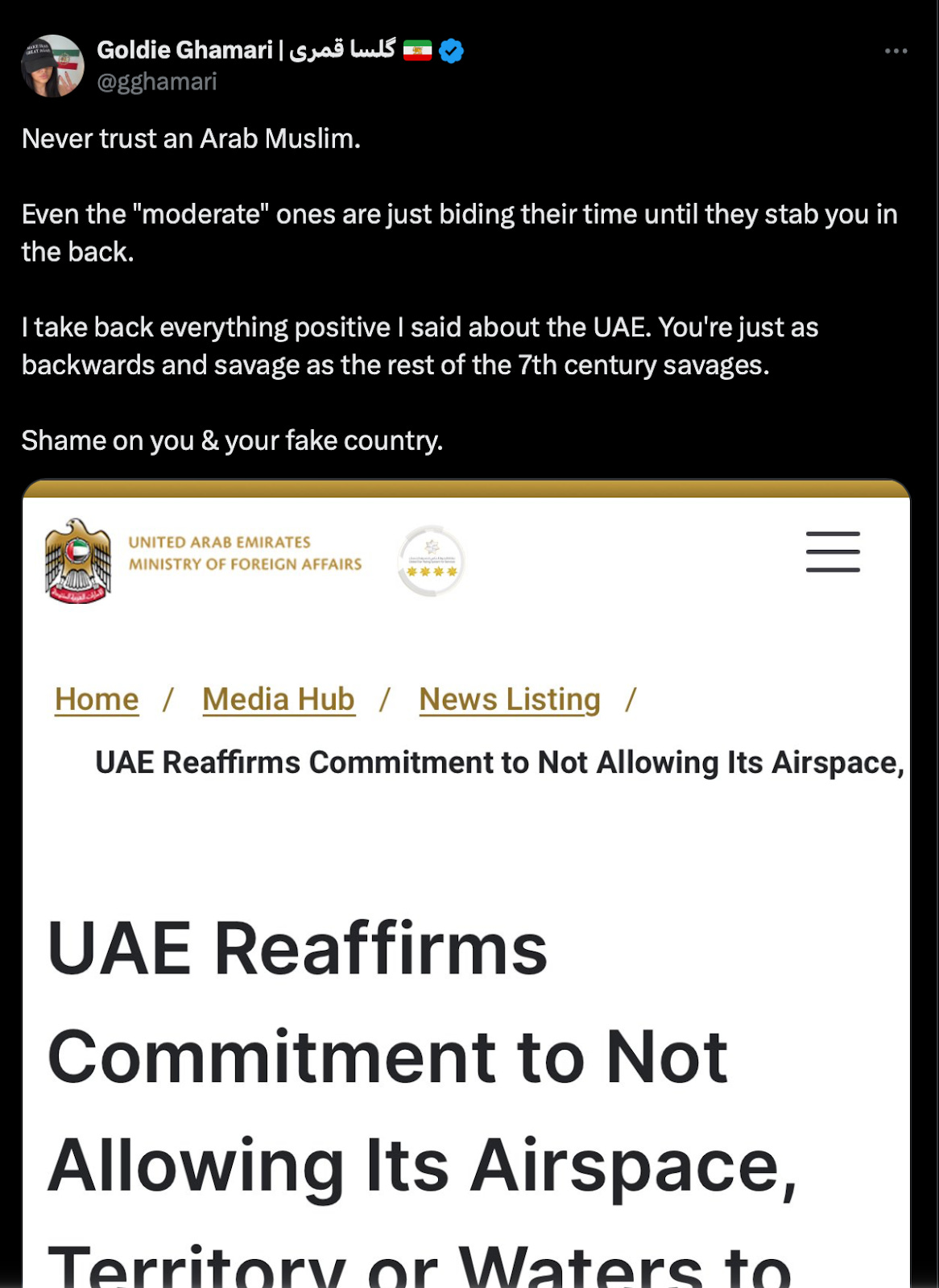
As I looked around, one student was wearing a keffiyeh. Though certainly not uncommon on our campus, this struck me as particularly odd for this protest. That’s because Gaza and Iran are two causes that share few activists, and as you’ll see from a quick scroll on X, many pro-Pahlavi and anti-regime activists engage in incredibly dehumanizing and anti-universalist rhetoric against Muslims and Arabs broadly. Take prominent X personality and former Ontario MPP Goldie Ghamari, who told us to “never trust an Arab Muslim,” specifically Emaratis, whom she alleged were “just as backwards and savage as the rest of the 7th century savages.”
Similarly, earlier this month, Christiane Amanpour, a CNN journalist who grew up in Tehran, confronted Pahlavi in an interview at the Munich Security Conference about the fanatical, trolling dogmatism of his supporters. The Pahlavi-ists responded by proving her point, heckling at her: “Khak bar sahr-e-toon! Cheghad as shomah-eh lajan ma bademoon meeyad!” (“Shame on you! How much we f**king detest you maggot scum!”), “You are a disingenuous journalist, shame on you!”, and “You decided to lobby for regime!” They did so because she had apparently “disrespected” the protesters in Iran and the “crown prince”—all for simply questioning him in an hour-long interview. Never mind Amanpour’s many previous hard-hitting interviews of Islamic Republic officials over the past three decades, or her refusal to wear a headscarf when speaking with the late President Ebrahim Raisi in September 2022, leading to the interview’s cancellation.
There are many other examples—mostly along the lines of “I am not Muslim, I am Persian!” or “We are Aryans!”—but I shall spare the reader further snippets of racialist commentary on X.
Angel, CC ‘29—the keffiyeh-donning kid from earlier—told me that he was there to support the people of Iran, though from the get-go—unprompted by me—he said, “I kind of object to the Kingdom of Iran’s flag.” Contrary to the protest leaders’ claims that the crisis in Iran was “simple,” he acknowledged that Iran was a “complicated situation,” and supported the idea that the people of Iran “should decide for themselves” free from U.S. intervention. On the topic of his keffiyeh, Angel said he was mostly wearing it because it was cold that day, but that it is nonetheless always “political” to wear one at Columbia, and that the protest organizers had told him to take it off.
Still, for his disagreement with the pro-Pahlavi messaging and the demand that he remove his keffiyeh (he clearly had not complied), he stayed. I found his willingness to put aside political disagreements with the protest organizers and show up for the Iranian people somewhat commendable. This, of course, does not reflect too well on CISA.
“Obviously, they’re people here at Columbia who have the funds to be here, who are part of the diaspora, who haven’t experienced the conditions of Iran firsthand,” Angel continued. “I haven’t either. And so I think it’s kind of concerning that they sideline the keffiyeh. They also mentioned during their speech some of the other issues concerning funding proxy wars, directly referencing Iran’s support for Palestinian fighters in Palestine.” He added, “Obviously, I just think of it to be really silly.”
Ignoring that Angel uses the euphemism “Palestinian fighters” for Hamas terrorists, the keffiyeh is indeed also complicated. On the one hand, for Iranians, it is a controversial symbol based on its usage by the Ayatollah. Still, to make enemies because of this garment alone makes little sense in the current moment, especially as many diasporic Iranians hope for more individuals to join their cause. Bottom line: if they’re implicitly referencing the pro-Palestinian protests and don’t want anyone to wear a keffiyeh at theirs, they’d be better off just shutting up.
This, as I would find out, is exemplary of a disconcerting pattern of ideologically dogmatic behavior from CISA. As they were planning their protest, per a tip, they also wanted to pressure the administration into somehow firing tenured professor Hamid Dabashi simply for his assertion on Al Jazeera that Mossad was helping orchestrate the protests in Iran, even though an Israeli operation to install Pahlavi has been corroborated by extensive reporting from Israel’s paper of record, Haaretz, and Mossad presence on the streets has been corroborated by former Secretary of State Mike Pompeo.
Mia Feizbakhsh, BC ‘26, the co-president of CISA, confirmed to me in a voice note that “there are members of the general body of CISA, and board members, who had wanted to create a petition to pressure the administration to fire Hamid Dabashi” over his Al Jazeera interview but, following a vote, they decided against doing so “at this time.”
We are being told that now is the time to unite for Iran. We are being told to never mind that Pahlavi is clearly at the helm of this movement, that there will be a time to decide once the Ayatollah is done with. We are being told not to ask questions about potential U.S. bombing, invasion, and regime change—despite the fact that we don’t have good answers about all the chaos that may ensue following it.
Pahlavi claims an invasion would be “humanitarian.” What a profound oxymoron, I think to myself, and theft of the Iranian people being able to eventually stage a rebellion or reform movement independently, of which they can look back in a few decades and be proud. Furthermore, the goal of full-scale, dramatic regime change may also be a shortsighted one. As Sohrab Ahmari writes, what remains in Iran is now best described as a “ghost regime,” economically decrepit, its proxies diminished, merely parroiting out slogans nobody even believes in anymore, so unlike the dramatic fall of the Berlin Wall, what is much more likely is an “ending is one in which more nationalist elements within the current regime take over, with or without a little push by outside powers.”
But perhaps the Iranian people—especially diasporic Iranians, in Los Angeles and at elite institutions like Columbia—have already forgotten of Mossadegh, of the Shah’s tyranny, of 1979 (or perhaps they never really cared, and their bourgeois families were always happy with the Shah, which is undoubtedly the case for many). And so, if we follow their lead, maybe the endless cycle of chaos, despair, and bitterness is to ensue, for Iranians to continue—as the old adage goes—“az chaaleh dar-aamadeem oftaadeem too chaah” (we came out of a pothole and then fell into a well). Maybe the Iranians are condemned, after fifty years of suffering under the current tyrannical regime, to return to the dynasty they had in the 70s (or some 21st century adaptation thereof): for it to have all been for nothing at all.
Ultimately, until the broader anti-Ayatollah movement gets organized around core principles aside from mere fanatical support for Pahlavi, rejects explicit anti-Muslim and anti-Arab bigotry directed to these people as individuals and not just “joking around,” and stands up for universal principles, it’s hard to imagine how they might achieve their own stated goal of grassroots support. For now, we may find that protesting in designer labels will do nothing much at all.
Mr. Mohammadi is a sophomore at Columbia College majoring in American studies. He is a senior editor for Sundial.
The opinions expressed in this article are solely those of the author and do not necessarily reflect the views of the Sundial editorial board as a whole or any other members of the staff.