


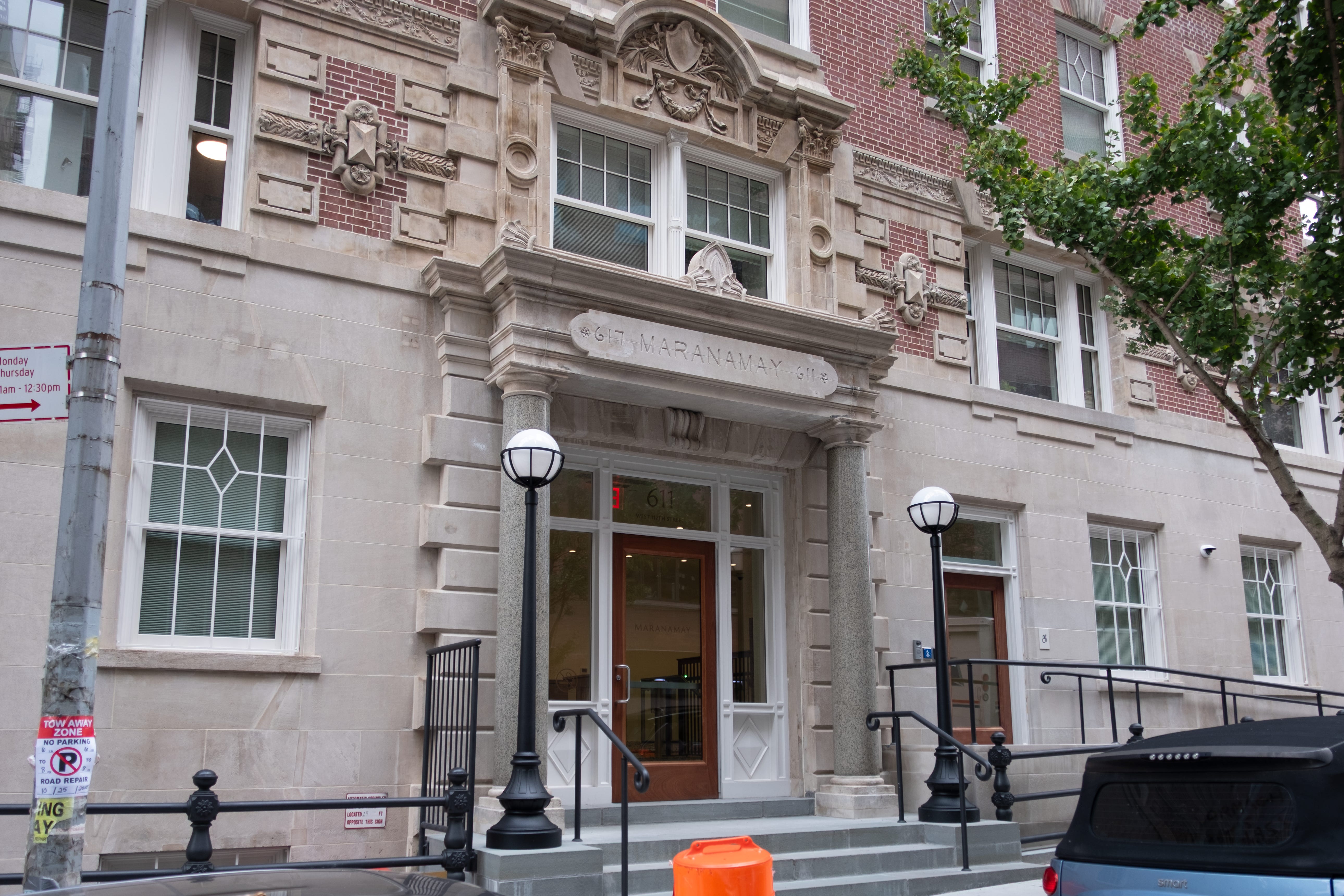
One week before the fall term, Columbia University cut the ribbon on 611 West 112th Street, its first so-called all-electric undergraduate residence hall. The building is being touted as a milestone in the University’s Plan 2030—a gleaming promise of a future free of fossil fuels.
But behind the speeches and sustainability hashtags lies a maze of contradictions. How much of this project reflects real environmental progress—and how much is electricity-washing? Can a campus powered by its own gas-burning plants truly claim to be green?
From Maranamay to Model Dorm
Before its 2025 makeover, 611 West 112th had a long history in West Harlem. Built in 1904, converted to single-room occupancy in the 1940s, and later reborn as the Maranamay Hotel, the building spent the last decade abandoned, water-damaged, and structurally unsound.
Columbia bought the property in 2022 for $25.7 million. Immediately, the neighborhood objected, supplicating to preserve part of it for affordable housing. However, the University went another direction: a full gut renovation to house undergraduates.
Construction reports, letters, and the like describe the gutting of practically everything but the original facade. In other words, it’s not a new building so much as a historic shell rebuilt from the inside out. That distinction matters as reusing the old structure saves some embodied carbon, while using excessive new materials wastes more.
A Messy Construction and a Mixed Reception
Consigli Construction, a construction firm behind several Ivy League capital projects and a standing legacy in environmental vanity, was contracted for 611 West 112th. During the renovation, labor groups protested Consigli for alleged worker exploitation. Additionally, local residents have complained about noise and disruption. Since this renovation’s groundbreak, the company has been fined over $15,000 for safety violations—from missing guardrails to improper material storage—leading to two partial stop-work orders.
Still, the University insisted the project continue.
What “All-Electric” Really Means
The dorm is billed as “all-electric;” however, Sundial staff parsed what that claim entails and where possible exceptions may lie.
The dorm’s old oil-based heating systems were replaced with fully electric equipment for heating, cooling, ventilation, and lighting—part of the University’s pledge to stop installing fossil fuel connections in any new or renovated buildings. Every major system in the dorm, from temperature-control to water-heating and lighting, now runs on electricity rather than gas or oil.
This transition is significant because it moves energy use away from on-site fossil fuel combustion—a visible and symbolic step toward ‘fossil-fuel–free’ operations. Yet, it also shifts responsibility for emissions upstream to wherever that electricity is generated.
Because Con Edison, New York City’s main utility company, does not supply steam north of 96th Street, the University runs its own steam system to provide heating, cooling, and hot water campus-wide. The dorm, therefore, represents both progress and paradox: It eliminates direct emissions at the building level (a clean facade in more ways than one), while still depending on a fossil-based energy system beneath the surface. Columbia claims that all operational heating, cooling, ventilation, and hot water are provided electrically. That is a meaningful step—but it does not guarantee net emissions reduction if the electricity itself is carbon-intensive.
Columbia’s Power Paradox
Operating its own micro-utility gives Columbia rare control over energy reliability and efficiency. Engineers can capture waste heat, balance electric and steam systems, and even reduce grid strain during summer peaks. It’s a remarkable feat of infrastructure.
Yet that autonomy comes with ethical tension. The plants sit near residential areas of Harlem and Morningside Heights, where emissions contribute to local air-quality concerns. And despite Columbia’s self-proclaimed energy independence, the University still buys about 5 percent of its power from Con Edison.
LEED Gold: A Shiny Label, a Cloudy Reality
Much of Columbia’s celebration revolves around one main accolade: LEED Gold certification. Developed by the U.S. Green Building Council, LEED awards points for efficiency, materials, water use, and indoor air quality. A Gold rating—60 to 79 points out of 110—signals strong environmental performance, but not carbon neutrality.
The key flaw? LEED’s criteria distribution is innovative and necessary, but imperfect. The system has long faced criticism for rewarding design intentions rather than actual results. A building can score highly on paper while performing poorly once occupied—a disconnect between predicted and real-world performance.
Critics also point out that LEED’s point-based structure encourages gaming the system. Developers often chase easy credits, like installing bicycle racks or recycled carpeting, while sidestepping more impactful measures like long-term energy monitoring or deep carbon reduction.
Others say it focuses too narrowly on building features instead of how the space functions (i.e., how people actually experience, use, and maintain it over time).
The framework can also be costly and overly generic, offering limited guidance for local climate conditions or campus-scale energy systems like Columbia’s. And it largely overlooks circular-economy principles—such as reuse, retrofitting, and life-cycle material recovery—that are central to long-term sustainability.
The fact that LEED incentivizes developers to consider even the bare minimum sustainability and accessibility efforts is absolutely admirable. However, improving LEED via critique and trial is critical.
Although the Gold plaque looks good on a brochure, it doesn’t answer the real question: How clean is the power behind the plug?
The Deeper Question: Optics Versus Outcomes
All in all, the 611 West 112th Street project is technically ambitious, and it’s symbolically compelling—a sleek banner for Columbia’s Plan 2030. But it exposes fault lines.
Is it truly reducing emissions, or simply moving them off-site? Given Columbia’s own power plants self-admittedly burn natural gas, the building’s “all-electric” label shifts pollution from the dorm itself to the University’s central energy system. The real carbon impact depends on how clean that electricity is, especially during peak demand.
Does the 43 percent carbon reduction claim reflect real performance or optimistic modeling? Columbia still has time to make this claim a reality. But without disclosing the assumptions behind that figure—or publishing hourly emissions data—Columbia risks obfuscating and overstating its progress.
Is this about leadership or marketing? The project’s heavy branding around being “fossil fuel-free” fits neatly into Plan 2030’s marketing narrative, yet steers attention away from tackling the real energy sources for the rest of Columbia’s 150 other campus buildings still reliant on fossil fuels.
Most importantly, who actually benefits? Only the future can tell. It is possible that this building may even increase energy costs or externalize emissions to nearby neighborhoods, unevenly displacing the social costs of “green” construction.
Until Columbia releases a full life-cycle carbon analysis (as required by LEED’s v5)—including construction materials and long-term energy sourcing—the dorm stands as an obstruction to Columbia’s future. Will Columbia truly dedicate itself to its sustainability goals, or will it straddle the line with fossil-free facades built on a fossil-fueled foundation?
Giselle Sami Dalili is a Master of International Affairs candidate at the School of International and Public Affairs concentrating in development and governance. They are a staff writer for Sundial.
The opinions expressed in this article are solely those of the author and do not necessarily reflect the views of the Sundial editorial board as a whole or any other members of the staff.