


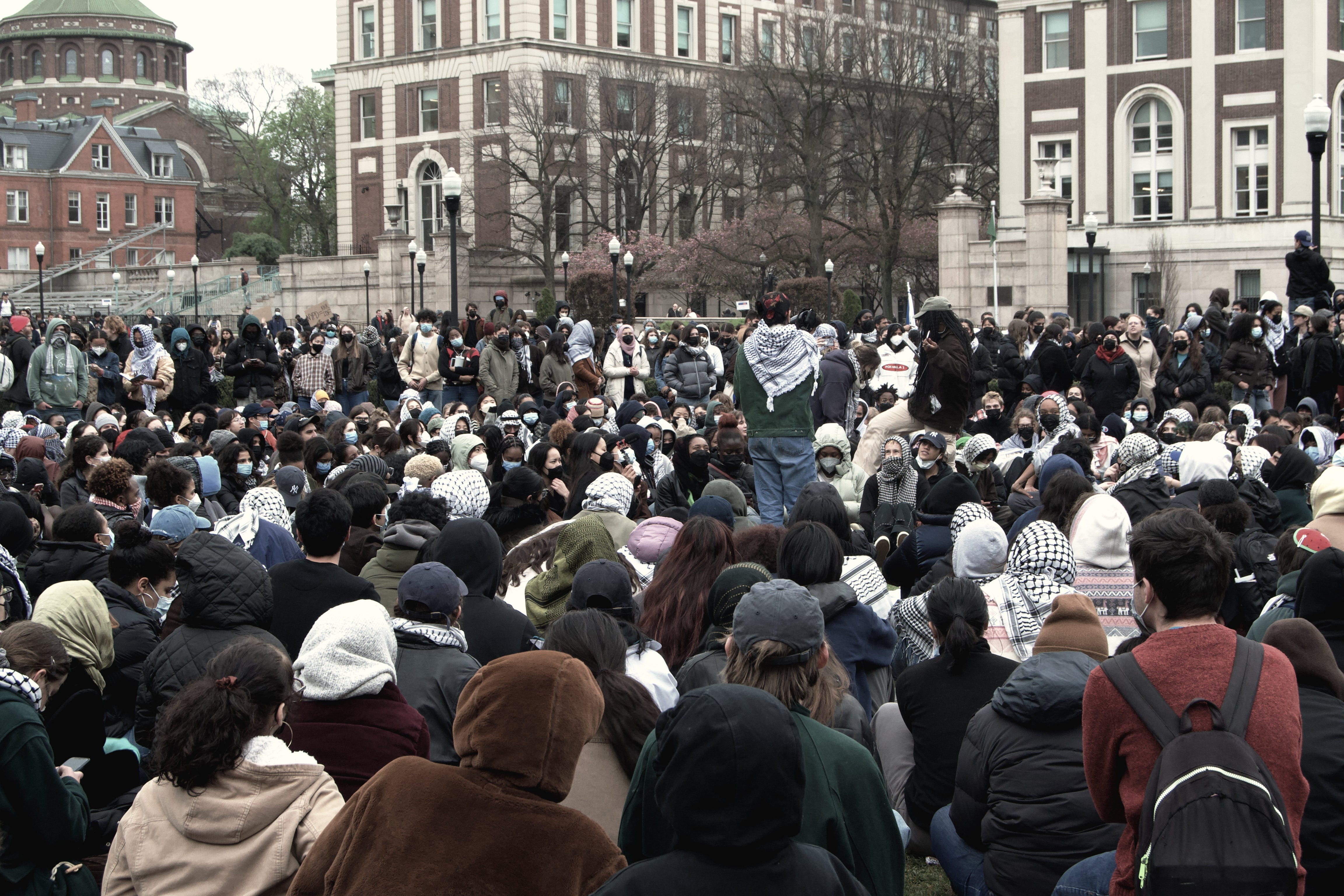
On the evening of April 20, 2024, Columbia student Jonathan Lederer CC ‘26 was assaulted by a pro-Palestine protester inside the campus gates. Minutes later, as he and a group of Jewish students stood near the encampment, masked protesters called them “inbred” and accused them of having “no culture.” On their way out of campus, the group of Jews was told to “go back to Poland,” where their ancestors were slaughtered less than a century ago. The next day, when two Jewish students attempted to enter the encampment, hundreds of students linked arms to “push them out.”
These events are all well documented. It is no grand secret that the encampment participants engaged in, and invited, blatant discrimination against Jews, nor is there much doubt that this all violated Columbia’s policies.
Nevertheless, throughout the encampment period in April 2024, more than 100 faculty members stood guard outside the encampment: blocking Jewish students from entering on the basis of their connection to the Jewish national project, and ostensibly protecting the protest from potential law and security enforcement actions. At first glance, one might reasonably believe that these faculty actions resulted from an ideological alignment with the protesters’ cause. But on April 26, 2024, the University Senate passed a resolution by a wide margin—62 in favor, 14 against, 3 abstaining—that reframed the entire conversation. They resolved to condemn the University for undermining “the traditions of academic freedom and shared governance” when it acted to regulate the out-of-control and rights-violating protests.
On December 9, 2025, I argued in the Columbia Daily Spectator that the University must confront an unresolved question: What happens when professors invoke the concept of academic freedom to defend discriminatory conduct that is unrelated to scholarship? I suggested that a concept of “academic freedom” that protects such conduct while providing cover for rule-violators has lost credibility.
In response, Sundial deputy editor Imaan Chaudhry published a rebuttal, claiming that I had abandoned academic freedom altogether in service of my “immediate cause,” pro-Israel advocacy. She argued that in doing so, I neglected “the principle that safeguards all views.” I believe that her interpretation of my argument misconstrues both its structure and its purpose.
Chaudhry suggests that my argument is structured as follows: since academic freedom has been abused, it must therefore be abandoned. She accuses me of adopting the progressive impulse “to conclude that because abuses occur, the ideal itself is no longer worth defending.” However, this ignores the nuance of my point. In reality, I argued that if academic freedom is indeed construed to legitimately protect discriminatory conduct, then the term has lost its credibility, precisely because it no longer resembles the ideal itself. That distinction is critical because it determines whether academic freedom is being misapplied, or whether it has been expanded to include conduct that reshapes who may participate in the academic community.
Chaudhry and I seem to agree on the context. During the encampments, certain faculty members did more than express “controversial” views. They physically guarded exclusionary protest perimeters and participated in those protests themselves, lending institutional legitimacy to a movement that, in practice, excluded members of the University community on the basis of their ethnic or national identity. When pressed, academic freedom was invoked as a shield. My argument in Spectator, thus, began by asking what follows if that invocation is accepted.
By my logic, one of two things can be true. Either academic freedom protects these professors’ conduct, or it does not. That is a question of principle. Personally, I agree with much of the “conservative” account of academic freedom that Chaudhry invokes. A principle of academic freedom that protects dissenting scholarship from ideological retaliation is worth defending vigorously. That should be obvious, and I have never argued otherwise.
But preserving a principle by virtue requires preserving its intelligibility. If the Columbia community accepts that academic freedom is not meant to protect discriminatory conduct, then it is our responsibility to call out these professors’ misapplication of the term. If, on the other hand, these professors truly believe that academic freedom protects what they’ve done, then I argue that the concept’s scope has been redefined to depart so dramatically from its original purpose—truth-seeking—that it no longer resembles the otherwise defensible principle Chaudhry articulates so well.
Indeed, the burden falls squarely on those invoking the concept to identify what they are referring to when they talk about “academic freedom.” Are they talking about the principle meant to protect what acclaimed Boston College professor of higher education Ana M. Martínez Alemán calls “the faculty’s sovereign claims to determine pedagogical values [and] set research agenda and curricula”? Or is it something broader? Professors who appeal to academic freedom to justify their conduct must either defend a definition broad enough to include discrimination and harassment, or concede that their behavior falls outside its classical bounds.
In collapsing the nature of my argument and reframing my question as a moral crusade, Chaudhry accuses me of reasoning like a “progressive”—admittedly a low blow—and suggests that I am attempting to empower administrators “because they are acting on [my] side.”
But I did not call for administrators to arbitrarily promote my own moral cause. I called for consistency. Columbia acknowledged the encampment as a discriminatory movement. Many students who participated in it and other rule-violating protests were eventually disciplined. My question was whether faculty participation in materially similar conduct is categorically insulated by the principle of academic freedom. That has nothing to do with progressive moralism, as Chaudhry suggests. It is, at its core, a question about whether general rules of conduct apply as they should: generally.
Asking these questions does not risk “intellectual amnesia.” If anything, allowing a principle to be stretched in the name of short-term political activism, without clarifying its limits, invites even further instability. A boundaryless concept cannot protect anyone reliably. It can only be reinterpreted again and again as power shifts. That is precisely what I want to avoid.
Chaudhry ultimately arrives at her conclusion on the basis of a false assumption. She writes that academic freedom “has consistently been understood not to protect explicit activism outside the scholarly context,” and that this point “is not particularly controversial.” The unfortunate reality at Columbia suggests the opposite: the fact that faculty participation in the encampment is defended in the language of academic freedom suggests that its limits are, in fact, up for debate. Ignoring this reality means blindly defending the term based on purely theoretical ideals, without regard to its practical application. That outcome is far more destabilizing than asking hard questions about its misuse in order to fulfill one of the core purposes of university governance, which is, according to former American Association of University Professors vice president Larry Gerber, “identifying the appropriate boundaries for the exercise of that [academic] freedom.”
In the end, the practical use of academic freedom cannot be entirely divorced from its meaning. When faculty invoke academic freedom to shield conduct which demonstrably falls outside its scholarly purpose, they weaken the principle Chaudhry rightly defends. By insisting that they either defend that expanded definition openly or concede that their conduct lies beyond its traditional scope, I simply sought to insist on conceptual clarity, not discard the principle entirely.
The real question I hope we can ask, then, is not whether academic freedom in its ideal form should be preserved—we should certainly try. It is whether academic freedom in its ideal form still exists.
Mr. Baker is a senior at Columbia College studying Middle East History, and the former co-chair of Columbia Aryeh. He is a guest contributor for Sundial.
The opinions expressed in this article are solely those of the author and do not necessarily reflect the views of the Sundial editorial board as a whole or any other members of the staff.

Thank you for writing this 🙏🏼
These events are all well documented.
Just not well witnessed…
Real Jews don’t lie. Real Jews don’t steal. Real Jews don’t kill.
These are the three pillars of Zionism.
Real Jews stand with Palestine!
🇺🇸❤️🇵🇸