


Editing a college publication requires constant adaptation. As an active editor for three separate Columbia publications this past academic year, I’ve found that we are increasingly forced to grapple with the impact artificial intelligence has on our editorial standards, beginning on the granular level and gradually inserting itself into all facets of the publication process.
Understandably, a handful of student-led publications on campus retain a firm stance against the use of AI in any capacity in submissions. Per the Columbia Economic Review’s website: “Plagiarism, including the use of generative artificial intelligence technologies, is unacceptable.” Meanwhile, the Columbia Undergraduate Law Review “prohibits the use of generative-AI, both in writing and in substantive editing of works set to be published.” However, this complete aversion to AI lacks merit in a world where such technology has increasingly permeated into nearly every aspect of our daily digital processes.
The writing process, especially, is no exception to AI’s growing ubiquity. To attempt to prohibit AI in journalism or publications of any subject—in principle—is impossible, as even a quick Google search’s summarize feature is informed by the algorithms of language models. Even modern scholarly databases such as JSTOR have begun to integrate these model-informed toolkits. Between the prevalence of AI at all stages of the research process and the limited capacity to track and register what is written by a Large Language Model (LLM) versus what isn’t, to reject AI entirely is to fight a losing battle against the inevitable.
Put another way: The notion that journals refuse AI’s involvement at any stage of the writing process is an impossible one. There simply can’t be a binary between an article that used or didn’t use AI, as the line between these categorizations has been increasingly blurred to the point of no return.
What is more, the very policy of prohibiting AI use in writing has become increasingly unenforceable. At first, it was very simple. For example, a paper with excessive usage of em-dashes was often an indicator of the lingering presence of ChatGPT or other LLMs. However, as AI output is trained on human output and as humans continue to consume the output of these models, the “is-it-AI-or-not” distinction becomes the age-old chicken-or-egg question with no clear answer. As readers are exposed to more em-dashes, they become more mainstream and integrated in our own daily writing processes. The same process could be said to happen to any new “indicator” of AI use: In effect, the skepticism is perfectly poised to become a witch hunt without end. Publications, thus, have begun to rely on AI “detectors” like Pangram: mechanisms, we are told, which simplify the task of editors in recognizing increasingly complex AI writing patterns.
However, their output—listed in percentages of AI versus human-generated writing—comes without context. These AI models also tend to flag what’s considered trite or overused language; sometimes, even quotes and cited sources such as the entire U.S. constitution are wrongly flagged as “AI plagiarism.” What’s to differentiate someone who’s simply been trained to write by mainstream sources from someone who has deliberately used AI in the work?
How is an editor expected to act on a guess? Should there be a cut-off point of, for example, 45% instantiated? What, then, keeps this threshold from being arbitrary? Furthermore, given that most student-led publications run on limited funding and unpaid student editors, we can’t expect these papers to afford high-end AI-detection services. The next “best” option is using the deeply flawed, free models.
Most alarming, AI detectors have been proven to have biases when it comes to non-native English writers. Even black teens, for example, are disproportionately more likely to have schoolwork incorrectly flagged as created by generative AI. In this context, these models are unable to act as an accurate measure of AI use. How can one base decisions on something with so many faults? This question is extremely pressing, as it often concerns a person’s social, professional, and academic reputation. With so much on the line for the writer, does a blanket statement of strict no AI use from the editors truly resolve the issues at hand?
The final blow is dealt when analyzing this technology. Models that are most often relied on—such as GPTZero, Grammarly, or ZeroGPT—are AI models themselves. If AI is marked as an unreliable source, these systems of measurement are just as much. As AI-generated writing increasingly comprises a greater number of online content, AI detectors may output percentages and judgments based on training data that’s increasingly unhuman. When the entire process, start to end, is based on such a black-box process, the potential for miscarriage of justice seems unacceptably high.
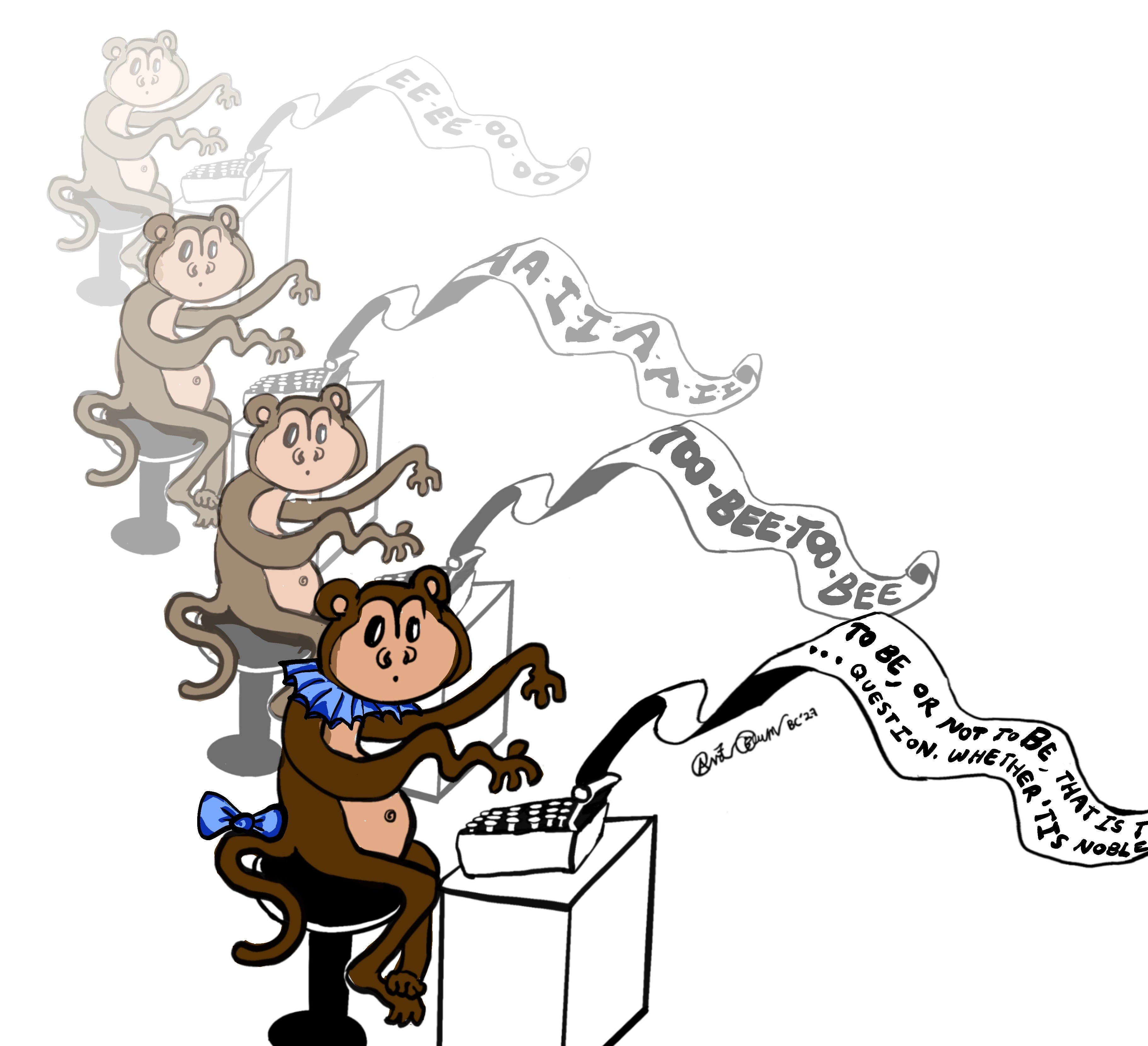
I can’t help but compare this to the thought experiment of the monkey and the typewriter. Sit a monkey at a typewriter, give it enough time and bananas, and let it type its heart away until one day it eventually outputs the completed works of William Shakespeare. I think AI can be seen in a similar manner; the limitations of AI’s language production are endless, it’s just a matter of time and resources until its output causes human and LLM writing to become indiscernible. Therefore, the question of AI is not if, but when, and so what?
Taking normatively anti-AI thinking to its logical conclusion, we must be as distrustful of AI checkers as we are of the use of AI in the writing process. If, as editors, we strive to be objective in the publication process, relying upon such false processes masquerading as an “objective” source is hypocritical at best.
If it’s so inevitable, why do so many publications keep rejecting AI’s existence in the research and writing process? Perhaps because, at Columbia and in higher academia in general, it is a rather shameful thing to admit in the first place. I will be the first to say, AI has been involved in my writing process, because I’ve learned to integrate it in a responsible yet productive manner. While AI is a core element in the research and framing stages, the words that I publish or submit are my own.
The reality is, we all are using AI, whether we like it or not. It could be as simple as the algorithmic categorization of secondary sources; some might take it further by forcing it to write whole essays with a lifeless and hollow tone, but the truth is that AI has already established a foothold in some of the most fundamental stages of research and thinking, and there might be no going back.
One solution would be to make writers document AI use at every step of the writing process. In an ideal sense, this would facilitate transparency and honesty. What is more, this could serve as a useful tool to help immerse editors in their writer’s draft process. As an editor myself, seeing the process rather than a half-finalized draft makes me feel more secure about my edits and further immersed in the vision of my writer. This is also fair to the writer’s time, as the cost of setting aside a minute or two to document use is the least of their concerns; implementing these language models can serve to be extremely time efficient. We might find a regained transparency that we often lack nowadays in conversation with our professors, professionals, and between ourselves as peers.
AI should not be mindlessly demonized per se, because it’s our new reality, whether we like it or not. Learning to use it and to judge its use through a reasonable lens is a much more productive path forward. If we remain “purists” of our respective crafts, then the likelihood of our work becoming obsolete increases. A love for literature like mine must learn to incorporate AI. Yet, a full submission is just as dangerous, as we may lose ourselves along the way. AI is not inherently evil, no more than the internet was in the early 2000s: Instead of setting off on ill-justified AI witch hunts, a more productive use of our time would be to learn and exercise its responsible use.
Mr. Vanuno is a senior at Columbia School of General Studies majoring in English literature. He is a staff editor for Sundial.
The opinions expressed in this article are solely those of the author and do not necessarily reflect the views of the Sundial editorial board as a whole or any other members of the staff.
