


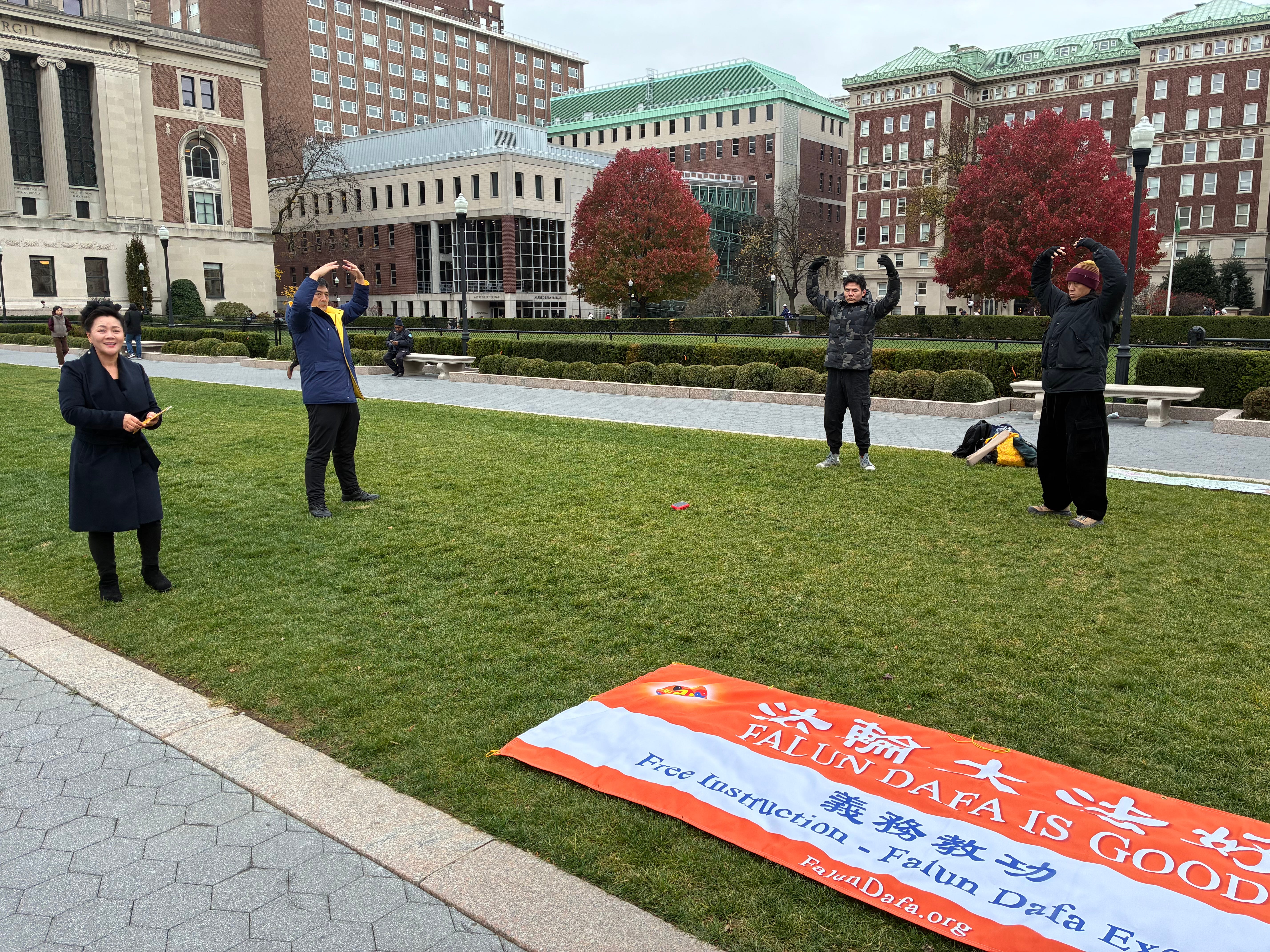
Who are those Asian aunties manning a yellow tent outside Columbia’s gates?
Among a never-ending stream of pedestrians, they stand smiling and vigilant, eager for the slightest opportunity to snag an unsuspecting passerby. They stuff the hands of those passing with fliers and lotus trinkets, alongside the promise of transformative spiritual wellness. If this seems strange to you, you’re not alone. This is Falun Gong, also known as Falun Dafa, roughly translating to “the great way of the Dharma Wheel” in English.
“Truthfulness. Compassion. Forbearance.” Falun Gong repeats this message like a mantra. They claim to be a group focused on meditation practice, improving health, and connecting members to traditional Chinese culture. But beneath this wholesome veneer of spiritual wellness lies an entanglement of political activism and dogmatic practices. Its origins trace back to one man who blended traditional Chinese physical and spiritual exercises with claims of supernatural healing.
The Falun Gong Table
During parents’ weekend, my mom and I were strolling along Broadway, and as usual, Falun Gong was set up outside the 116th and Broadway campus gates. Wanting to know more, I approached the stand, where four enthusiastic women stood. They were advertising a meditation event being held later that week at an Italian restaurant on 109th Street, handing out flyers to pedestrians. As they saw us approaching, their faces visibly lit up.
In Mandarin, I asked to learn more about their organization and whether it was an official club at Columbia. They told me that Falun Gong was a student organization, despite none of the volunteers being Columbia students. They positioned themselves as a wellness club based in traditional Chinese culture; one of the volunteers proudly boasted that since she joined Falun Gong, she has never gone to the hospital. In an attempt to gauge our political ideologies, she pointedly inquired if my mom had been part of the Young Pioneers of China, a mass youth organization founded by the CCP. My mom answered that she was indeed part of the group in her childhood; it was common for children deemed “exemplary” to be chosen to join, though she has had no ties to the group after she aged out in middle school. It seems that after the volunteer confirmed that my mom was not connected to the CCP, she abruptly moved on to pitch their upcoming event.
They handed a number of items to us, including multiple fliers showcasing stretches, another flier detailing persecution the group faced under the CCP, and two lotus charms that read “Falun Dafa is Good.”
Mysterious Origins
Li Hongzhi founded Falun Gong in 1992, following a resurgence in qigong’s popularity in China (“discipline of the vital breath”), a traditional Chinese exercise aimed at promoting longevity. Li, who claimed to have studied under Buddhist and Daoist masters, began to spread his own version of qigong techniques, which were compiled in his book titled Zhuan falun, or Turning the Law Wheel, which also serves as the main text for Falun Gong’s teachings. His philosophy soon became popular across China in the 1990s, as followers believed the practice had health benefits that would prevent illness. Li soon took his teachings abroad, traveling around the world to spread his beliefs. Eventually, he became a permanent resident of the United States, settling in New York City in 1998.
At the time, high-level CCP officials were divided internally over the legitimacy of qigong practices. Following a massive unannounced protest of 20,000 Falun Gong members outside the Beijing CCP headquarters in 1999, the Chinese government grew wary of their popularity. The potential for widespread protests initiated a nationwide crackdown on qigong, in which thousands of Falun Gong members were detained. The CCP also called for Li’s arrest, who was already in New York at the time. Months of protests culminated on January 23, 2001, when five members of Falun Gong poured gasoline over themselves and set themselves on fire in Tiananmen Square. Falun Gong leadership denied that the incident was carried out by real members of the group, and openly declared that they forbid their members from committing suicide.
Falun Gong has since turned its attention abroad, creating its own newspaper, TV station, and dance company: The Epoch Times, New Tang Dynasty, and Shen Yun. Falun Gong has also set up headquarters called Dragon Springs in Orange County, New York. Dragon Springs is also home to the Fei Tian Academy of the Arts, which trains Shen Yun dancers. Perhaps most fascinating of all, Falun Gong operates their own private college, Fei Tian College, which is accredited by the state of New York.
Inside a Falun Gong Meditation
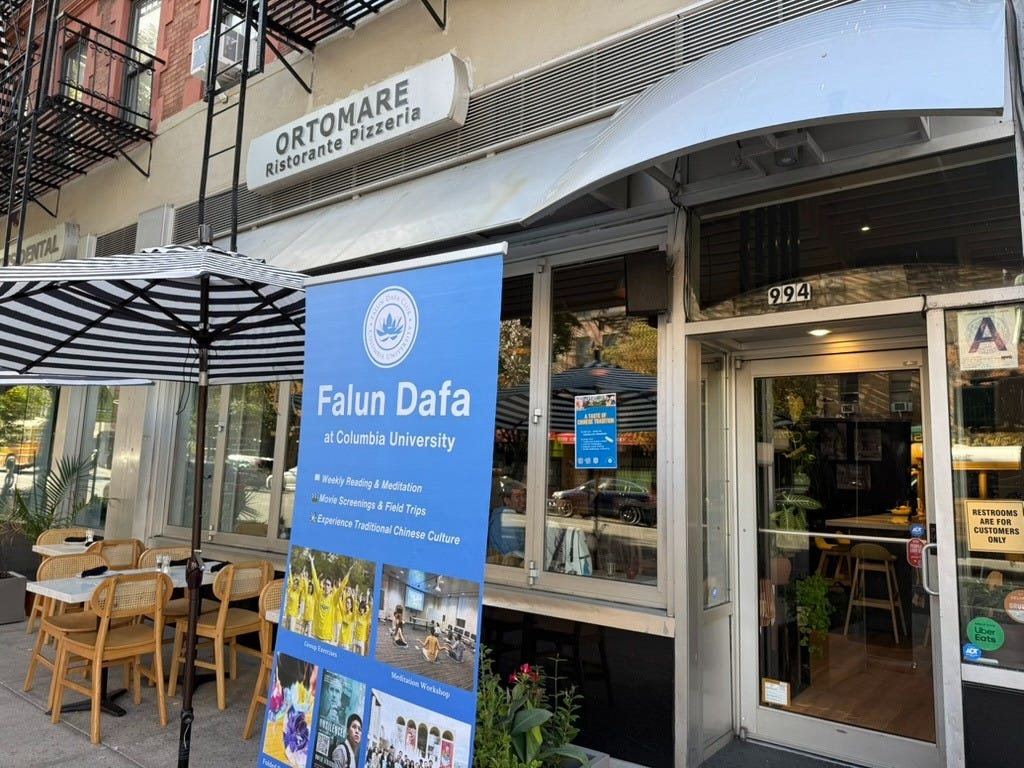
On the afternoon of October 24, I walked to the Italian restaurant where the Falun Gong meditation was being held. It was eerily quiet outside the restaurant, missing the buzz that would typically be expected of a lively cultural event. Confused, I looked around, suspecting I had arrived at the wrong address, until I spotted a large banner with the words “Falun Dafa at Columbia University.” As I surveyed my surroundings, the club’s chairman, a master’s student at Columbia, suddenly appeared, welcoming me inside vigorously.
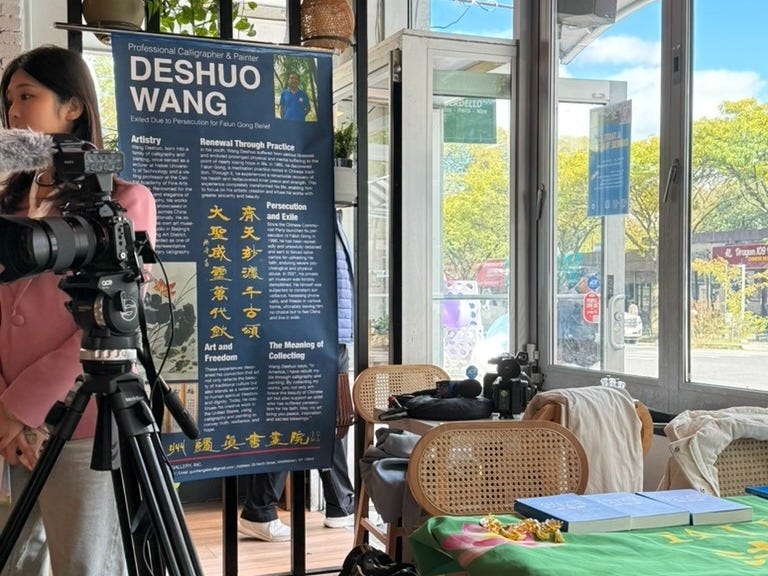
The inside of the restaurant was quieter than the streets outside. The event had attracted only around eight people, all of whom were Chinese, gazing around the room. I watched a young woman dryly present a slide deck on a portable TV with a camera pointed at her, which the club’s chairman explained was for a TV station. Copies of Zhuan Falun, the central text of Falun Gong, were lying on a nearby table. At the same table stood a banner promoting Deshuo Wang, a Chinese calligrapher, painter, and avid Falun Gong practitioner, who spent most of his time dozing off or scrolling on his phone during the event.
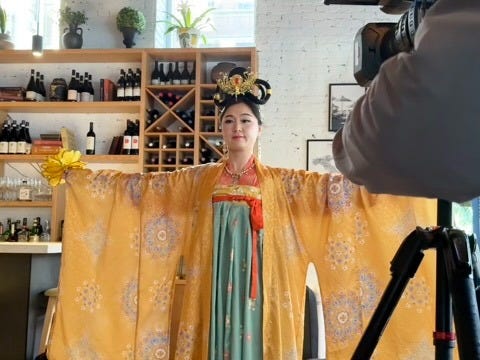
The advertised “Asian food” consisted of several drab mooncakes, a tray of prawn crackers, and a sparse array of grapes and apples. The “traditional couture show” was one woman dressed in a Tang Dynasty costume who strolled lethargically around the restaurant and posed intermittently.
Unlike the “taste of Chinese tradition” the event promised, it felt like I was at a stiff lecture. For the next two draining hours, the speaker preached about Falun Gong’s principles, meditation practices, and even showcased a clip of Shen Yun’s production of Journey to the West.
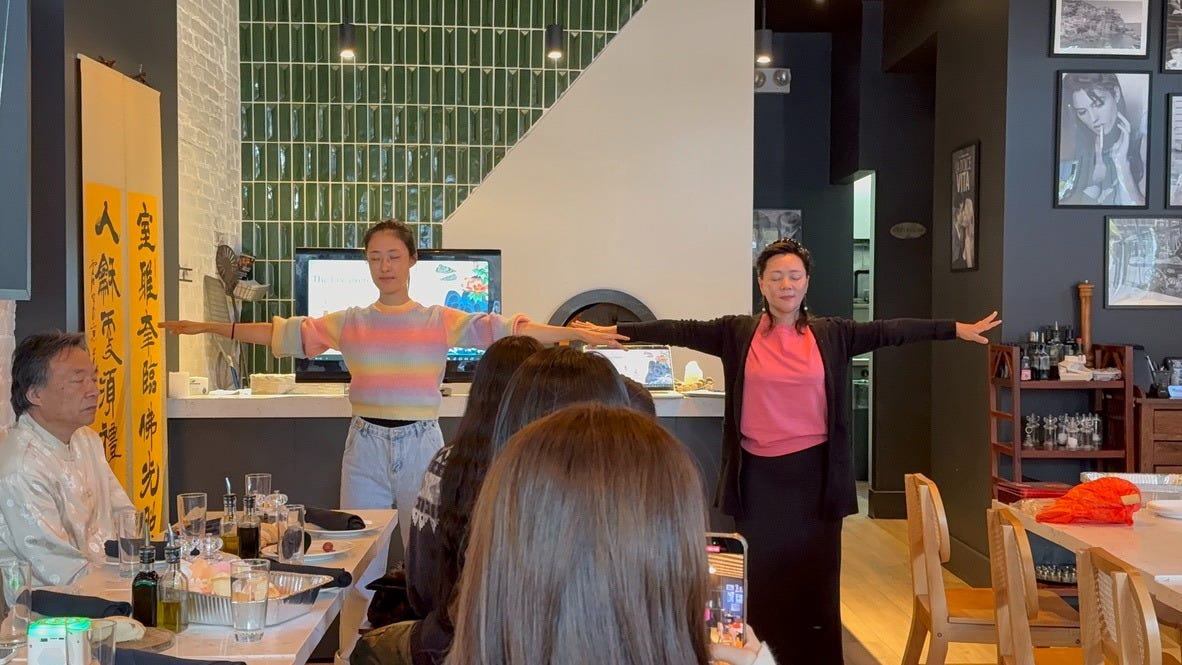
The longer I sat, the clearer it became that the audience members were already practitioners—except for a single non–Chinese woman—listening to the lecture intently and nodding vigorously. At one point, three audience members voluntarily shared their experiences with the practice. Two Mandarin-speaking middle-aged men attested that they had improved their patience in coping with family and work challenges, and a middle-aged woman boasted that becoming a practitioner improved her health and preserved her youth and beauty. Another participant told the group, “I have been practicing Falun Gong following my parents’ lead; I have never been to the hospital,” which members frequently cite as one of the greatest benefits of joining Falun Gong. This underscores a central component of Falun Gong’s ideology—the rejection of modern medicine.
Falun Gong’s aversion to modern medicine stems from the belief that illness and injury result from bad karma, and that strong faith will protect followers from getting sick. As a matter of fact, in the view of Falun Gong, seeking medical treatment is viewed as a sign of weak faith.
These spiritual beliefs were further reinforced as one member told Sundial, “I’ve had the third eye since I was little.” When asked what the benefits of practicing Falun Gong were, she replied that the group taught her to be kinder, compared to those who would go overseas and become “degraded” as they, in this woman’s perception, indulge in drugs and homosexuality.
During the event, one member presented a video published by Epoch TV to provide a “scientific” basis for the group’s practices. The video features Dr. Daniel A. Monti, who cites multiple studies and a neurologist claiming that meditation (not Falun Gong’s practices specifically) positively impacts the brain. The chair of the Falun Dafa club at Columbia University, Andrew (a pseudonym), told Sundial that Falun Gong is “special because it doesn’t need people to renounce worldly life and enter a monastery to practice it. Instead, it could be practiced in modern daily life.”
Falun Gong’s Allegations Against the CCP
One of the most prevalent allegations that Falun Gong makes against the CCP is that it orchestrates organ harvesting. Outside the Columbia gates, Sundial obtained a pamphlet from Falun Gong claiming that the CCP is harvesting organs from its practitioners, Uyghurs, Tibetans, Muslims, and Christians for government officials. The evidence lacks some key datapoints, with numerous allegations circulating and the CCP refusing to release data that would assist in an “effective investigation and prosecution of traffickers.”
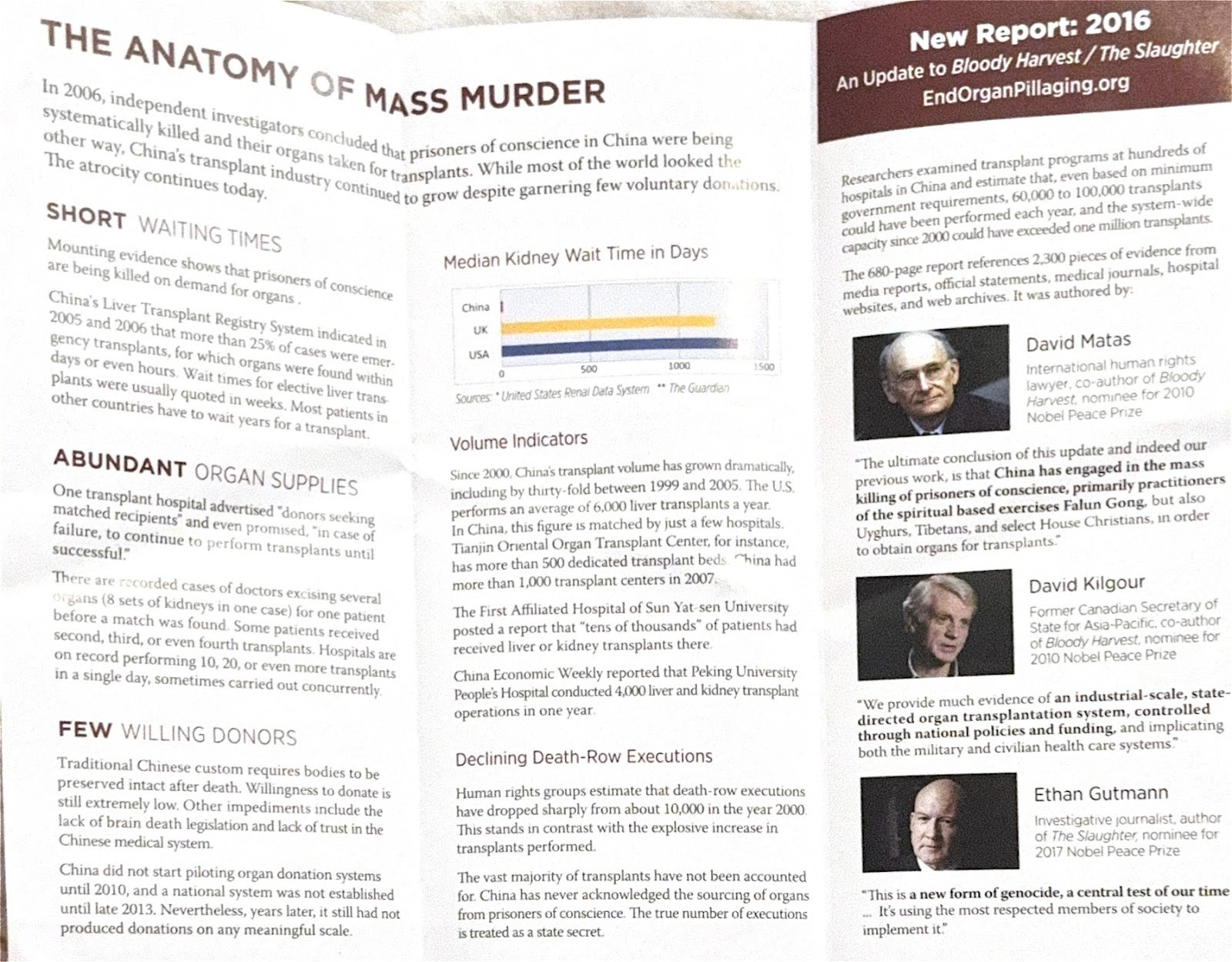
Falun Gong members frequently draw on statistics and references to Western scientists to lend legitimacy to their arguments. In all of the resources obtained by Sundial, Falun Gong only cites white scientists. For their affiliated news outlet, The Epoch Times, the editorial board appears to be predominantly white. This is no mistake: Falun Gong exploits the social capital associated with whiteness in China to enhance its credibility among Chinese and global audiences. In doing so, they frame their message within a dichotomy of the antagonist—the CCP, pitted against the West as the embodiment of freedom and justice.
Additionally, Falun Gong’s websites frequently cite their own sources and outlets. The practitioners also repeatedly told Sundial that their news outlet is “the only real news.” The similarity between members’ recruitment narratives and Falun Gong pamphlets suggests that their knowledge base is limited to materials produced or financed by the group itself. When asked about his response to the “cult” label applied to Falun Gong, Andrew replied, “Only the evil CCP will call us so.”
As I conducted more interviews, it became clear that the practitioners are skeptical of sources external to Falun Gong when information does not align with their narrative. When questioned about the August 2024 New York Times report on the alleged exploitation of Shen Yun dancers, Andrew stated, “The CCP let its demonic grasp infiltrate the free world abroad, bribe overseas media, wage a propaganda campaign, and poison the world.”
A Cult or Not?

Should we consider Falun Gong as a cult?
All well-established religions today technically began as cults, but there are key differentiators. Most scholars characterize cults as having charismatic leaders, who are often described within the practice as messianic or prophetic. Members of cults are usually isolated from non-believers and subject to shame and punishment for questioning accepted practices. Another common feature of cults is apocalyptic thinking, where messages foretell a future cataclysmic event. While it’s presumptuous to assume that all Falun Gong practitioners believe in its ideologies to the fullest extent, Falun Gong fulfills these criteria to a substantial degree.
Falun Gong’s website prominently highlights Li Hongzhi’s teachings, which often describe his direct communication with “The Creator” and humanity approaching “End Times.”
When Andrew was asked what his goals are for Falun Gong’s Columbia chapter, he said it is to help students relieve stress, preach kindness, and “reveal the oppression that is happening in China, and spread the truth,” asserting that the “Falun Gong is the only one that could reveal how the CCP is actively oppressing those who threaten its power.” Andrew describes the chapter’s mission as to “help everyone become good people, while exposing China’s mainland oppressions, igniting people’s sense of justice and conscience.”
What are the Implications of Falun Gong’s Presence at Columbia?
On March 30, 2025, Falun Dafa at Columbia hosted a screening of Unsilenced, a film about the persecution of Falun Gong practitioners, in the Lerner Roone Arledge Cinema. Photos of Columbia’s Falun Dafa Club on campus grounds were last documented in 2021, based on the club’s Instagram page. Although the club’s profile remains on the Columbia Student Organizations website, Rob Mugno, Secretary of the Student Governing Board (SGB), told Sundial that Falun Dafa at Columbia was derecognized as a student group in Spring 2025 due to its failure to “maintain membership responsibilities” required under SGB. However, they still regularly use Columbia’s name in their outreach efforts. Its events are now primarily held in areas surrounding campus rather than on University grounds. When asked about the club’s status, Andrew explained that this arrangement allows people outside Columbia to participate as well. Andrew also told Sundial that there are only two or three active members who are Columbia students in the club.
Falun Gong not only relies heavily on self-produced materials and publications, but also pushes for strict conformity to the group’s stringent requirements and rejection of medical treatment. The group’s practices are ill-advised and even dangerous, especially to those who need medical treatment. Through illusions of science intertwined with political justice, Falun Gong members often adopt intense anti-science and martyr-like attitudes, regardless of educational background or profession. From my first-hand interactions with Falun Gong members, it is clear that they self-isolate from sources that challenge their point of view, falling victim to confirmation bias and tunnel vision. This mentality defines the success and ideology of Falun Gong, an antithesis to what Columbia students should strive to be: open-minded and eager to challenge their own perspectives.
If you ever pass by a yellow-table managed by friendly faces outside campus, just know: An entire world of history, controversy, and ideology awaits you.
Angelina Xu is a freshman at Columbia College studying political science. She is a staff writer for Sundial.
